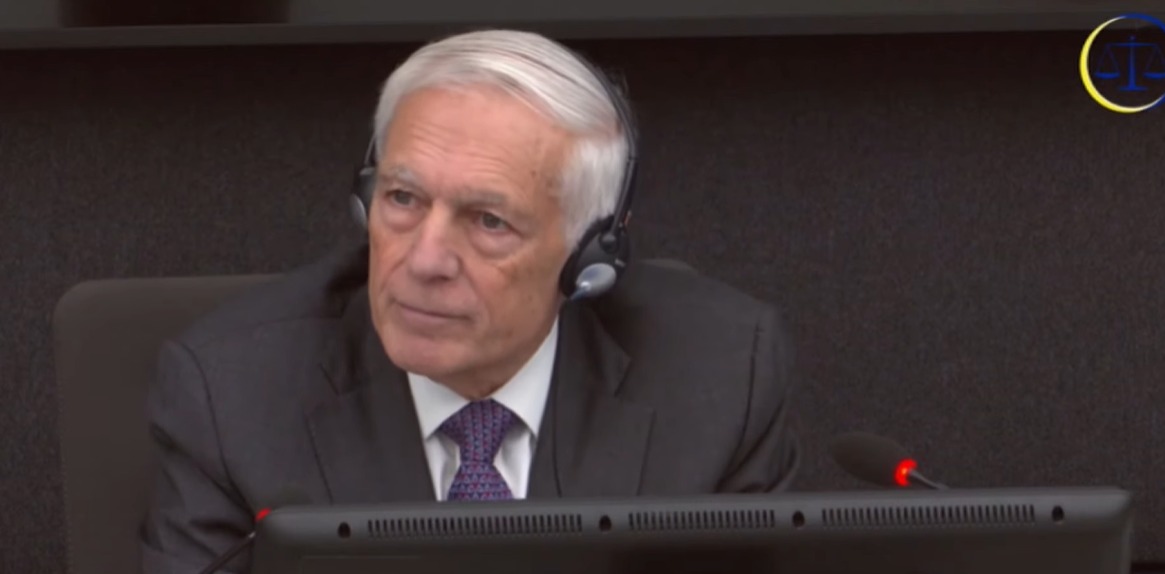
 Wesley Clark in the courtroom on Monday, November 17, 2025. Photo: Kosovo Specialist Chambers/Livestream.
Retired US general Wesley Clark told the Hague court that the KLA was a response to decades of oppression against ethnic Albanians – and was not responsible for post-war acts of revenge against Serbs.
In his two-day testimony at the Kosovo Specialist Chambers in The Hague, General Wesley Clark, the former NATO Supreme Allied Commander for Europe, said the Kosovo Liberation Army, KLA, was the reaction of ethnic Albanians to more than a decade of oppression by the Serbian regime, and denied it committed ethnic cleansing against local Serbs after the war ended.
“I have no evidence or proof that the KLA was behind this [violence against Serbs], but I have indications that prove the opposite,” Clark said on Tuesday.
He was responding to a question about his statement from 1999, when he also told an Albanian-language newsletter, Shekulli, that there was no evidence that the KLA had committed ethnic cleansing of ethnic Serbs.
As NATO’s Supreme Allied Commander for Europe, Clark commanded the Western alliance’s campaign of air strikes in 1999 aimed at forcing Yugoslav President Slobodan Milosevic to end his violent repression of Kosovo Albanians.
Prosecutor Matthew Halling asked Clark to explain whether the acts of the KLA at the time were seen as terrorist acts by the international community. Clark acknowledged that, at the time, the KLA was referred to as a terrorist organisation – but insisted that in reality it was a liberation movement.
Clark explained that Kosovo had been an autonomous entity within Serbia in the former Yugoslavia since 1974. However, in 1989, Serbian President Slobodan “Milosevic removed [its autonomy]. Some people who were collectively called terrorists became the liberators of the people, they became the collective protectors of their own people.
“I want to explain that at a point when people fight against oppression, they go from being terrorists to being freedom fighters, and at a certain point, world opinion and world consensus comes to the conclusion that people are entitled to withstand the pressure of war,” Clark said.
On Monday, Clark also told the court that ethnic Albanians in Kosovo had faced decades of oppression prior to the war, explaining that “these men who fought back were very independent minded. These were local people who risked their lives to stand up against oppression” and were not prone to accepting orders. He said the KLA did not have a proper army command structure similar to Western militaries.
On Tuesday, he claimed that the post-war violence and acts of revenge occurred amongst neighbours, saying that the KLA did not hold responsibility for them. He said many people were very resentful.
At the end of his testimony, Clark highlighted that he has followed the trial and that “I stand by my previous conviction that Hashim Thaci is not responsible for what happened in Kosovo. He is not responsible for individual acts of violence or revenge.”
On Monday, he said Thaci was not a military commander and “it was pretty clear that he wasn’t in charge.”
Thaci and his co-defendants Jakup Krasniqi, Rexhep Selimi and Kadri Veseli, are accused of having individual and command responsibility for crimes committed against prisoners held at KLA detention facilities in Kosovo and in neighbouring Albania, including 102 murders. The crimes were allegedly committed during and just after the war in 1998 and 1999.
The Kosovo Specialist Chambers are part of Kosovo’s justice system but are based in The Hague with an international staff to ensure fair proceedings after witness intimidation problems in previous KLA-related cases. Many prosecution witnesses have testified behind closed doors to protect their identities due to fears of reprisals, but this has led to allegations of a lack of transparency. Even Clark’s testimony went into private session several times since it started on Monday.
The so-called special court is widely criticised by ethnic Albanians who consider it ethnically biased and against what is widely accepted as a just war of the KLA. Prosecutors have insisted that the KLA is not on trial, despite the perception. Nonetheless, the KLA War Veterans’ Organisation has staged four mass protests across Europe in support of the ex-KLA leaders on trial, with the latest on Sunday in Strasbourg, after earlier protests in Pristina, The Hague and Tirana.


18 November 2025 - 17:50

Following the war crimes convictions of former KLA leaders in The Hagu...
Letters exchanged between Fehmi and Xheve Lladrovci in the 1980s, whil...
Kosovo's attempt to curb the Hague-based Court might not yield results...
In a last minute save, Kosovo MPs avoided another snap parliamentary e...