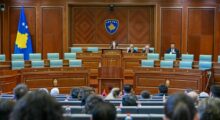
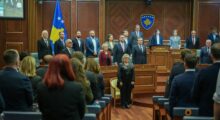
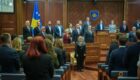
Kosovo’s parliament failed to choose a new president late Thursday, plunging the country back into uncertainty after almost a year of political stalemate in 2025.
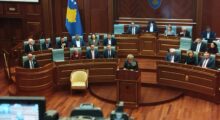
A session that started two hours before the constitutional deadline to elect the new head of state was interrupted because of lack of a quorum as only 65 of Kosovo’s 120 MPs were present in the chamber – 15 short of the number required for the vote.
The opposition boycott came after the ruling Vetevendosje party insisted on its own candidate for the presidency, failing to agree on a consensus name with the opposition parties, and rejecting the possibility of a second term for current President Vjosa Osmani.
The situation now remains subject to the interpretation of constitutional law. The opposition is asking sitting President Osmani to dissolve parliament and announce new snap elections, while the ruling Vetevendosje maintains that the constitution allows parliament 60 more days to try to elect a president.
Minutes after the parliamentary vote failed to happen, speaker Albulena Haxhiu announced that she has addressed the Constitutional Court to provide an assessment of the “constitutionality of the procedure for the election of the president of the Republic of Kosovo”.
“Through this request, we have also asked the Constitutional Court to impose a temporary measure to suspend the constitutional deadline related to the procedure for electing the president, until the publication of the verdict,” Haxhiu wrote on Facebook.
Under constitutional provisions, the president is elected by parliament over three potential rounds of voting. The first rounds require the support of two-thirds of all MPs, or 80 votes in total. The third requires only a simple majority of 61 votes.
However, a Constitutional Court ruling in 2014 made the election more complicated by laying down also that at least 80 MPs must be present in the chamber when any vote takes place.
To add to the complications, the same Constitutional Court ruling said that for any vote to be valid, two or more candidates must be on the ballot, a norm which has prompted political groups that propose a candidacy to invent a second contender just to tick the box.
This was the case with Thursday’s session when Vetevendosje, which initially proposed its MP, Foreign Minister Glauk Konjufca for the post, then added its MP Fatmire Haxha Kollcaku to the competition. The outgoing President Vjosa Osmani was not proposed for a second term despite her ambition to run.
The vote was destined to fail after meetings two days earlier between Prime Minister Albin Kurti, who leads Vetevendosje, and opposition leaders Bedri Hamza of the Democtaric Party of Kosovo, PDK, and Lumir Abdixhiku of Democratic League of Kosovo, LDK, did not produce a consensus name for the post.
Vetevendosje blamed opposition parties for the failure.
“We witnessed that opposition MPs did not participate in the session and did not propose a consensus name. We have been ready to give our signatures to any consensus candidate,” Arberie Nagavci, head of Vetevendosje’s parliamentary group, said after the session.
But Abdixhiku from the LDK accused the Vetevendosje of refusing to offer a solution that would provide a consensus, instead offering a choice between two candidates from the ruling party.
“The president should not have a party affiliation. This is not the way to reach a consensus or unity,” Abdixhiku said.
The presidency will become vacant on April 5 when Osmani’s five-year term ends. In the absence of an elected president, the head of parliament will serve as acting head of state.
The failure to elect a president comes less than three months after Kosovo held snap parliamentary elections, which were intended to end a ten-month deadlock that left the country in political limbo for most of 2025.
The deadlock was caused by Kurti’s inability to create a governing majority after previous polls in February 2025.