


A court in Kosovo will issue its verdict on Friday in the trial of three Serb men accused of involvement in a deadly attack on police in 2023. According to the indictment, Serbia is also in the dock.
On Friday, Spasojevic, Tolic and Maksimovic will learn their fate.
All three have pleaded not-guilty to charges of terrorism and serious acts against the constitutional order and security of Kosovo, but Spasojevic nevertheless expressed regret for his role in the attack in the village of Banjska.
“I am sorry for the death of the policeman Afrim Bunjaku and for the other injured parties; I am sorry that I participated in that event,” he told Pristina Basic Court on Monday during closing statements. “I cannot say that I am a terrorist, because I have not killed or injured anyone. I did not fire a single bullet at members of the police or anyone else.”
The case is far bigger than the fate of three alleged gunmen, however. It could potentially end with a Kosovo court branding Serbia a sponsor of terrorism.
In the indictment, prosecutors say the attackers underwent training at the Pasuljanske Livade military training ground in central Serbia, a little over 100 kilometres north of the Kosovo border, just days earlier, citing drone footage seized in Banjska. Serbia, it states, placed at the group’s disposal “all necessary” military infrastructure and logistics equipment “to commit the terrorist attack of September 24, 2023, in Banjska”.
Was Serbia involved?
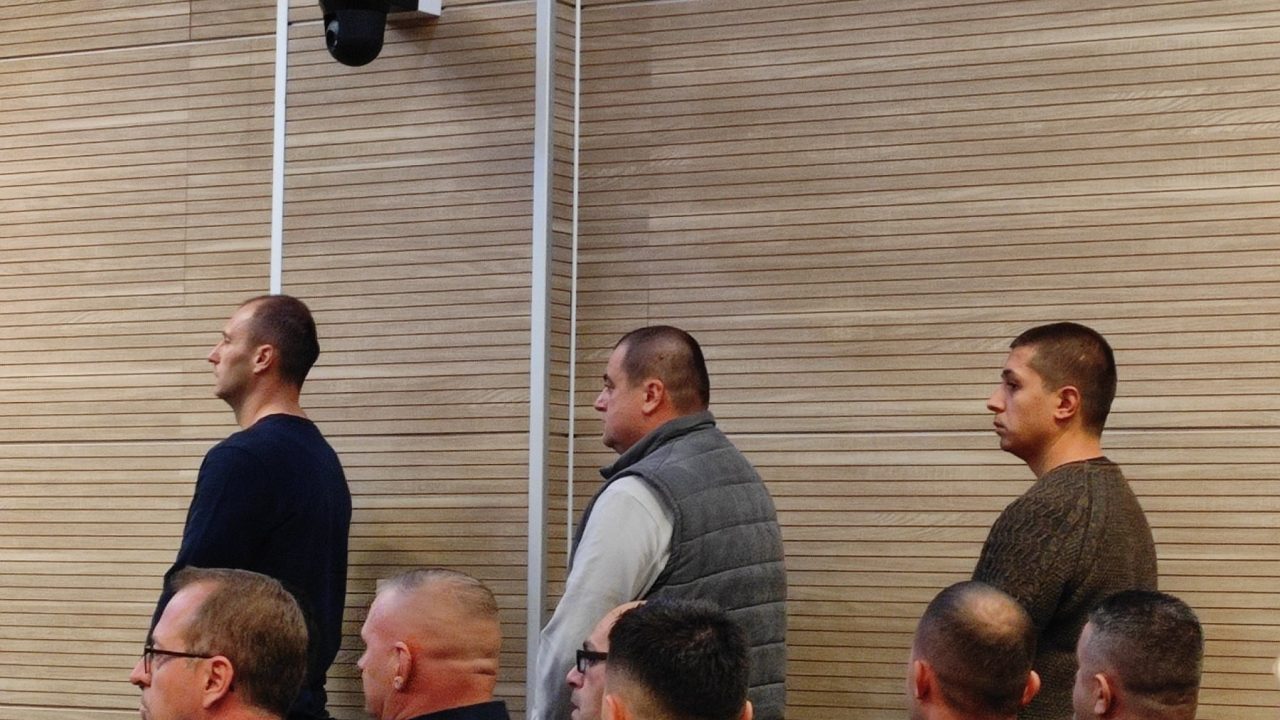
Left to right: Blagoje Spasojevic, Vladimir Tolic and Dusan Maksimovic at Prishtina Basic Court on October 9, 2024. Photo: BIRN
In total, 44 individuals and one legal entity are named in the indictment. Forty-three of them, including Spasojevic, Tolic and Maksimovic, are charged with terrorism and serious acts against the constitutional order and security of Kosovo. The legal entity, RAD d.o.o., and its owner, Radule Stevic, are charged with money-laundering, as is one of the other 43 – the alleged ringleader, local Serb powerbroker, businessman and politician Milan Radoicic.
Two of the gunmen were confirmed killed, but reports say others were injured and treated in Serbia, their fate unknown.
Only Spasojevic, Tolic and Maksimovic are on trial, while the case against the others has been separated until such time as authorities can get their hands on them. Kosovo has issued international warrants for their arrest.
After the attack, Kosovo police seized anti-personnel mines, Zolja anti-tank rockets, 60mm mortar rounds and an M93 automatic grenade launcher.
Tolic, however, pleaded ignorance.
“I couldn’t have imagined such a tragedy would occur,” he told the court. “I did not want to be part of any violence.”
Maksimovic said he wasn’t involved at all, despite what prosecutors say are videos, photographs and phone conversations that place him at the scene, armed. All three face possible life imprisonment.
Radoicic is in Serbia, as, almost certainly, are the rest of his co-accused. He quickly took responsibility for the armed attack, but Serbia shows no sign of handing him over or putting him on trial itself.
Indeed, for years Radoicic had been a close political and business ally of Serbia’s government, deputy leader of the Belgrade-backed Srpska Lista party that works hand-in-glove with Serbia’s ruling Progressive Party in safeguarding Serbian interests in the north of Kosovo – a former Serbian province that broke away in war in 1998-99 and declared independence in 2008.
Radoicic stood down from the party in the wake of the Banjska attack and was questioned by Serbian prosecutors the following month on suspicion of creating an armed group, amassing weapons and “serious crimes against general security”. He was never charged in Serbia.
Radoicic claimed Serbia had no knowledge of his plans, but Kosovo says he would never have been able to amass such a cache of weapons and launch such an audacious attack without, at the very least, the tacit approval of Serbia.
In October 2023, BIRN reported that the mortar rounds and anti-tank rocket launchers used had passed through state maintenance centres in central Serbia in 2018 and 2021 respectively; the ammunition included 7.62x39mm assault rifle rounds that match those made in 2022 by the Belom factory, Serbia newest state arms producer.
Prosecutors in the case say preparations for the operation began almost two years earlier, at a meeting just over the border in Serbia between Serbian President Aleksandar Vucic and political representatives of the Kosovo Serbs, including Radoicic. Vucic has dismissed this as nonsense.
According to the indictment, Radoicic had been financing a “structured terrorist group” since 2017, with the aim of “separating” four Serb-majority municipalities in northern Kosovo “to join them with the Republic of Serbia”.
Prosecution seeks life imprisonment
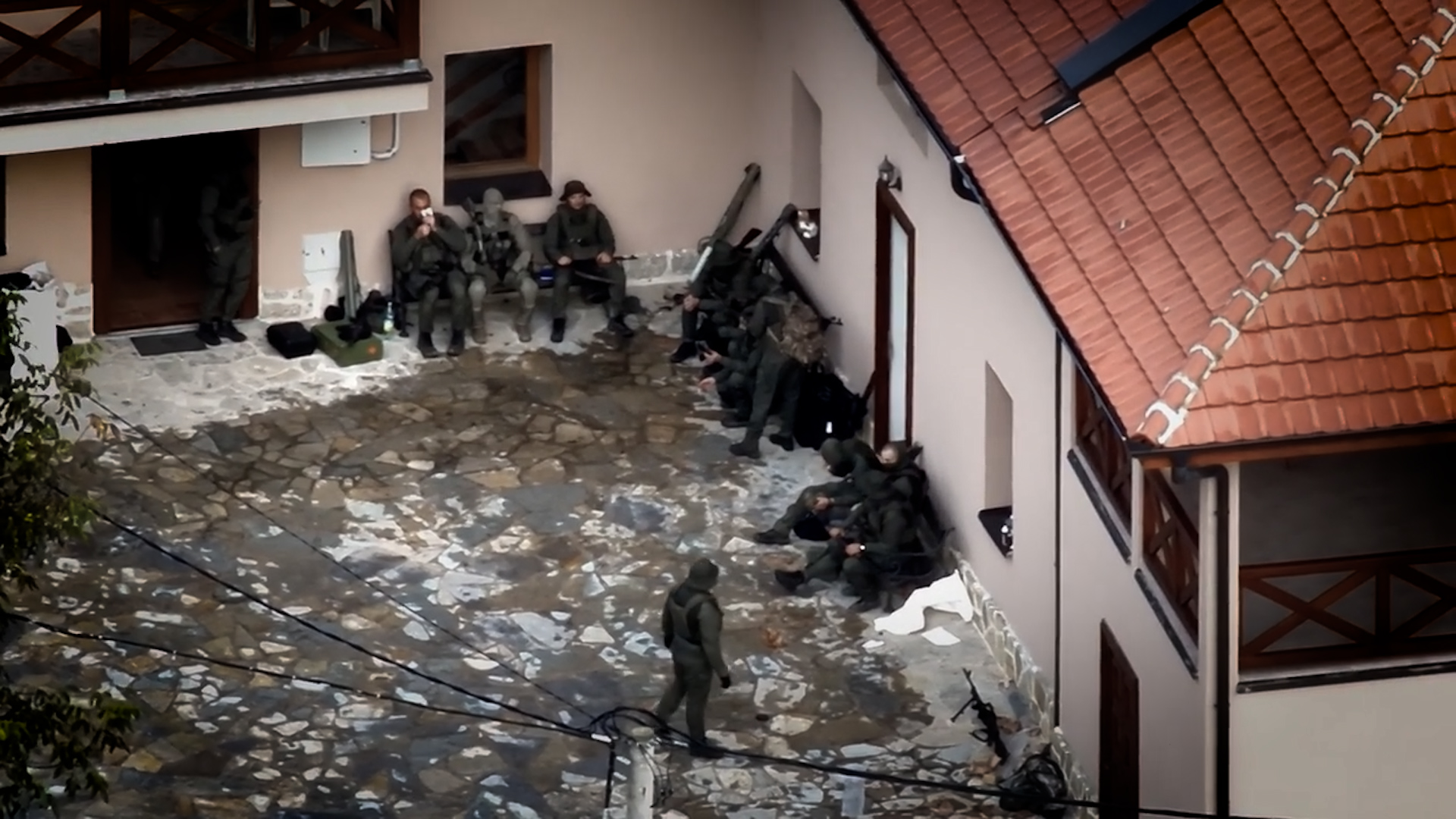
Drone footage shows Serb gunmen in Banjska during the armed attack on September 24, 2023. Photo: Kosovo Interior Ministry.
Defence lawyers have called on the court to acquit the trio, insisting Tolic’s role has not been proven and that Maksimovic wasn’t even in Banjska on the day of the attack.
Spasojevic’s lawyer, Lubomir Pantovic, said there was no evidence to support the prosecution’s request for life imprisonment.
“Proposals for life imprisonment are general and arbitrary, aimed at the public,” he said.
But Arianit Koci, lawyer for the family of the police officer who was killed, said such a sentence was justified.
“The group’s aim was not only the killing of an individual, but an attack on the state and the unification of northern Kosovo with Serbia,” Koci told the court.
During the year-long trial, the court heard from witnesses who described a coordinated attack from multiple positions, involving snipers, rocket launchers and explosives.
Police officer Alban Rashiti recalled seeing two large trucks parked on a bridge in Banjska during a routine night patrol.
“Within seconds, gunfire started from many directions,” Rashiti told the court. “The attack came from the entire village, from dozens of positions with different weapons. We returned fire, but I saw Sergeant Afrim Bunjaku lying down, seriously wounded and motionless.”
Banjska resident and hotel security guard Rade Nedeljkovic testified that armed, uniformed men brought a wounded individual into the hotel where he was working. He said he also saw armed men on the hotel terrace.
Some witnesses testified in closed session, with prosecutors citing national security concerns and threats to their safety.
Kosovo’s Western allies, as well as NATO, have called on Serbia to help bring to justice those still at large. NATO still heads a small peacekeeping force in Kosovo, more than a quarter of a century after the alliance bombed to push out Serbian forces accused of killing and expelling Kosovo Albanian civilians during a brutal counter-insurgency campaign.
Speaking in late January this year, NATO Secretary General Mark Rutte said the alliance expects accountability from authorities in Belgrade for events in Kosovo, and singled out the Banjska attack and mob violence against NATO-led troops earlier in 2023.
“I have a personal relationship with President Aleksandar Vucic; we have known each other for many years,” Rutte said. “But we expect him to determine responsibility for what happened.”