


Prishtina is the first stop outside Germany for Antifascism: Now, a decentralised network of exhibitions looking at the legacy of antifascism and what can be done today to confront a resurgence of fascism.
Rieken is Transnational Curator of Antifascism: Now, a decentralised network of exhibitions that begin and end in Germany but with a particular focus on Eastern and Southeastern Europe and the former Yugoslavia.
The exhibitions began this year and will end in 2029, unfolding across 13 different locations and bringing together artists, curators, journalists and researchers in exploring how political violence is remembered, how authoritarian narratives take hold and how resistance can be reimagined.
The Prishtina chapter, A Bird with a Stone Wing, is being hosted in the Kosovo’s capital’s Prison of Ideals Museum and BIRN’s Reporting House.
In the former prison, the old cells contain stories of political repression, socialist memory, women’s resistance, far-right networks and the consequences of war.
The exhibition and accompanying research project poses the question: what does anti-fascism mean today?
“This place carries so many different and complex histories that can speak a lot about resistance, about oppressed groups, groups that are only oppressed if a certain regime is in place,” Kalas Liebfried, Initiator and Artistic Director.
For Rieken, the exhibition is not only about revisiting the past, but an attempt to understand how authoritarianism can reappear under different conditions.
“We see a lot of the term fascism, a lot of fascist sort of resurgencies, but there’s very little definition of what it is now,” he told BIRN. “The question is not: ‘Is there fascism?’ But ‘How much fascism is there?’ ‘Where is it?’ and ‘How can we work against it?’”
The past inside a prison
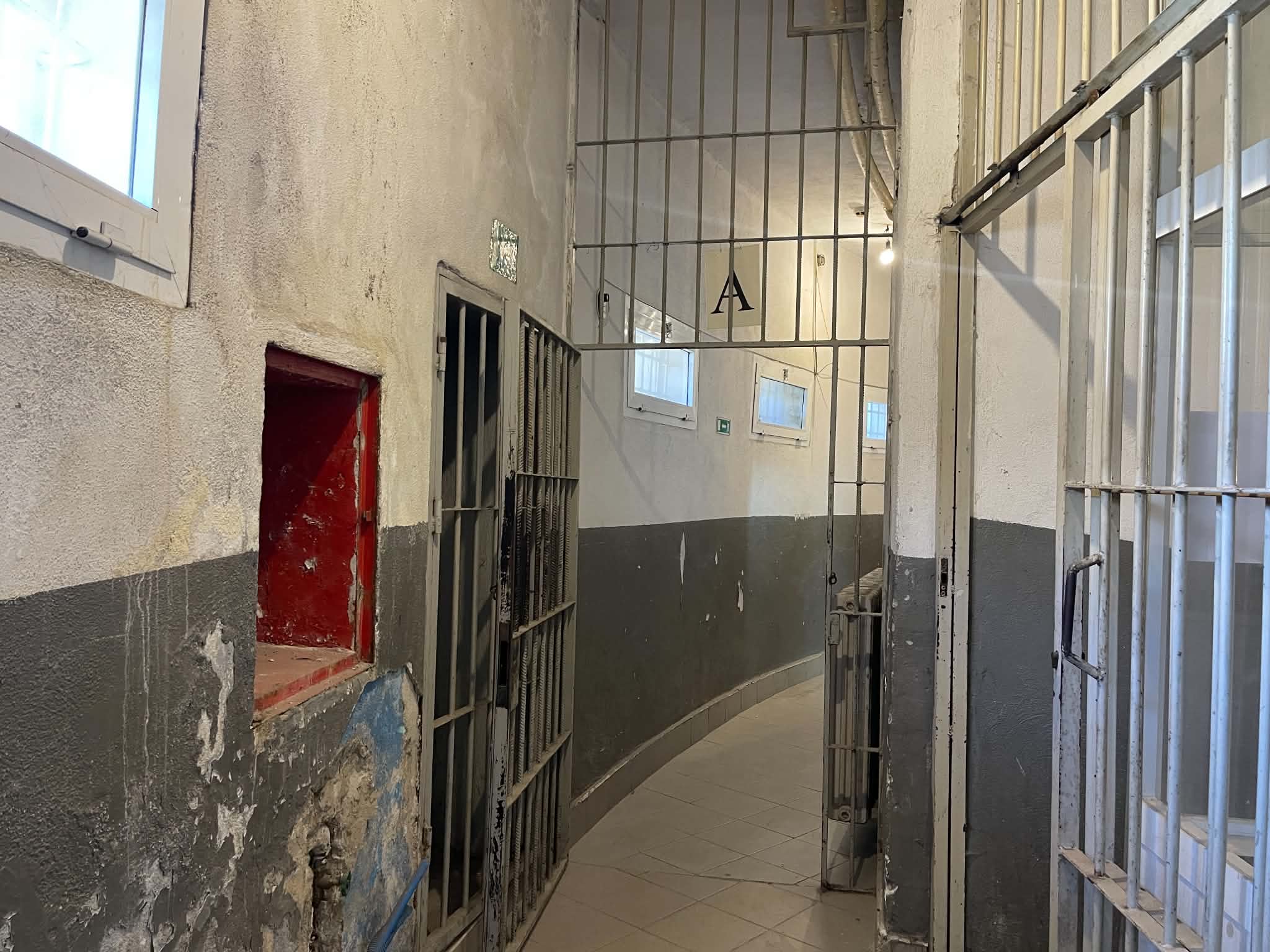
Prishtina prison-turned-museum. Photo: BIRN
Antifascism: Now began in Munich, a city that was central to the rise of Nazism. Prishtina is the first leg outside Germany, and part of a region synonymous with antifascism during World War Two and the emergence of the Non-Aligned Movement during the Cold War that followed. This history fed into the wars of the 1990s when federal Yugoslavia fell apart, and is still argued over today.
“Prishtina is a challenging place to begin the international programme,” Rieken said.
The Prison of Ideals Museum was once a site of political detention and violence, during the socialist period and after, when Kosovo was ruled from Belgrade under Slobodan Milosevic. It ceased to exist as a prison in 2015.
In what was once the prison shaving room is now an installation by Italian artist Stefano Romano, called Songs for the Present Tense, a performance co-written by current women inmates of the correctional centre in Lipjan/Lipljan, some 25 kilometres south of Prishtina.
“If you listen to the performance, they all speak about freedom, guilt, paying the price of their actions,” said Romano.
Another cell contains paintings by artist Vigan Nimani depicting, among others, Yugoslav leader Josip Broz Tito, while filmmaker Blerta Haziraj highlights the Antifascist Front of Women, known as AFZ, and the history of women partisans in Kosovo.
The exhibition also looks at violence suffered by LGBTQ+ communities, including a video installation by Igor Grubic revisiting anti-LGBTQ+ in Serbia in 2001.
A different kind of confrontation appears in work by Jonas Hoschl, created in collaboration with the recherche-nord collective and Rashad. Played on a TV placed in one of the prison cells, it shows journalists’ encounters with far-right networks at a pub in a small German town popular with local extremists.
Love letters
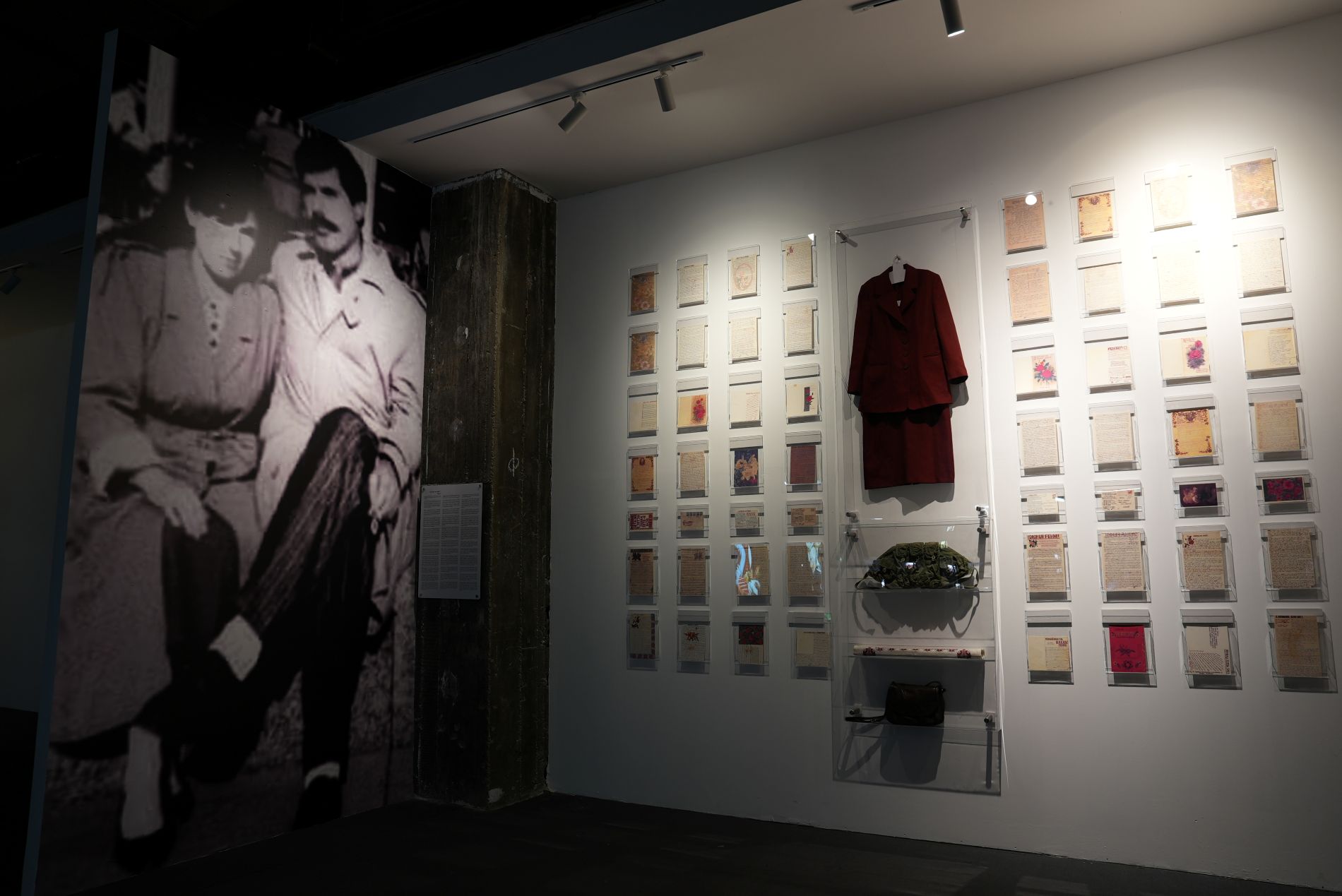
Xheve Krasniqi Lladrovci’s wedding dress displayed at Reporting House in Prishtina along letters to her husband during his jail term. photo: BIRN
At the Reporting House Museum, the exhibition moves from the architecture of imprisonment to the ways journalism and personal testimony shape historical memory. The question of who holds the camera and who is seen through its lens is addressed.
It features a painting of a photograph of Albanian migrants arriving in Italy by ship during the exodus that followed the fall of communism in Albania in the early 1990s. The photograph captures an unusual reversal: an Albanian migrant, narrates Armando Lulaj, photographed journalists as they photographed the arriving migrants. Those who were the subjects of the image turned the lens on the people documenting them.
Lulaj says that the painting was commissioned by MANIFESTO Collective, who asked Albanian artist Zef Shoshi to produce what Lulaj described as Shoshi’s “Last Socialist Realist Painting”.
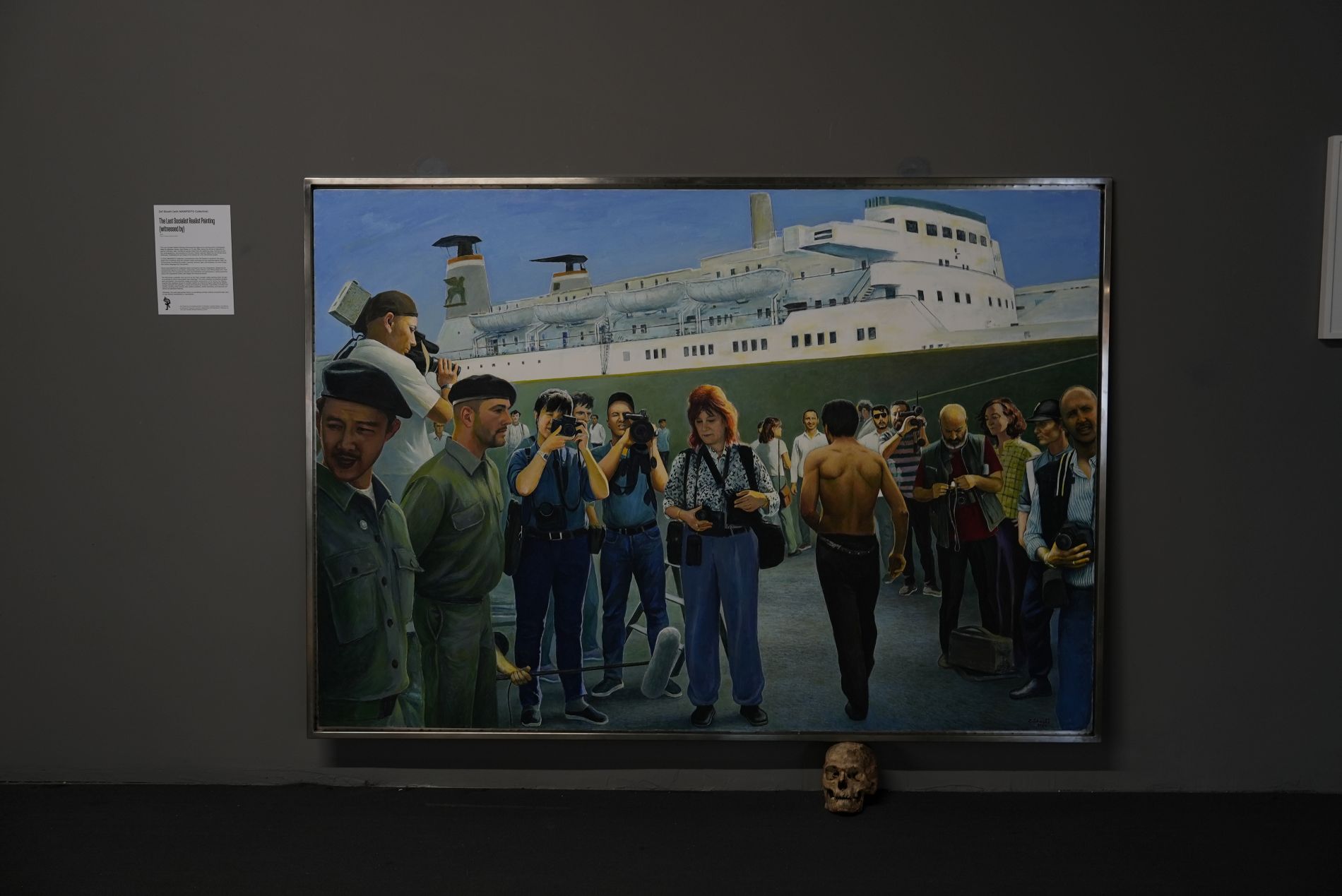
‘The last socialist painting’ at Antifascism: Now exhibition in Reporting House Museum in Prishtina. Photo: BIRN/Denis Sllovinja.
It is displayed above a real human skull, bringing together migration, artistic memory and the physical traces of human life.
“I am glad we made this part of the museum, as the first documentation of the exodus in Albania we have in the museum,” said BIRN Kosovo executive director Jeta Xharra.
Also in Reporting House, ‘A Wall Divides Us’ presents dozens of letters exchanged by Kosovo Albanian activists Xheva Krasniqi-Lladrovci and Fehmi Lladrovci between 1985 and 1990, coinciding with Milosevic’s rise to power in Serbia, growing repression of Kosovo Albanians, and the twilight of federal Yugoslavia.
Lladrovci was imprisoned in the former Yugoslavia for his agitation for Albanian rights. He and Krasniqi-Lladrovci had been engaged for just over a month when he was imprisoned. Their communication continued throughout his detention.
Xharra said it was “rare to find this much passion and political energy within the same letters”, presented publicly for the first time in almost 40 years,
“It particularly impressed me how Xheva was teaching the elderly generation how to read and write [in order to write to their dissident sons in jail] and arguing for more education for young Kosovo Albanian girls who were abandoning school when Milosevic closed Kosovo public schools in 1990.”
Alongside letters, the exhibition includes the red outfit Krasniqi-Lladrovci wore when she got engaged, and the ammunition vest she was in when she was killed in 1998 alongside Lladrovci while fighting Serbian security forces.
From denial to remorse
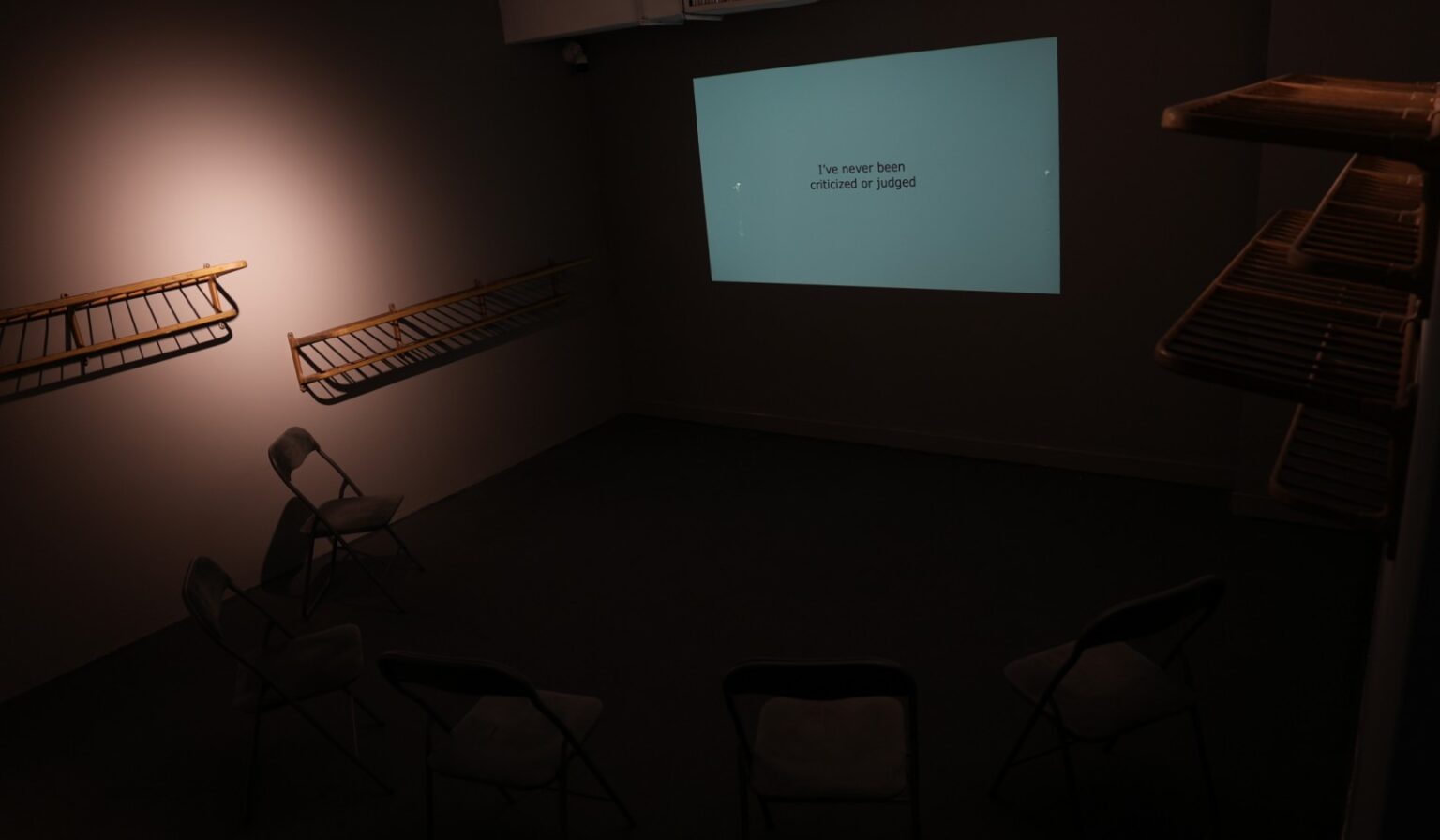
‘Antifascism: Now’ exhibition. photo: BIRN
Also in BIRN’s Reporting House, The Camp Guard is an award winning, 40-minute interview with Esad Landzo, a former guard at the Celebici prison camp in Bosnia and Herzegovina during the 1992-95 war.
Landzo was convicted by the International Criminal Tribunal for the former Yugoslavia, ICTY, for crimes against prisoners, including murder, torture and the infliction of severe suffering.
After serving his sentence, he moved to Helsinki, Finland.
“This country gave me a second chance at life and I’ll forever be grateful,” Landzo tells Croatian journalist Barbara Matejcic.
The audio interview follows his journey from denial to remorse.
“This is the only war criminal in former Yugoslavia who actually showed remorse for his victims, admitting guilt,” said Matejcic. “I found no other war criminal indicted ever showed remorse.”
For Gazmend Ejupi, curator of the Reporting House museum, the project’s ambition extends beyond the individual artworks.
“For me, it’s not just an exhibition,” he said. “It’s a project with the potential to be an art movement.”
That ambition is reflected in the structure of A Bird with a Stone Wing, which evokes the image of a bird trying to fly while weighed down by history. It inhabits the contradiction of moving forward with histories that cannot simply be left behind.
The exhibition in Prishtina runs until November 28.