

Craftsman Fahri Krasniqi has not allowed his physical disabilities to stand in the way of his creative will and passions.
In a small workshop in the village of Grashtica, some 10 kilometres from Kosovo’s capital, Prishtina, Fahri Krasniqi, 45, spends his days turning ideas into reality.
Working with wood and metal, he makes everything from miniature ornaments to specially adapted musical instruments and bicycles. Each of his creations reflects his talent and his determination to find creative solutions for the challenges he faces.
A childhood accident left him with limited use of his left hand and forced him to leave school, but his passion for creating persisted.
Krasniqi, a father of two, adapts objects to suit his needs. He has modified a çifteli, a traditional Albanian two-stringed instrument, so he can play it with one hand, and built a bicycle designed to accommodate his limited hand movement.
“It’s difficult to replace a hand, but for my own enjoyment, I can manage to play a few notes. That’s why I came up with this invention,” says Krasniqi, demonstrating his adapted çifteli.
A passion that overcomes limitations
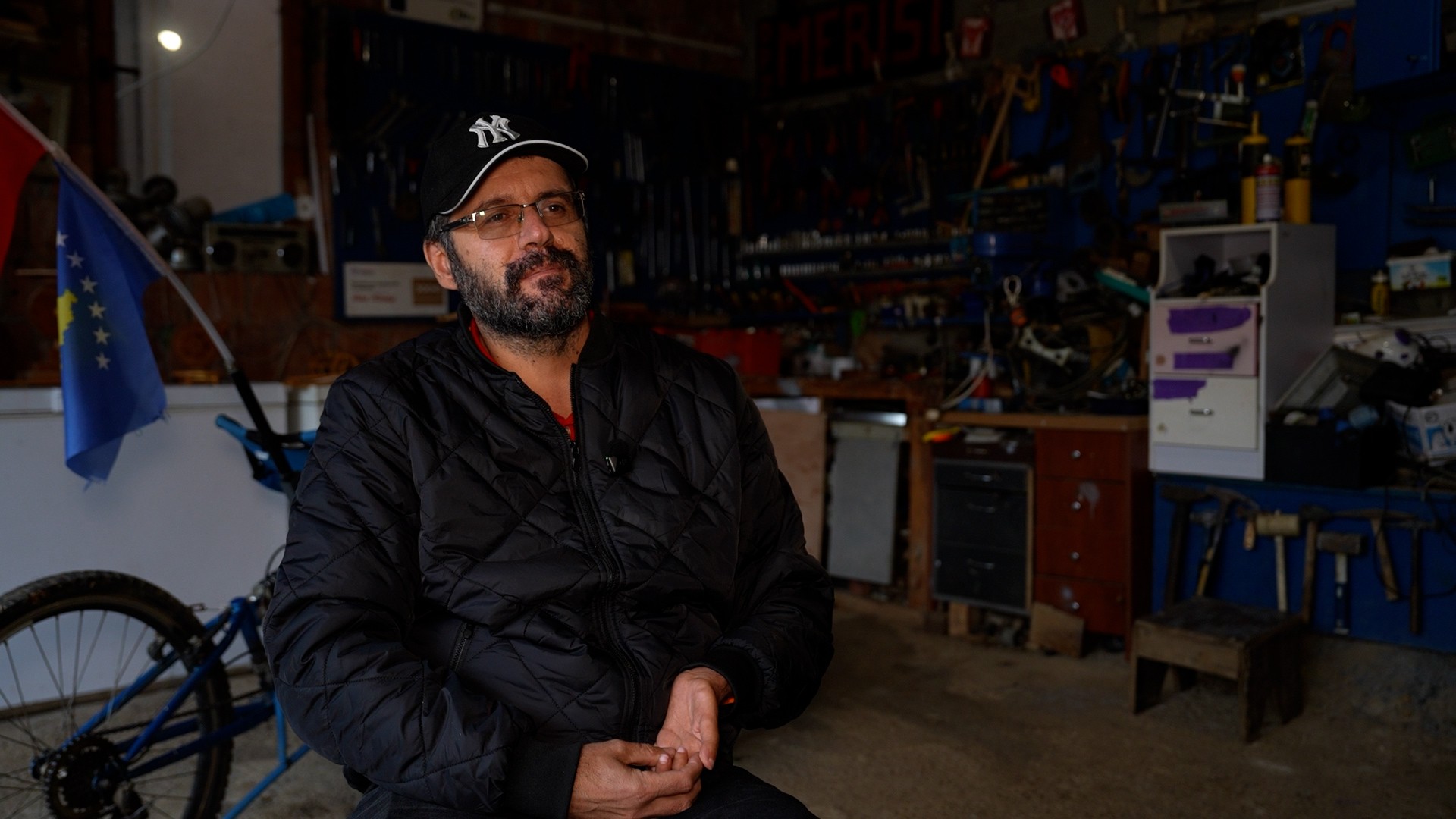
Fahri Krasniqi. Photo: BIRN
His workshop is located in the garage of his family home, where he spends most of his time experimenting with different materials, tools, and ideas.
The idea of adapting the çifteli came from his desire to continue playing the instrument despite being unable to use both hands, an idea that took him several attempts and modifications to perfect.
“I had a craftsman install the frets, but I realised I still couldn’t play it. Then I started experimenting with different ideas, including installing different motors,” he recalls.
Krasniqi has also made several conventional çifteli instruments.
The adapted instrument is not his only creation. His workshop is filled with wooden objects, some of which were exhibited at various fairs and festivals.
A childhood interrupted
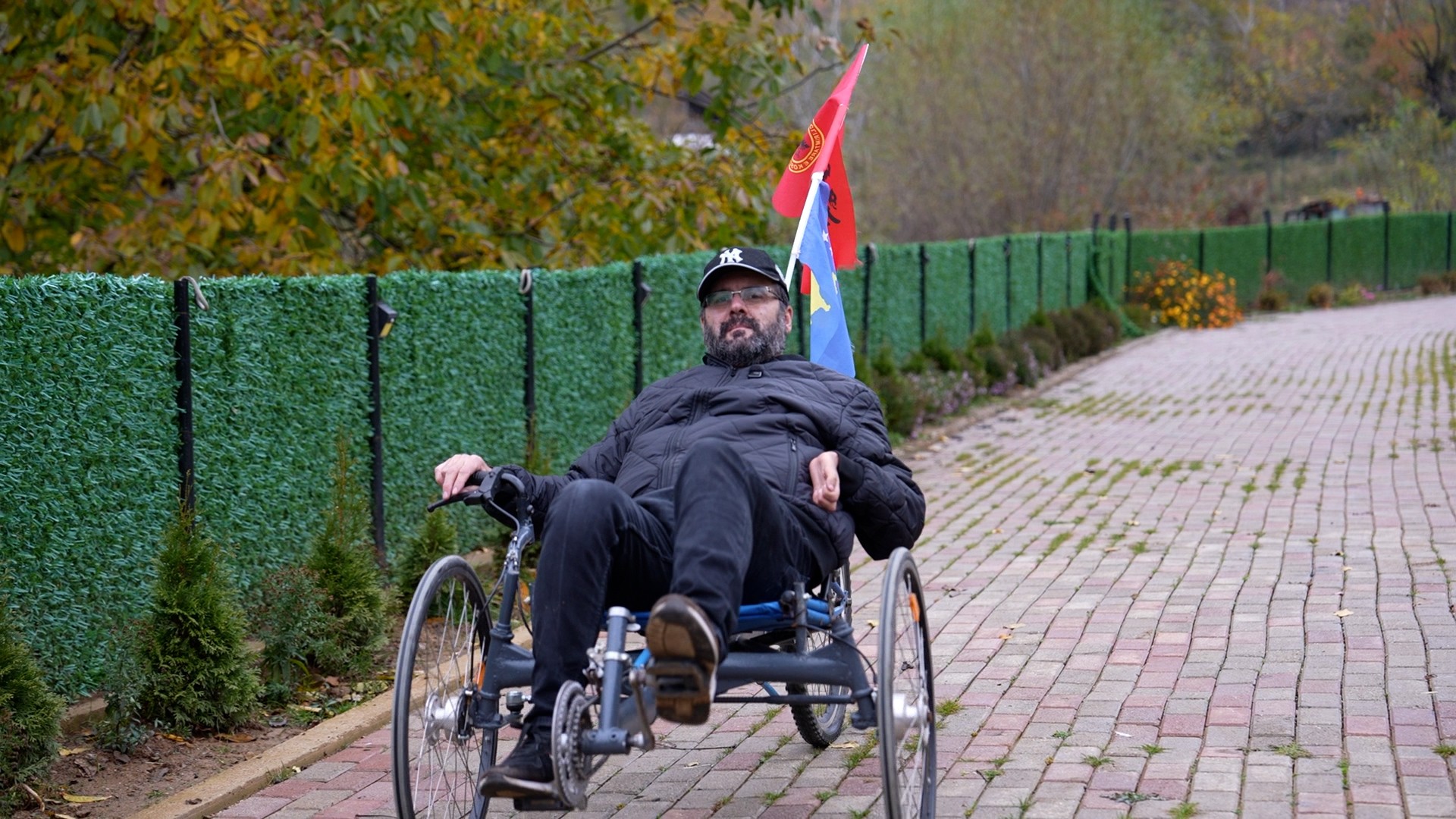
Fahri Krasniqi with the bicycle he improvised according to his needs. Photo: BIRN
His passion for woodworking started in childhood, when he would watch his maternal uncles practice their craft.
“Whenever I heard an axe, a hammer, or any other tool, I would be the first one there, watching them. I was fascinated by woodworking,” Krasniqi recalls.
But developing his craft was far from easy.
In 1988, when he was seven years old, Krasniqi was involved in a serious accident. He was hit by a car, which left him with multiple injuries, including damage to his left hand, a broken leg, and broken teeth.
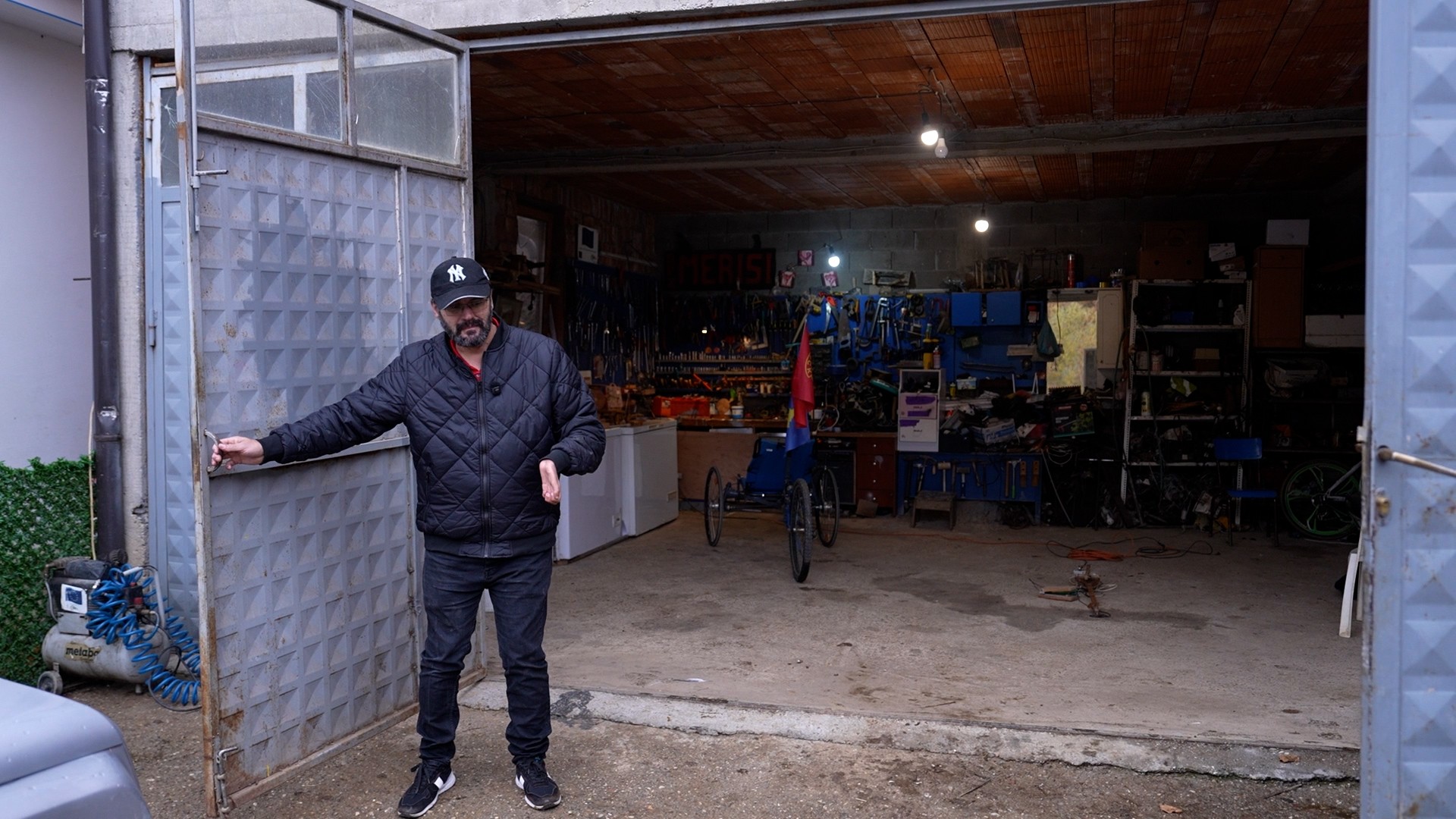
Fahri Krasniqi. Photo: BIRN
“I was seven years old, looking after livestock with children from the neighbourhood when the accident happened. My left hand stopped functioning, and I also had a broken leg, and damaged teeth. When I took the cast off and started walking again, both my legs gave way,” he says.
Despite doctors’ assessments that there was little hope of recovery, Krasniqi refused to accept that his condition would define the rest of his life.
“I was paralysed until I was 13. Eventually, I started trying to recover on my own,” he says.
The doctors had given up and told him there was no hope of recovery and that he had to accept his condition. “But I refused to give up. I started by taking two or three steps at a time. I would take bicycle pedals, improvise with them and use them for exercises. I could see that the exercises were helping me,” he recalls, adding that at that time he didn’t get the needed physical therapy for his condition. “Shortly after that my father was fired alongside most of the Albanians in Kosovo at the time.”
His health problems also disrupted his schooling.
“I completed first grade as a regular pupil, but after that my condition deteriorated and I could no longer go to school,” he explains.
Rediscovering his talents
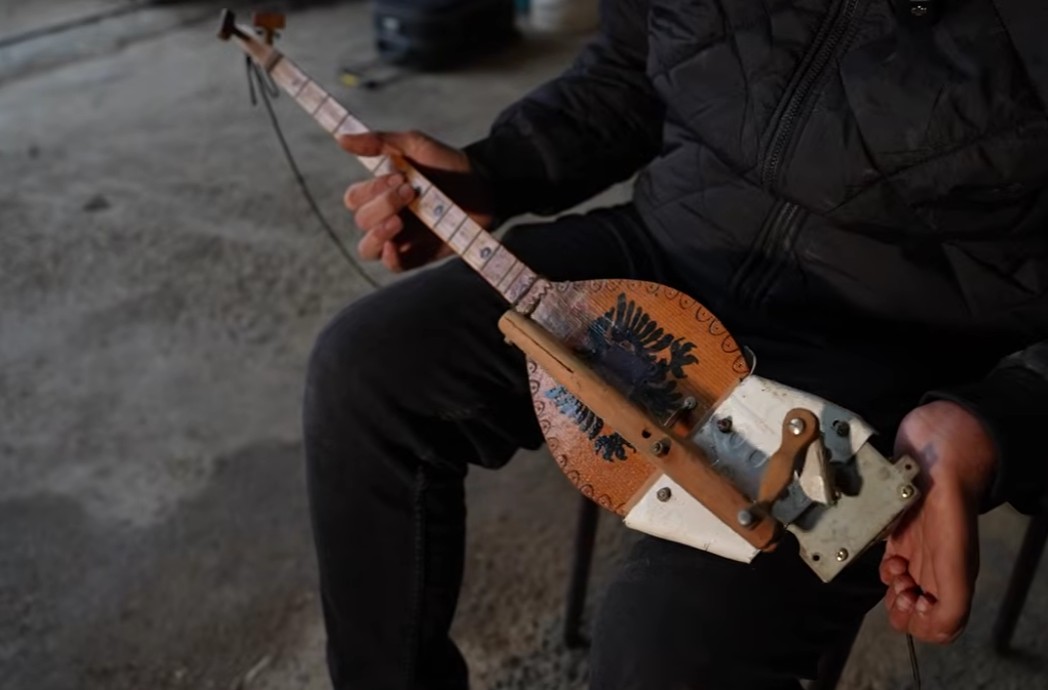
Fahri Krasniqi playing the çifteli, a traditional Albanian instrument he built himself. Photo: BIRN
Krasniqi’s desire to learn and express himself was never dampened. After the war in Kosovo, in 2000/2001, while attending a computer course, he began writing again. It was there that he discovered another passion: poetry.
“We had to type something on the computer. That’s when I started writing poetry,” he says.
Meanwhile, his woodworking, which had initially been more of a personal hobby, gradually developed into a professional activity.
In the early 2000s, Krasniqi began dedicating himself more seriously to the craft. In 2002, he received a grant and attended entrepreneurship training through the Handikos organisation. A modest grant he received helped him purchase equipment and expand the range of products he could make.
“I gradually expanded into other products, making miniature versions of [traditional] objects that had been used in the past. I sold them at various fairs. I had a market, mainly people from the diaspora,” he adds.
But his desire to invent and experiment and to adapt everyday objects to his needs has never faded.
His latest creation is a specially adapted bicycle designed for people with disabilities. The idea came to him after he saw a similar bicycle on social media.
“I saw that the price was astronomical for me, around 3,000 euros, and I thought, why not make one myself? I dismantled three bicycles and built this one. Now I ride it just for pleasure,” Krasniqi concludes.