


Amid Kosovo’s political instability in the past two years, a nickname hardened into a title: Albin Kurti’s voters no longer call him Prime Minister but Baba –father. This essay asks what that word is doing and why it keeps reappearing at moments of political and economic anxiety?
Since 2024, Kosovo has lived in near-permanent electoral crisis: coalition talks collapsing, parliaments dissolving, snap election following snap election. Through every round of that chaos, one man has kept winning—and winning bigger—Albin Kurti, the leader of Kosovo’s biggest party Vetëvendosje (Self determination) and acting PM.
Kurti first won in 2019, had a landslide victory in 2021, and then three consecutive majorities between 2025 and June 2026—a feat with no precedent in Kosovo’s short democratic history. Amid the political instability, a nickname hardened into a title: Kurti’s voters no longer call him Prime Minister but baba (father).
“Precisely because you intend to give me your children for me to raise, you call me Albin baba,” Kurti said ecstatically during the election campaign in January 2025.
Often, referring to someone as “the father of X” carries the implication that, having created something, they have the right to control it. From Kronos in Greek mythology, who devoured his own children for fear they would overthrow him, to the anti-colonial philosopher Frantz Fanon’s notion of the debilitated father, the metaphor of the father has never been neutral. Across centuries, it has served as a way of thinking about authority, power, and legitimacy.
As a civil society activist and dissident, Kurti was among the most outspoken critics of the personality cult of Ibrahim Rugova, Kosovo’s pacifist leader during the height of Serbia’s violence against ethnic Albanians in the 1990s and in the post 1998-99 Kosovo war years.
Back then, Kurti argued that Rugova, as father of the nation in the literal pre-independence sense, had been reified into a figure beyond political accountability.
The white European canon would maintain that the son who names and resents the father’s authority is always at risk of becoming that authority’s truest heir; Oedipus does not escape the throne by understanding its corruption, he inherits it.
Today, Kurti has become exactly the cult-fetish-father he once diagnosed in Rugova.
A leader nicknamed ‘baba’, armoured by electoral majority and charisma rather than by institutional accountability, whose interventions in market, welfare, and society are increasingly read as beyond the reach of negotiation rather than subject to them.
Who is your daddy?
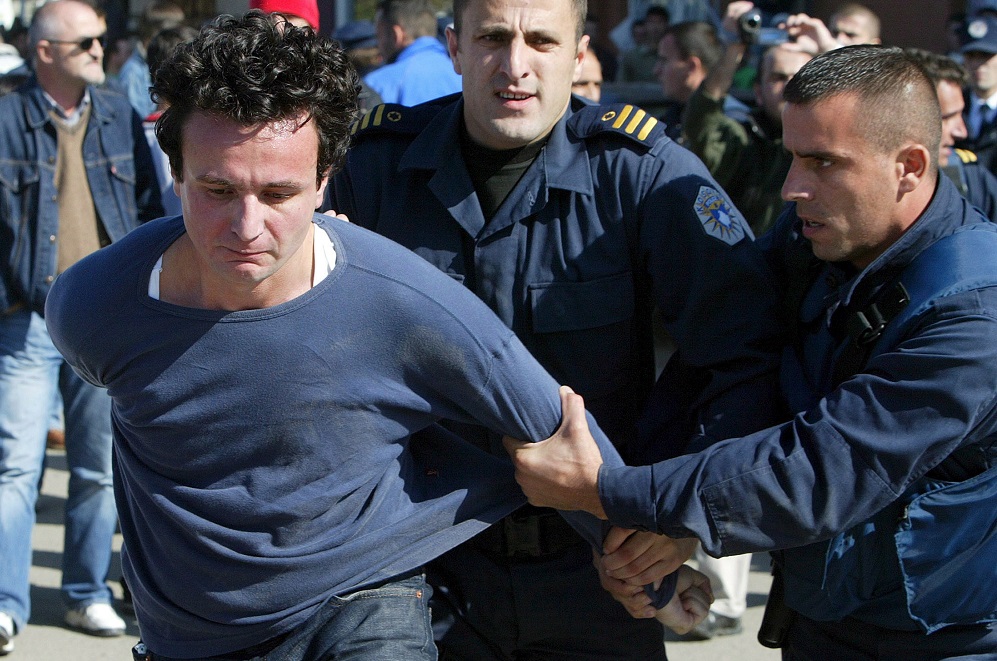
Kosovo police officers arrested Albin Kurti, leader of Vetëvendosje movement, at the time not a political party, in Prishtina, Kosovo, October 19, 2005. Photo: EPA/Valdrin Xhemaj
The Oedipal drama assumes a stable family triangle in which the father is present enough to be internalized as law in the child’s world. In this predicament, the father’s authority was never dismantled from outside before the family drama could begin.
In his 1952 book Black Skin, White Masks, Fanon argued that colonialism deforms this triangle at its base. The colonized father is not a presence but a diminished, humiliated figure, stripped of authority by the colonial order. Therefore, per Fanon, instead of the father, the post-colonial child internalizes the colonizer as the law.
Kurti’s own biography reads almost as a case study written to Fanon’s specification, and not the European bourgeois.
He was imprisoned by the Serbian state in 1999. In the mid-2000s, as an activist demanding self-determination, he was kept in custody repeatedly by then UN interim administration of Kosovo, UNMIK, that he named “neocolonial” at the time.
In 2020, in the middle of the COVID-19 pandemic, his own government was removed in a coup orchestrated from Washington by Donald Trump and Richard Grenell. This third humiliation is the clearest demonstration that even electoral legitimacy remained subject to withdrawal by fathers elsewhere.
Three father-apparatuses, three humiliations, none of them internal to a family drama: the Serbian state, the international administration, and the US guarantor each disciplined him in turn and each occupied, briefly, the place of the father.
Friedrich Engels in his 1884 book, The Origin of the Family, Private Property and the State, argues that paternal authority is not a natural but a historical achievement, tied to a specific economic transition. The “father”, as a category of authority, emerges with the rise of private property that men controlled and wanted to transmit to verified heirs. Beyond that, fatherhood was invented to perform duties such as securing survival and distributing resources, which for Max Weber, as explained in the 1921 book Economy and Society, were in turn bureaucratized in the welfare state in nineteenth-century Europe.
Going beyond phallocentric approaches to economic and political thought, Audre Lorde argues in the 1978 book Uses of the Erotic, that within any oppressive structure there is a fantasized standard-bearer: white, male, young, heterosexual, and financially secure, against whom everyone else is measured. Here, baba as a political title functions exactly as a claim to occupy that mythical authority, regardless of whether the man in question actually embodies any of its content.
Indeed, the father reappears in politics precisely at moments when markets, bureaucracies, laws feel like they are failing to protect citizens. Hence, considering contemporary Kosovo, the question is: when a society starts calling someone baba again, what is it confessing about what it no longer trusts?
The answer lies in Kurti’s paternalistic economic interventions in recent years. They are not depersonalized, rule-bound, predictable welfare policies that are means-tested, market-correcting, or social-investment-oriented. They function like personal provisions, timed to elections, given from baba rather than from the system—a symbolic father seemingly replacing a welfare state.
Paternalistic economics: Baba as welfare state
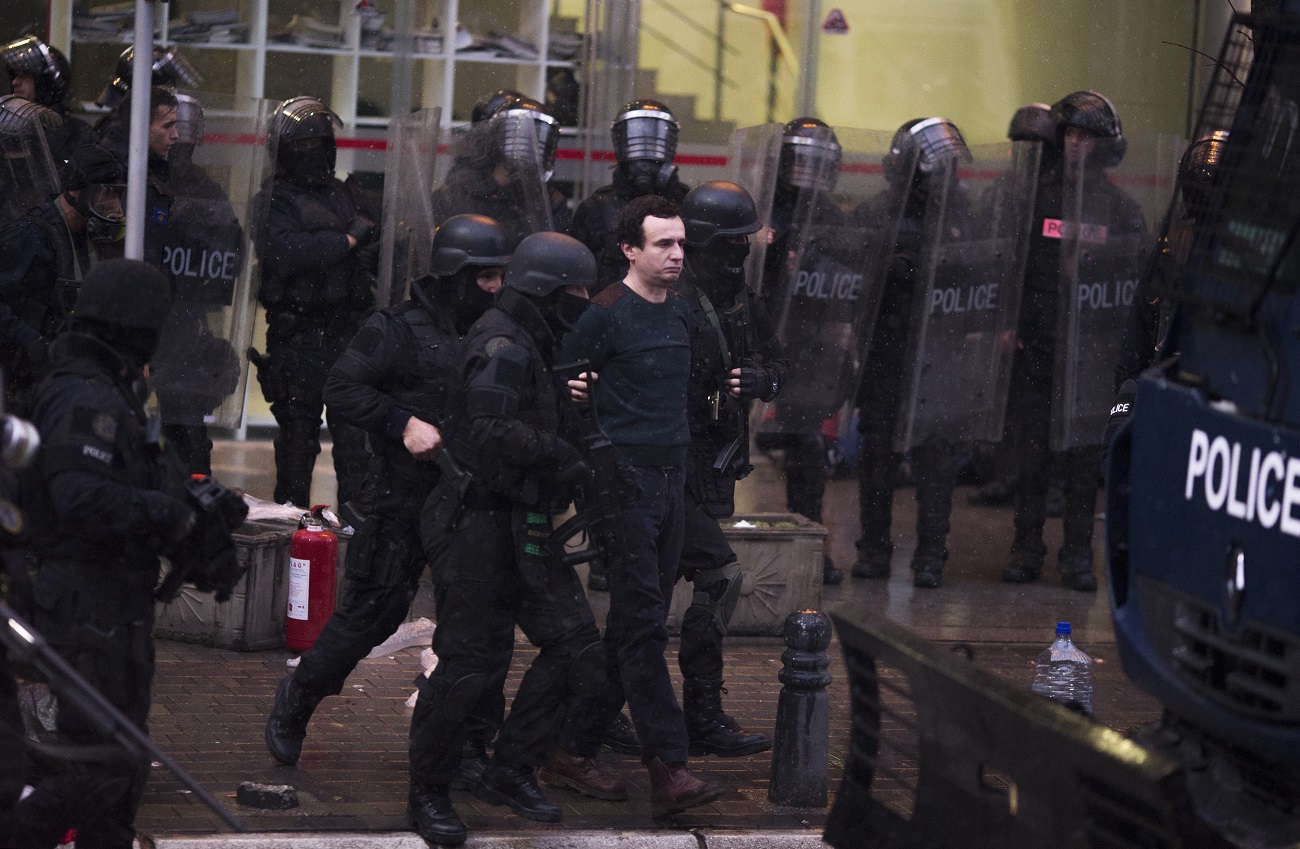
Kosovo police officers arrest Albin Kurti, (C), then leader of opposition party Vetëvendosje, after a protest in Prishtina, against the EU facilitated dialogue with Serbia, November 28, 2015. Photo: EPA/Valdrin Xhemaj
Unlike the missing welfare states Engels and Weber describe, Kosovo’s welfare gap is missing in a more complicated way. It has been partially constructed, partially dismantled, partially outsourced to international organizations, and permanently deferred by the same Euro-Atlantic order.
Baba, therefore, steps in to fill a gap that is not accidental but structural.
Following the February and December 2025 elections, the government did not present a draft budget until February 12, 2026. Even then, it merely re-approved the version the outgoing, Kurti-led, caretaker government had adopted in October 2025, without publishing a Medium-Term Expenditure Framework and without reflecting the new government’s 19 ministries. The government also failed to publish the citizens’ guide to the draft budget on time.
On February 20, 2026, the Minister of Finance, Hekuran Murati, called the draft budget “temporary and urgent,” without clarifying its temporality nor its urgency. Part of the draft budget was the implementation of a thirteenth salary for the public sector. Even though wage earnings, especially in the private sector (which this thirteenth salary still does not apply to) are low, a study from the Prishtina based think tank, GAP Institute, showed that this provision is not aligned with the Law on Wages.
Over 81% of the allocated budget for capital investment went to projects carried over from previous years rather than new ones. In the period 2019–2025, spending on subsidies and transfers has almost doubled, limiting the capacity to invest in infrastructure projects. More than 1 billion euros in planned capital spending, between 2021 and 2024, was not executed. This showcases a structural shortfall in exactly the kind of unglamorous, depersonalized public investment, such as roads, schools and pre-school facilities, digitized classrooms, hospital supply chains, that a functioning welfare state ought to deliver.
Engels locates paternal authority precisely in the power to decide who receives what, when, and on what terms.
Days before the October 12, 2025, local elections the Kurti led acting government decided to allocate 100 euros per student.One month before the December 28, 2025, parliamentary elections, Kosovo students received a warm and personal enough message from Kurti: that the receiver still has to feel something for the giver rather than for a system.
The Kurti led government allocated an impromptu €100 to every student in Kosovo. The payment could have arrived as an anonymous bank transfer, but instead, it arrived as a message from baba to “his” students:
“Dear students, allow me to wish you a happy new academic year with the good news that you have qualified as a beneficiary of the one-time supplement of 100 EUR. With our government, students will always have the support of the state.
Yours, Albin Kurti, caretaker Prime Minister of the Republic of Kosovo.”

The translated text message by the Kosovo Prime Minister’s Office, signed by Kosovo acting PM Albin Kurti, sent to Kosovo students. Illustration: Besnik Krivanjeva/BIRN
The text message is not a bureaucratic disbursement notice. It is a personal SMS, signed by baba, in the grammar of intimate correspondence rather than public administration. If a functioning welfare state is fatherhood successfully bureaucratized, as Weber would have it, then this text message is the precise moment when that transition is reversed in real time. This is paternal authority small enough to fit into a phone’s notification screen.
A father who hands out €100 before an election is not building a welfare architecture. He is performing the gesture of fatherly provision at precisely the moment it buys the most loyalty.
It did not stop there!
The day after the December 28, 2025, parliamentary elections Kurti announced that, starting the following day, €100 would go to children and pensioners. While the payment was timed to land just outside the elections, the promise itself had already done its work during the campaign. Several weeks before the June 7, 2026, parliamentary elections Kurti’s cabinet decided to hand out 100 euros to students and pensioners.
It is against this backdrop that personal payments resumed at scale in the late spring of 2026, just ahead of the June 2026 snap parliamentary elections.
One of the five commitments of the new Kurti government was a so-called Inflation Package. The government sent this 122 million euros support package to the Parliament in late April 2026, two and a half months after the government’s formation, and only three days before the Parliament’s own constitutional mandate was set to expire.
It did not pass in parliament so the government acted by cabinet decision instead.
On May 22, it approved a new round of payments under the label Inflation Package 2.0, allocating approximately €105 million in total. This included €73 million in one-off €100 payments to more than 322,000 adult beneficiaries of social assistance schemes and over 405,000 children, as well as €7 million in €100 payments to 70,000 students.
The inflation rate in Kosovo for 2026 stands at 6.8%—the highest in the region. Because the government operates as if the nominal, inflation-driven growth of the budget were itself a benefit, the state’s fiscal behaviour comes to feed the very inflation it claims to be controlling.
On the one hand, the government’s structural economic instruments—such as social benefit adjustments, the draft budget, and the Medium-Term Expenditure Framework—move slowly, incompletely, or not at all. On the other hand, its personal, discretionary instruments—the text message and the cabinet decision—move precisely on the electoral calendar: signed, dated, and felt as coming from baba.
The absent baba
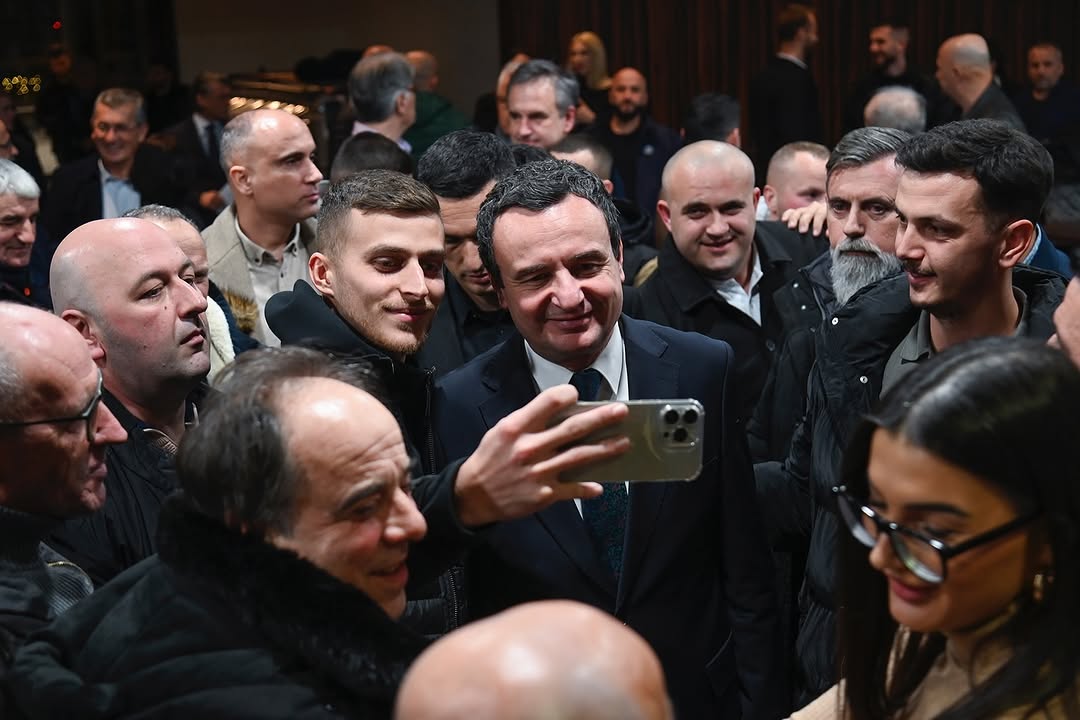
Kosovo Acting PM Albin Kurti meeting Kosovo diaspora in Slovenia, December 14, 2024. Photo: Albin Kurti/Instagram
Kurti’s principal paternal role is structurally evacuated by geography.
Baba governs one of the poorest countries in Europe, whereas his only child is growing up in the Norwegian welfare state. What should be enacted by baba in his household is instead exported onto the body of the nation, where no custody arrangement, no co-parent, no foreign court can contest his claim to the title of father.
Kurti governs the one country in Europe where paternal-economic presence is materially load-bearing, while his own daughter exists in the one context where that paternal-economic support has been substantially socialized away by the state itself. The compensation does not run from public weakness to private theater; it runs from private absence to public theater.
Ordinarily, it would not be politically productive, nor is it my aim here, to adjudicate modes of parenting. But when a leader chooses to internalize and caricature the figure of the father, and extends it to claim the nation’s children as his own, that choice itself invites scrutiny, including the distant parenting in his own family that he has kept outside the frame.
The universal father of the Western canon was never universal. Angela Davis’s 1981 book Women, Race and Class, explains how slavery legally and structurally abolished Black fatherhood, while the white bourgeois father in the writings of Weber and Engels was being consolidated next door.
Relatedly, in the 1977 Song of Solomon, American novelist Toni Morrison depicts the father as rarely a stable authority figure in the ostensibly Freudian-Oedipal sense but missing, broken, violent, or himself a traumatized residue of slavery and capitalism.
Kosovo’s history with fathers is also a fractured one, and it needs to be read in the Fanonian register. Long before Kurti, Kosovo had already learned to live with absent fathers.
Between the 1960s and 1980s, under decades of structural oppression and economic stagnation imposed by Belgrade, hundreds of thousands of Kosovar men left as Gastarbeiter (guest workers) for Germany, Switzerland, Austria, and elsewhere. They sent money home while their wives ran the households, raised children, and cared for aging in-laws and extended family. The father in this generation’s lived experience, was not a daily presence but a remittance: a monthly transfer, a voice on a crackling phone line, a man who came home for two weeks in August smelling of a different country and then left again.
In the episodic presence of Gastarbeiter fathers, mothers became the de facto heads of household in everything but name and law. They ran the farm or the family shop, negotiated with neighbors, disciplined children, managed grief and illness, while remaining formally subordinate to a patriarchal order whose literal representative was absent for eleven months of the year.
In this light, the Gastarbeiter father’s absence becomes the literal enactment of what French philosopher Simone de Beauvoir would call patriarchal transcendence: he goes out into history, into wages, into the world. She is consigned to the repetitive and undocumented labor of running the home, labor that sustains everything and accrues nothing; no name, no title.
Fanon would insist that the Kosovar Gastarbeiter father was itself a colonial imposition. He did not go out into history freely. He went because Belgrade’s structural oppression left him no other way to provide. He was, in Fanon’s terms, a father diminished by Serbian rule, performing authority at home—where that performance was still possible—albeit from a distance.
Maya Angelou’s 1969 autobiographical, I Know Why the Caged Bird Sings, offers a comparable portrait. Her own father—largely absent through her childhood, appearing briefly and charismatically before disappearing again—embodies a pattern of episodic, performative fatherhood rather than sustained presence. Angelou’s account is unsentimental: she neither romanticizes the rare appearances nor pretends they substitute for what was actually needed.
From the mid-1980s until 1999, Kosovar fathers were rendered brutally absent by Serbia’s genocidal war against Kosovo Albanians.
Fathers and young men about to become fathers fled military conscription into the Yugoslav army, returned in coffins, or disappeared into imprisonment without due process. We find something similar in Sulaiman Addonia’s Silence Is My Mother Tongue, where fatherlessness in his native Eritrea is produced entirely by war, displacement, and statelessness rather than by personal choice. Addonia’s fiction refuses any sentimental redemption of that absence; it remains a wound rather than evidence of devotion.
Kosovo’s Gastarbeiter fathers’ absence was similarly a wound inflicted by Serbia’s continuous oppression, and the money transfer was the closest thing to love that the situation allowed.
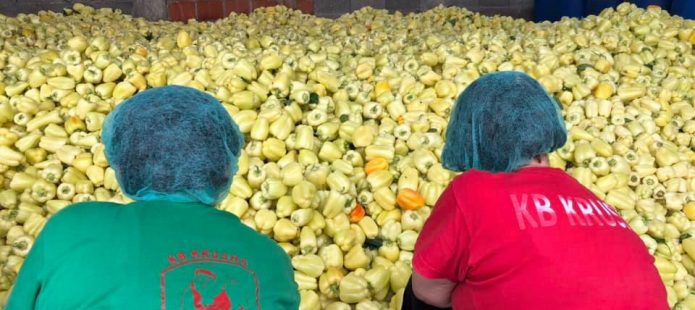
Two women work at the agricultural cooperative ‘Krusha’ producing home made pickles and ajvar in the village of Krusha, Kosovo, November 19, 2024. The agricultural cooperative ‘Krusha’ was established on the initiative of some women, who lost their husbands during the 1998-99 Kosovo war. Photo: Kosovo Ministry of Agriculture/Facebook
In her 2003 book Dark Continents: Psychoanalysis and Colonialism, literary critic Ranjana Khanna argues that the historical belittling and humiliation of fathers leads to colonial melancholia at the collective level. For her, a nation cannot fully mourn its sovereignty and the authoritative fathers it lost, because the international order that partially remedied those losses never acknowledged them as losses in the first place. The loss is incorporated rather than mourned and in turn becomes part of the nation’s self-image.
Baba steps into this melancholic structure. Kurti does not only perform sovereignty for a domestic audience, as Fanon’s national leader does. He performs the recovery of what was lost: the Albanian father who stayed, who provides, who decides without asking permission from Belgrade, or Brussels, or Washington. The affection in baba is a melancholic attachment of what Kosovars have never been fully permitted to grieve.
Kurti’s fatherly figure is ever more evident in his relationship with the Kosovar diaspora. Since his first coming to power in 2019, his successive governments’ rhetorical and political investment in the diaspora have been noticeable. Various government bureaus and departments for diaspora affairs were formed, the government enabled the diaspora vote in the consulates of Kosovo around the world, not to mention Kurti’s—and his cabinet’s—frequent visits to Kosovar communities in Europe and North America. The reward has also been noticeable, with over 80% of diaspora votes going to Kurti’s candidacy as prime minister.
In May 2026, his government allocated €3 million to subsidize car insurance expenses for diaspora members “who come to Kosovo by car in the summer.” In the same month, the government issued another €2 million to subsidize flight routes for the diaspora. Given the snap elections taking place on June 7, this was in effect paying partially for the diaspora’s literal journey home in time to vote.
The diaspora is elsewhere. Like a distant father courting affection from afar, he spends public money to make himself felt where he is absent, while the ordinary instruments of presence at home—a transparent budget, parliamentary consultation, and accountable governance—are missing or arrive too late, year after year.
In this sense, Kurti has taken the script of Albanian Gastarbeiter fathers and voluntarily re-enacted its emotional structure at the level of the nation, as though absence itself were proof of fatherly devotion rather than its failure.
Kosovars, especially among the diaspora, do not need to be taught that an absent father can still be a loving and authoritative one. An entire generation’s mothers taught them this by necessity.
Here, baba slots into a forgiving cultural form, which is in part why the nickname has stuck affectionately, despite facts that on paper should embarrass it.
Baba, the patriarch
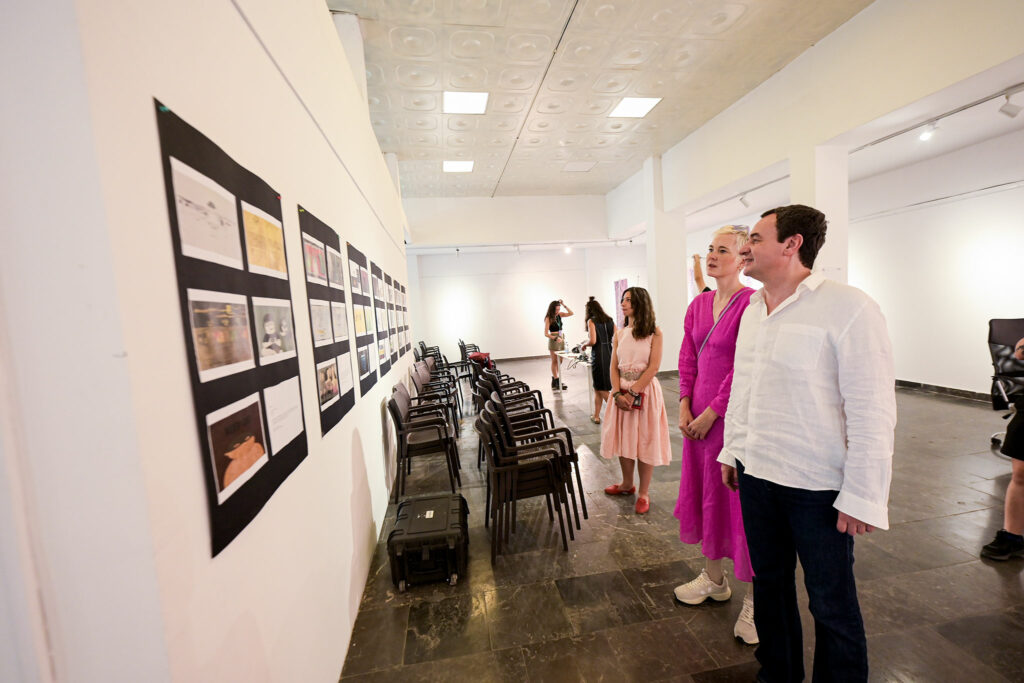
Kosovo acting PM Albin Kurti and his wife, Rita Augestad Knudsen, July 2024. Photo: Kosovo PM Office
Writing in the interbellum period, in his 1936 Studies on Authority and the Family, German philosopher Max Horkheimer argues that the bourgeois family with the father at its head is the very site where societal authority becomes internalized. For him, the family does not just reflect the authoritarian structure of capitalist society; it manufactures obedience, anxiety, and a craving for strong leadership that later submits to authoritarian politics.
In public, Horkheimer’s father is weakened by impersonal market forces, something he compensates for theatrically in his domestic authority. Fanon would also read Kurti’s enactment of paternalistic policy as quintessential to the post-colonial elite: a man whose real sovereignty is conditional, performs theatrical decisiveness at home because he cannot perform it abroad without permission.
In The Sexual Contract, written in 1988 by British political theorist Carole Pateman, the author argues that the “original contract” described by the founders of European political theory (Hobbes, Locke, Rousseau) is always shadowed by a sexual contract: an agreement among men about access to and authority over women, as a precondition for the public contract to function.
When a modern political leader is (self-)referred to as baba and exercises paternal command over the economy and society, it signals exactly the kind of pre-contractual, household-style authority being reinstated.
For example, Kosovo’s law on gender equality obligates public institutions to practice gender-responsive budgeting. Yet, as shown by the NGO Kosovo Women’s Network, the 2026 budget law contains no gender-sensitive annexes and no gender budget statement. The budget domestic violence shelters remains frozen at the previous year’s level, no funding has been allocated for a crisis center for rape survivors, and no budget provision has been made for a national emergency hotline for gender-based violence survivors, despite existing government commitments to fund both.
At the same time, the draft Civil Code provision that would have recognized civil unions between people of the same sex failed repeatedly to pass parliament, leaving the family as a legally and administratively patriarchal institution sitting at the literal center of how the state organizes care.
A number of state bureaus, and now an entire Ministry of Labour, Family and Liberation Values, are built explicitly around the family as the unit through which welfare, protection, and belonging are administered. The compression of labour, family, and liberation values into a single ministry, by a party that nominally calls itself left, is problematic.
Elsewhere in Europe we have seen the proliferation of ministries for the family. From Erdoğan in Türkiye to Orbán in Hungary to Kaczyński in Poland, these are gestures of conservatism and authoritarianism that use the return to the traditional heterosexual family as a political scapegoat. The company is telling.
Nowhere does the gap between Kurti’s personal biography and his public governance of other people’s reproductive lives become more glaring than in his pro-natalist policies.
In 2021, his government launched a postpartum benefit of €325.9, paid over six months to unemployed mothers or over three months to employed mothers, funded from the state budget as part of the Economic Recovery Package’s “Family Support” measure.
On May 25, 2026, less than two weeks before the elections, this sum was increased to 500 euros. IMF reports that Kosovo’s female labor force participation ranks among the lowest globally – below 20% – resulting in a substantial gender participation gap. The main reason reported for barriers to employment among women appear to be family and care responsibilities.lead
In 2024, the government allocated a monthly child benefit of €30 per child in families with two children, up to 16 years old, rising to €45 per child in families with three children. During the election campaign for February 2025 elections, Kurti also enthusiastically floated the idea of introducing some form of welfare support for mothers-in-law (but not fathers-in-law) who care for their grandchildren while the parents are at work.
These policies and promises preside over a political culture in which the question of who reproduces, how, and under what conditions is treated as a matter of national urgency.
Moroccan writer Fatima Mernissi explains that the state manages women’s unpaid labour through the generations without ever questioning why that labour falls to women in the first place, or why the man nominally at the head of both the household and the nation is exempt from its daily demands.
Much like baba himself.

Coal power plants in Obilic, Kosovo, February 2, 2026. Photo: BIRN/ Fatrion Ibrahimi
Most importantly, the government paying €30–45 a month to reward a child’s existence has done remarkably little to secure the conditions of that existence once it begins.
Nearly the entire child population of Kosovo—some 99%, per the Atlas Institute—breathes air below the World Health Organisation standards. In the schools where they spend their days, more than half of classroom-days in the depth of winter fall below the WHO’s minimum indoor temperature, with recorded lows near freezing.
Moreover, the debate over a bill to allow unmarried women to seek IVF, and to reduce its cost for couples, sharpens this further. It was largely opposed by several of the members of Kurti’s party Vetëvendosje, who were vocal critics of unmarried women accessing IVF on the grounds that it would “threaten” the institution of family and Albanian national identity.
The implicit argument is that reproduction is legitimate only when it occurs inside the patriarchal household, inside the structure that the absent father nominally heads and the present mother actually runs.
Unmarried women seeking IVF are a threat because they would be refusing the terms on which the post-colonial recovery fantasy is organized. Unsurprisingly, no equivalent scrutiny was directed at the absent Albanian fathers of the 1960s onward, at a time when procreation was considered quintessential to both resistance and liberation.
A final glaring example of baba as patriarch is Kosovo’s National Security Strategy 2022-2027, which makes no mention of gender-based security and is silent on the rising tide of gender-based violence. A ruling elite that does not see gendered violence as a security matter has already decided that the nation it protects is imagined as a male-headed household.
In fact, the only occurrence of the words “women” or “female” in the document, beyond employment statistics, comes at the very end, when women, much like men and children, are called upon to protect what is otherwise an inherently patriarchal state structure.
A scared baba
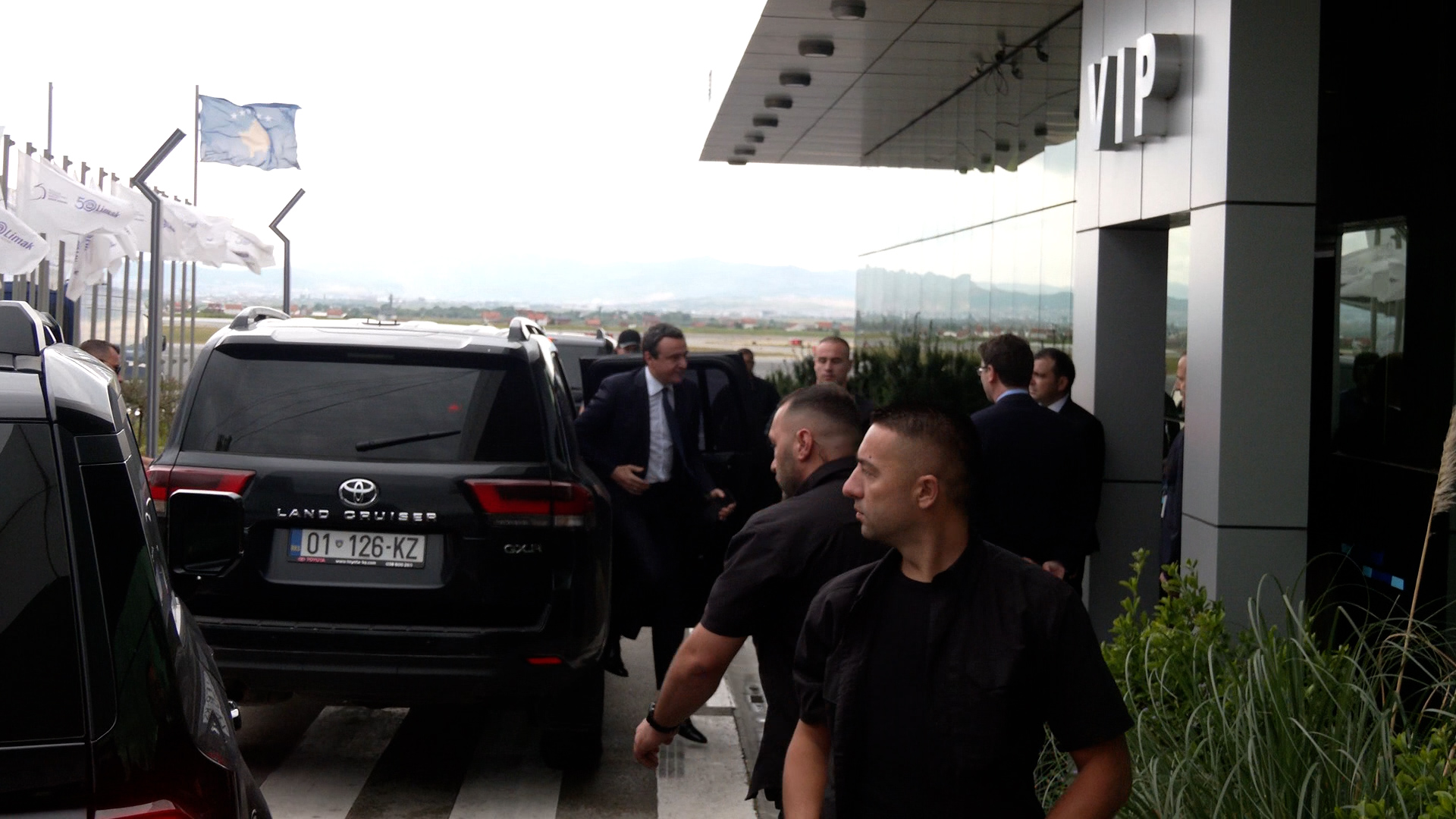
Kosovo acting PM Albin Kurti getting out of the official car, July 22, 2026. Photo: BIRN
Kurti is usually elected with around fifty percent of the vote, a showcase of the kind of public love a father might be expected to feel secure in. And yet, as his critics rightly point out, he is available to local media only on his own terms; he moves through his own capital behind armored glass, surrounded by bodyguards, sealed inside black jeeps.
Much like Kurti himself did while in opposition, when he vocally criticised such gestures by state leaders, Kosovars correctly read this as a sign of a leader’s distance. The question almost asks itself: who is baba afraid of?
In Fyodor Dostoevsky’s Brothers Karamazov, the elder Karamazov’s murder is committed not by the sons he ignored in the ordinary sense of neglect, but by the illegitimate child he never even acknowledged as a son, kept on the margins of the household, doing the family’s dirty work.
Baba’s fear can be read toward the constituencies his paternal claim never named in the first place: the women in budgetary and development policies; the women threatened and violated by their partners; the ethnic minorities excluded from the nation’s children rhetoric; the individuals who have the right not to procreate.
A man whose sovereignty is genuinely self-grounding does not need so much protection from the people he governs.
The glass and the guards are indicative of what the text message sent to Kosovar students tries to conceal: that the paternal authority being performed is borrowed rather than sovereign, conditional rather than self-grounding, and dependent on the approval of fathers elsewhere who could, at any moment, withdraw it. What appears to be the confidence of a man who answers to no one is, on closer inspection, the posture of a man whose authority ultimately depends on the approval of more powerful actors abroad.
Kosovo has spent seventy years learning to love men who are elsewhere. It has not yet been given the kind of schools, elderlycare, roads, childcare, gender-sensitive budgets, and rule-bound welfare state that would make that love unnecessary. Until it is, the seat at the head of the table will remain set, the text messages will keep arriving three days before the election, and baba will keep being somewhere else in every sense that matters.
Vjosa Musliu is associate professor of international relations at Vrije Universiteit Brussel (VUB) in Belgium teaching International Political Economy. She is author of the book “Girlhood at War: Interpreting War and Liberation in Kosovo”.
The opinions expressed are those of the author and do not necessarily reflect the views of BIRN.