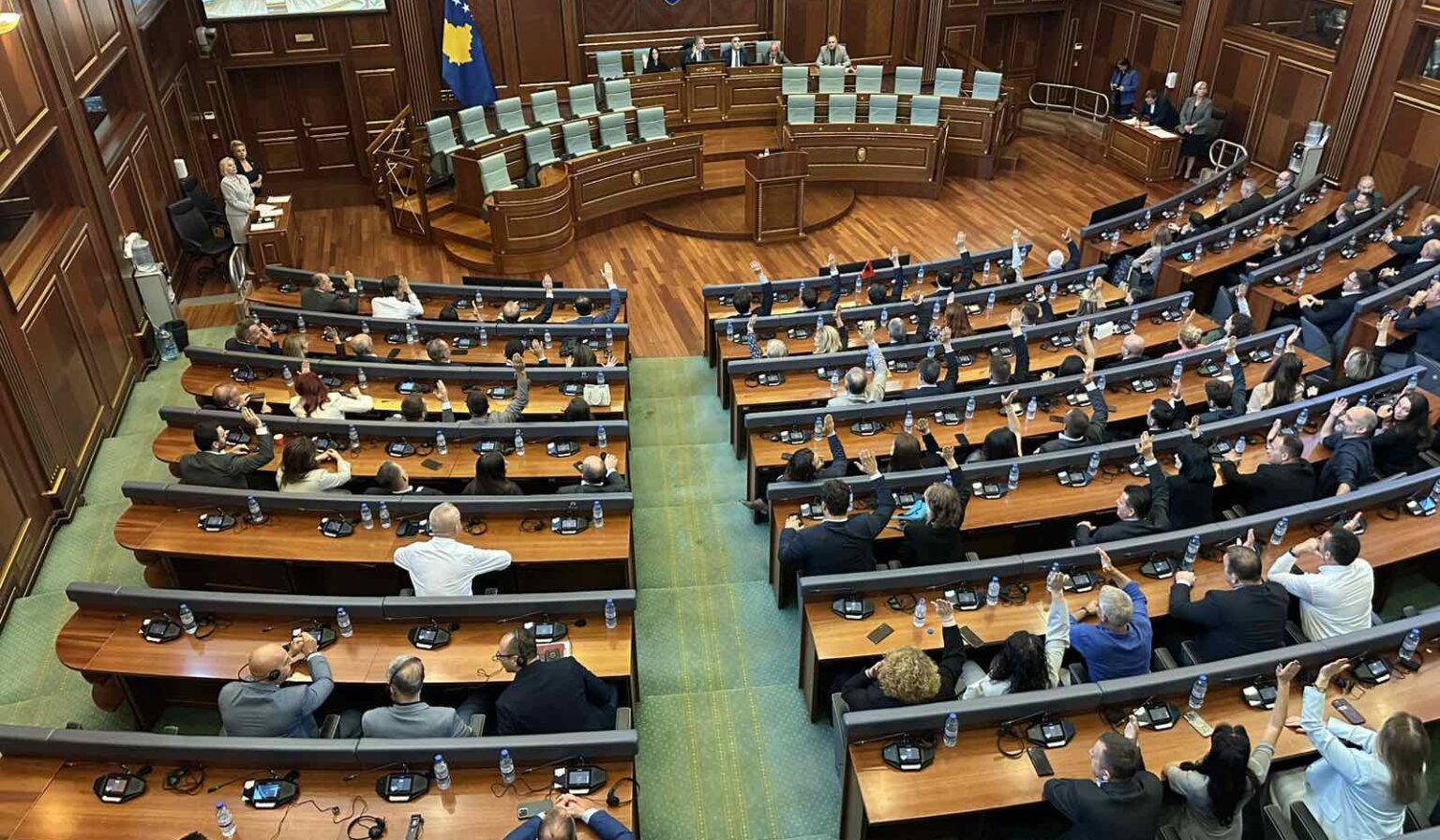
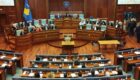
 Kosovo MPs vote for the Speaker of Parliament on August 26, 2025. Photo: BIRN
Kosovo MPs have voted Dimal Basha as parliament speaker. But the five-month long political logjam continues, due to a failure to elect a deputy speaker from the Serb community.
Dimal Basha, a Vetevendosje MP, was elected as Kosovo’s parliament speaker on Tuesday – but his election did not see the end of nearly five months of institutional deadlock.
Basha, 45, received 73 votes in favour and 30 against, while eight abstained.
It took two Constitutional Court verdicts and 57 interrupted sessions since April 15th for the winning party in February’s parliamentary elections, Vetevendosje, to finally find a candidate who would receive enough support among all MPs.
“I call for cooperation and unification. It is time to prove that despite political differences, we have the courage and wisdom to work together for the future of our country,” Basha told MPs after the vote.
Basha is the fifth candidate proposed by Vetevendosje, after Albulena Haxhiu, Donika Gervalla Schwarz, Arberie Nagavci and Hekuran Murati all could not reach enough votes. When Basha was first proposed for speaker on Sunday he did not get the necessary 61 votes. But he did so two days after.
Albulena Haxhiu, former Justice Minister in Kurti’s cabinet, was voted as deputy speaker, together with Vlora Citaku from PDK, Kujtim Shala from LDK and Emilija Redzepi as representatives from Bosniak, Turk, Roma, Ashkali and Egyptian MPs.
But the parliament has not been formally inaugurated yet as the MPs have failed to elect a deputy speaker from the Serb community, a position which is guaranteed by the constitution.
The candidate proposed from the Belgrade-backed Srpska Lista, Slavko Simic, did not get the necessary votes in three rounds. When his name was proposed for a fourth time, the new speaker did not allow the vote, citing the Constitutional Court’s verdict on August 18, which stipulated that no candidate for speaker can be nominated more than three times.

Basha maintained that the same rule applies for the election of the deputy speakers, but Srpska Lista’s MP Igor Simic did not agree and insisted on Slavko Simic’s candidacy.
When Srpska Lista refused to give the name of another candidate, Basha introduced candidacies by drawing among Serb MPs, but three of those who were proposed did not get enough votes. The session consequently was interrupted and will continue on Thursday.
An election of a speaker and the full quota of deputies would have opened the way for the country’s President, Vjosa Osmani, to hand Vetevendosje the right to elect a new government. But with 48 MPs in the 120-seat parliament, its leader Albin Kurti would need to enter coalition agreements with other parties.
“For several months, this parliament has been facing a challenge we have not experienced before, but let’s not forget that, despite all the battles, it is a lesson which has served democracy and the emancipation of our society,” Basha said in his address to MPs upon his election.
“These confrontations can be found even in developed countries, therefore it is important that everything has happened within the frame of democratic debate,” he added.
Most of the PDK MPs voted in favour of Basha’s candidacy as part of their stance to vote for any Vetevendosje candidate who did not serve as a minister in Kurti’s cabinet during his last term in office.
“This would have been positive news and, in principle, it is,” Memli Krasniqi, head of the second biggest party, PDK, told the media after the vote.
“In a normal situation we would never vote for someone like Dimal [Basha] but today we have voted to unblock the situation and to keep our public stance,” Krasniqi added.


26 August 2025 - 16:59
Albin Kurti's ruling Vetevendosje party pledges to appeal to the Const...
Kosovo has entered uncharted legal territory after parliament failed t...
Kosovo PM Albin Kurti first came to power in a landslide win in 2021, ...
Kosovo MPs elected Albulena Haxhiu of Vetëvendosje as speaker, openin...