


The latest BIRN report concluded that weak institutional coordination and legal shortcomings have created an environment where violations of occupational safety and health regulations are inadequately investigated and lightly punished.
Serious workplace safety violations in Kosovo are often met with light punishments because of weak institutional coordination and legal gaps in the justice system, according to a report launched on Friday by BIRN Kosovo, in partnership with the Advocacy Training and Resource Center, ATRC, and the Jahjaga Foundation.
“The problem is that employers continue to escape accountability, even when workers die in the workplace,” BIRN Kosovo director Jeta Xharra said at the launch event in Prishtina on Friday. She also pointed out that gender based discrimination in the workplace is another important issue that has long gone overlooked.
“Women are frequently excluded from employment because of maternity leave and such violations remain insufficiently documented,” she said.
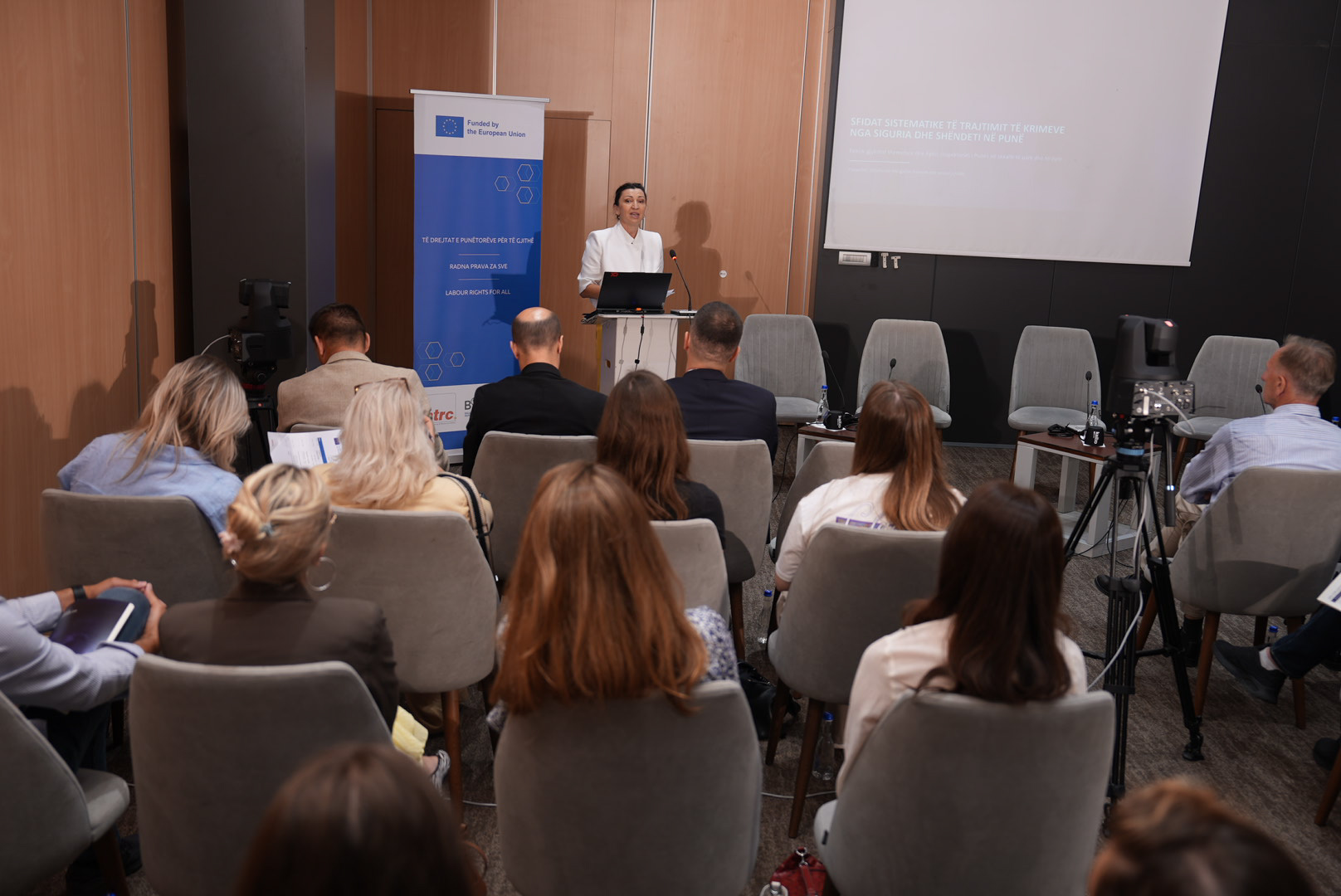
Jeta Xharra, Executive Director of BIRN Kosovo, at the launch of the report Systematic Challenges of Addressing Occupational Safety and Health Crimes in Prishtina on July 3, 2026. Photo: BIRN
The report titled Systematic Challenges of Addressing Occupational Safety and Health Crimes, found that inadequate coordination between institutions, weaknesses in the legal framework, and lengthy judicial proceedings have created an environment in which breaches of occupational safety and health regulations often go uninvestigated and the perpetrators escape accountability.
The construction sector remains among the country’s most dangerous sectors, accounting for the majority of fatal workplace accidents.
Deputy Minister of Labour, Family, and War Veterans’ Values, Agron Dobruna acknowledged that, “although Kosovo’s legislation is largely aligned with European Union directives, implementation remains challenging. The culture of prevention and risk management remains weak, but workers are also still insufficiently informed about their rights”.
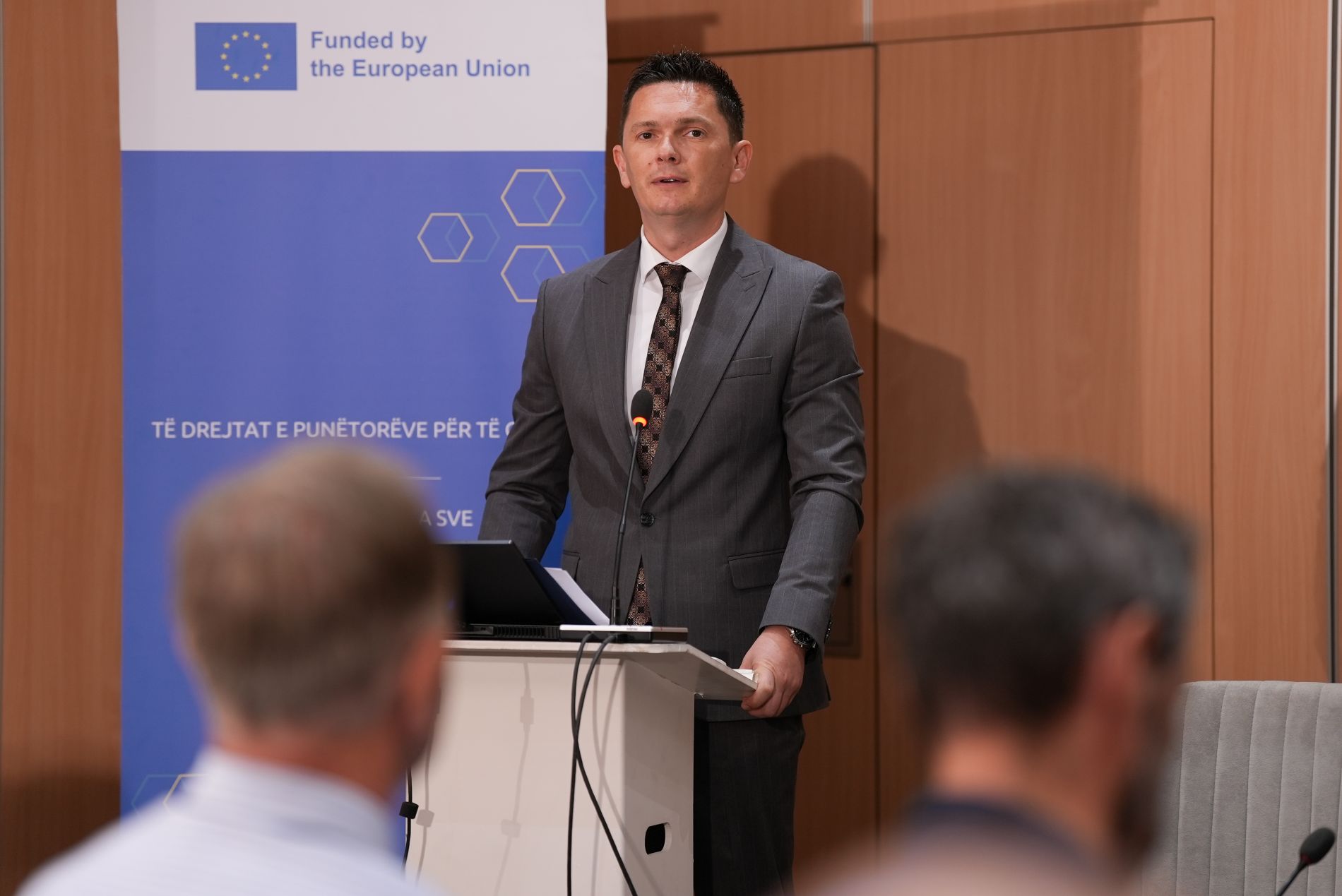
Deputy Minister of Labour, Family, and War Veterans’ Values, Agron Dobruna at the launch of the report Systematic Challenges of Addressing Occupational Safety and Health Crimes on July 3, 2026. Photo: BIRN
Since 2022, more than 500 workers and whistleblowers have shared cases of labour rights violations with BIRN Kosovo. Several cases investigated by BIRN were referred to the Labour Inspectorate, leading to more than 50 joint inspections over the past two years, with dozens of fines.
In 2025 alone, labour authorities imposed 1,747 fines worth a total of 2.78 million euros.
The report, citing official data, explains that between 2023 and 2026, 46 workers died in workplace accidents in Kosovo and 1,709 workplace accidents were recorded. Most fatal accidents occurred in high-risk sectors, particularly construction and manufacturing.
Jusuf Azemi, head of the Independent Trade Union of Private Sector Workers, said the union has recorded “significantly more workplace fatalities than official institutions.” The union claims that 77 workers died in workplace accidents between 2023 and 2026, more than double the official data because the unions calculate the deaths that occurred as a result of workplace injuries and not only those that happened at the workplace.
Kreshnik Gashi, managing editor at BIRN Kosovo and the report’s lead author, warned that many occupational safety violations and deaths do not enter official statistics.
“We have a dark figure that remains hidden outside official records,” Gashi said, highlighting that authorities frequently treat workplace safety offences as criminal cases only after a fatality has occurred.
“Businesses that fail to provide adequate workplace safety are effectively being amnestied. The absence of protective equipment should constitute a violation even when nobody has died,” he said.
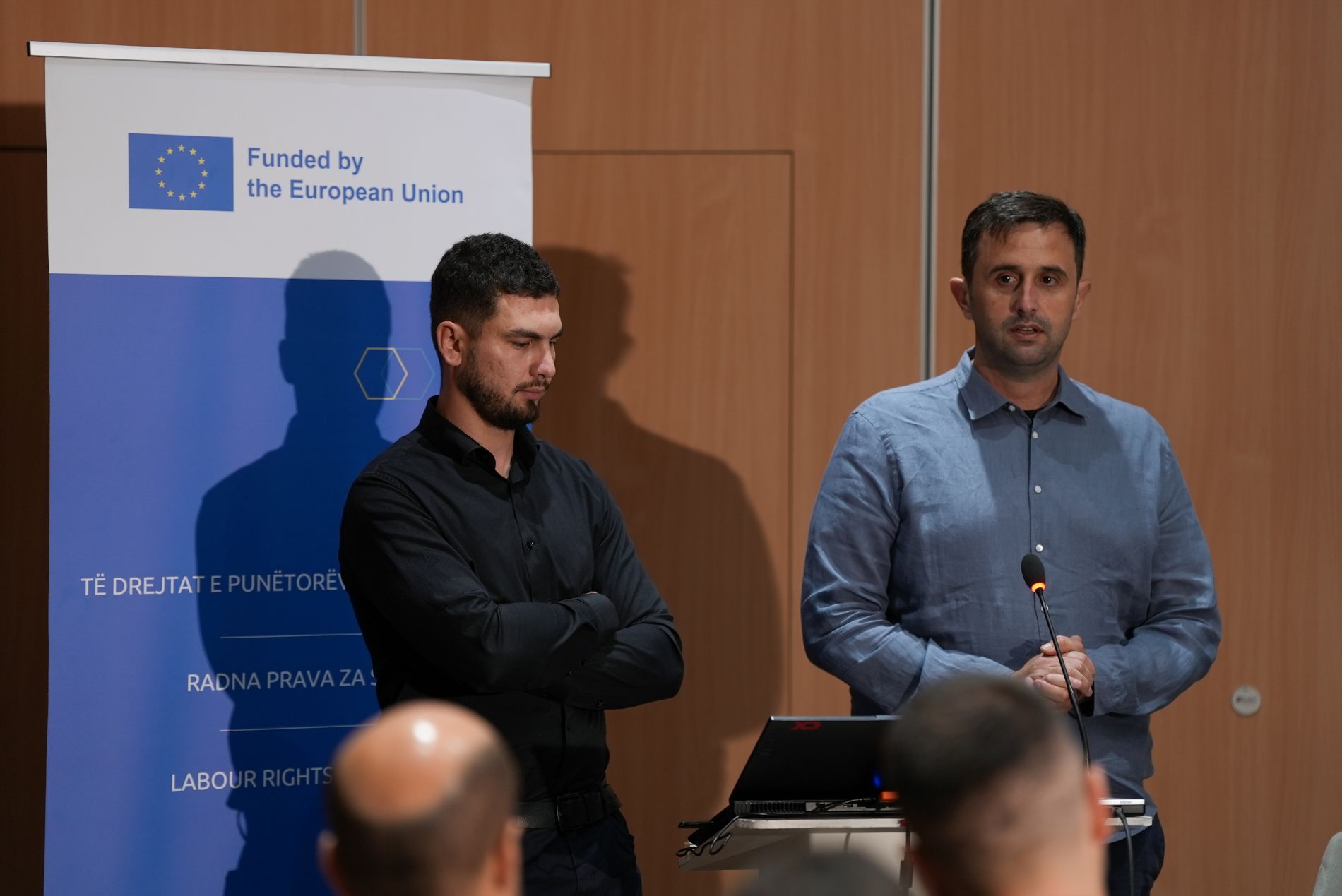
Laurant Berisha (left), legal officer at BIRN Kosovo, and Kreshnik Gashi (right), BIRN Kosovo’s editor-in-chief, at the launch of the report Systematic Challenges of Addressing Occupational Safety and Health Crimes on July 3, 2026. Photo: BIRN
The report also found that labour inspectors and prosecutors often work independently, with inspectors failing to involve prosecutors even when they identify criminal workplace safety violations.
As part of the research, BIRN analysed 37 criminal court judgments concerning workplace injuries and deaths. Of those, 35 resulted in convictions. However, courts placed significantly greater emphasis on mitigating circumstances than aggravating ones, contributing to lenient sentences.
According to the report, injured workers or the families of deceased workers wait an average of three and a half years for a first-instance judgment, while final legally binding decisions take approximately 42 months.
Of the 37 cases analysed, only three resulted in effective prison sentences of one year and six months, while just one of them included an additional ban on exercising a profession.
“The time needed to obtain a final judgment is excessive and undermines victims’ rights to timely compensation,” Gashi said, criticising the widespread use of plea agreements between prosecutors and employers.
“This is not fair to the victims. Once the employer reaches a plea agreement with the prosecution, the victim has no right to appeal the sentence,” he added.
The report also documents repeat offenders among employers who repeatedly violate occupational safety regulations.
“The reason there are repeat offenders is that penalties remain too low,” Gashi said.
Co-author of the report Laurant Berisha said the analysis identified an “imbalance in judicial reasoning, with courts consistently giving greater weight to mitigating than aggravating circumstances”.
Judge Burim Ademaj, commenting on plea agreements, said courts cannot reject agreements solely because they involve an admission of guilt.
However, he expressed concern over sanctions imposed on companies.
“What concerns me is how legal entities are being punished. Kosovo has legislation that provides for substantial penalties against companies, but the sanctions imposed in practice remain low,” Ademaj said.
Note: The report was produced with financial support from the European Union under the project “Labour Rights for All.” The contents of the report are the sole responsibility of BIRN Kosovo and do not necessarily reflect the views of the European Union.