


Kosovo will be represented at the 61st La Biennale di Venezia in 2026 by ‘Hard Teeth,’ an installation by artist Brilant Milazimi that examines waiting as a political and psychological condition shaped by uncertainty.
A 17 metre long landscape painting, picturing a dense sequence of closely huddled, waiting figures, titled ‘Hard Teeth,’ symbolising uncertainty and waiting, will be exposed for several months at the Santa Maria del Pianto Church in Venezia as part of the Venice Biennale.
At a press conference held on Wednesday, the Kosovo Pavilion unveiled its curatorial concept for the 2026 Biennale. The country will be represented by ‘Hard Teeth,’ an installation by artist Brilant Milazimi, curated by José Esparza Chong Cuy.
At the 2026 edition of the Biennale, the Kosovo Pavilion explores the theme of waiting as both a political and psychological condition. The composition reflects decades of a life marked by instability, because of political transition, contested international recognition, and a prolonged state-building process.
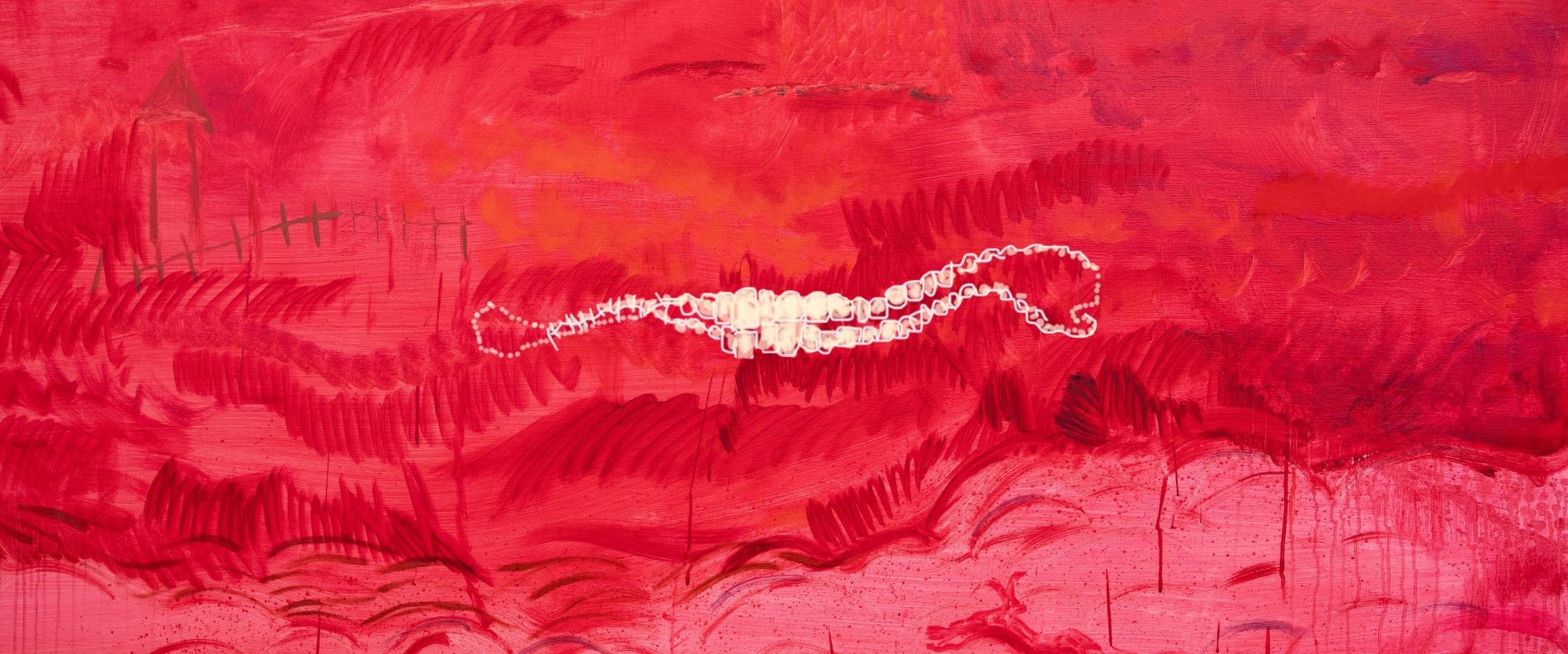
“Hard Teeth”, installation by Brilant Milazimi, part of the Kosovo Pavilion at the Venice Biennale 2026. Photo: Kosovo Pavilion
Brilant Milazimi, 32, from the eastern city of Gjilan, described representing Kosovo at the Venice Biennale as a “significant personal and professional milestone.”
“Artists from smaller countries like Kosovo are often expected to explain themselves, to produce clear and easily readable narratives. That has never been my ambition,” Milazimi said. “I want to create works that stand firm in their stillness, creating a space where others can enter and remain—a space that resonates beyond individual experience and conveys emotion without being explanatory.”
According to the curatorial team, ‘Hard Teeth’ examines waiting, not as a metaphor, but as a structure that shapes life and time in contexts defined by uncertainty, displacement, and the unfinished bureaucracies surrounding Kosovo’s sovereignty.
Nora Arapi-Krasniqi, an advisor at the Ministry of Culture, described the participation in the Vienna Biennale as an important step in strengthening Kosovo’s international cultural presence.
“Culture remains one of the main pillars of state representation.”
Curator José Esparza Chong Cuy shared details about the origins of the project, recalling his first encounter with Milazimi’s concept in Prizren, while the artist was preparing work for the Autostrada Biennale.

José Esparza Chong Cuy at the press conference on the curatorial concept of “Hard Teeth” on February 11, 2026. Photo: Kosovo Pavilion
“I noticed a small sketch in his notebook—a long line of people across mountainous terrain—and that opened a door,” the curator said.
“From that initial drawing emerged broader questions: Who waits? Why do they wait? Who moves freely, and who [moves] only after permission is granted?”
According to Esparza Chong Cuy, ‘Hard Teeth’ grew out of these conversations and from the understanding that waiting, particularly in politically complex contexts, is never neutral.
“In the long corridors of history, waiting is not just passive,” he said. “It is a political and psychological condition—a form of time shaped by documents, borders, and denied recognition.”
He noted that, globally, millions of people wait in lines to flee war, cross borders out of necessity, or seek asylum, often uncertain of what awaits them.
In Kosovo, he argued, “waiting has carried a distinct meaning, shaped not only by war and displacement but also by the prolonged delay in achieving full international recognition.”
“Sovereignty has often been experienced through documents that do not arrive and borders that do not open,” he said. “To wait in Kosovo has meant living in a country that exists, yet is continually asked to justify its existence.”
According to the curator, this prolonged condition has shaped a collective psychological awareness: that recognition, once granted, is never guaranteed.
“Teeth are not simply a motif in Brilant’s work,” says Esparza Chong Cuy. “They are a register. Teeth keep records. They preserve the evidence of time—stress, hunger, habit, pressure. They are both bone and memory. A life interpreted in a jaw.”