


Four former KLA leaders will learn their fate on Wednesday, when the Kosovo Specialist Chambers in The Hague delivers its first-instance verdict in their war crimes and crimes against humanity case.
After nearly six years since their arrest and transfer to the Detention Unit of the Kosovo Specialist Chambers in the Hague, four former leaders of the Kosovo Liberation Army, KLA, – Hashim Thaçi, Kadri Veseli, Rexhep Selimi and Jakup Krasniqi – are awaiting the court’s verdict on charges of war crimes and crimes against humanity.
Their trial, related to Kosovo’s 1998–99 war, began following their arrests and transfer to The Hague, where Special Chambers are located, in November 2020.
The announcement of the judgment was postponed twice. It was initially expected in mid-May 2026 and was again postponed to July 20, 2026. The court later set September 16, 2026, as the date for the set of the first-instance judgment.
On November 4 and 5, 2020, Hashim Thaçi, Kadri Veseli, Rexhep Selimi and Jakup Krasniqi were arrested and transferred to the Kosovo Specialist Chambers’ detention facility in The Hague. Their trial began in 2023.
At the time, Thaçi was President of Kosovo; Veseli was chairman of the Democratic Party of Kosovo, PDK, and a member of parliament; Selimi was head of the Parliamentary Group of the Vetëvendosje Movement and an MP; while Krasniqi was chairman of the National Council of the Social Democratic Initiative.
The four former KLA leaders were charged with war crimes and crimes against humanity. They pleaded not guilty to all charges.
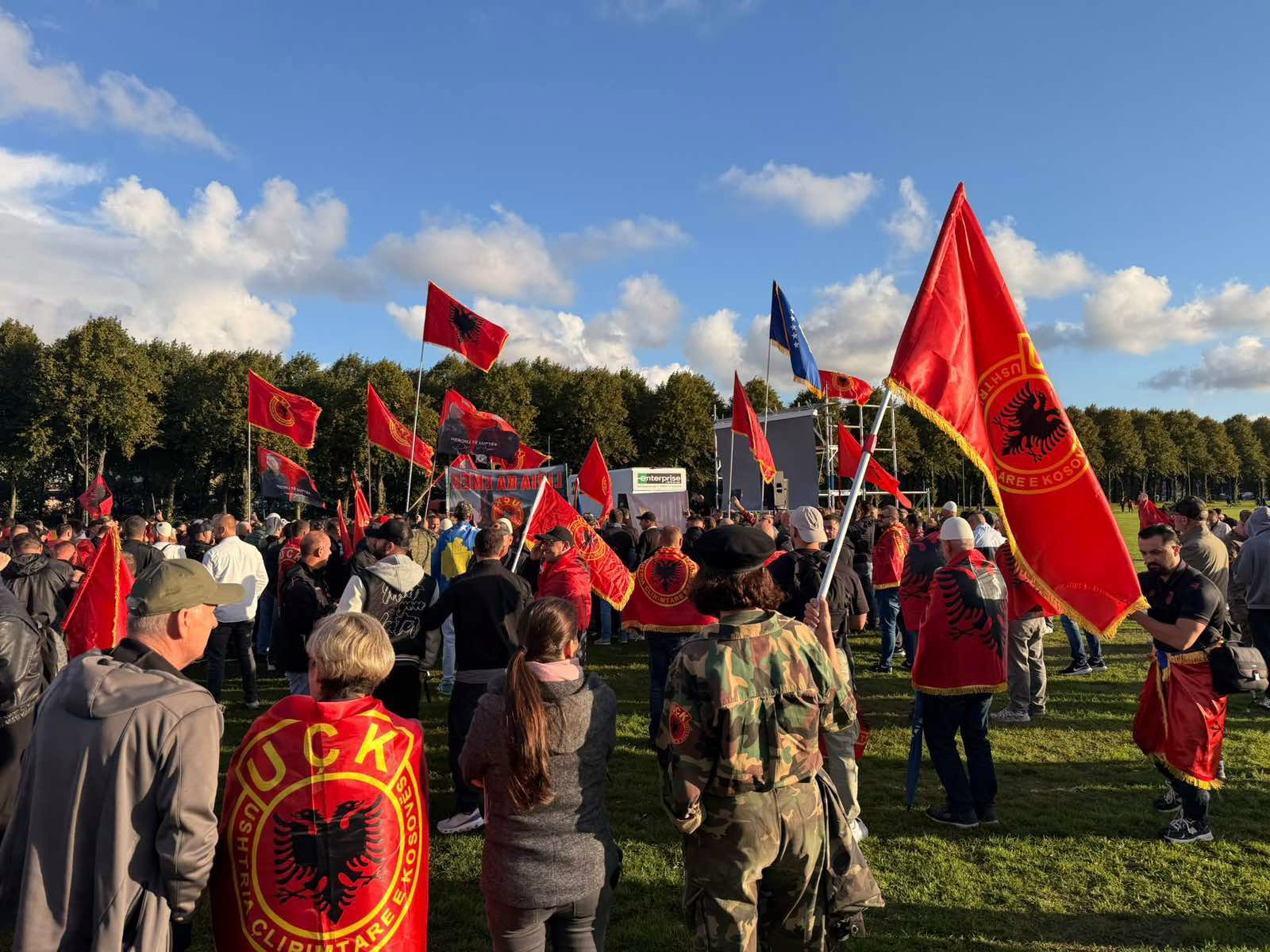
Citizens gathered near the court in The Hague. Photo: BIRN
The indictment against the four was confirmed on October 26, 2020 and made public on November 5, 2020. On September 3, 2021, the Specialist Prosecutor’s Office filed an amended indictment.
Hashim Thaçi was serving as President of Kosovo when the indictment was confirmed. On November 5, 2020, he resigned from the presidency before departing for The Hague.
Thaçi said he would not allow himself to appear before the court as President of Kosovo and that his resignation was intended to protect the integrity of the presidency and the state.
“It is not goodbye, but only see you again. We will emerge with our heads held high and we will see each other again,” Thaçi said in his final address as president on November 5, 2020.
He also said he was proud of his participation in the KLA and of fighting alongside Kosovo’s allies against the regime of Slobodan Milosevic.
Kadri Veseli announced that he would travel voluntarily to The Hague to face the charges, one day after the indictment against him was confirmed.
In his statement before leaving, Veseli said he appreciated the fact that the Specialist Chambers had invited him to appear before the court rather than arresting him. He said he was prepared for a lengthy legal battle to defend himself.
“I appreciate the fact that the Specialist Chambers showed courtesy by sending me an invitation to appear before the court instead of arresting me in an undignified manner. I have responded to this act of courtesy by agreeing to travel this morning to The Hague with representatives of the Tribunal, where I will formally appear before the trial panel to respond to the charges and begin a long process of defence,” Veseli said on November 5, 2020.
On November 4, 2020, Rexhep Selimi said that the indictment against him had been confirmed and that he would travel to The Hague.
Selimi described the indictment as unjust and said before his departure that he would go to The Hague “with his head held high.”
“I am going with my head held high and whenever I return, I will return with my head held high as well, because I was, am and will remain a soldier of the Kosovo Liberation Army, for which I am ready to give everything I have. The ideal of that glorious army stands above me, above anyone, above everything,” Selimi wrote on Facebook.
Jakup Krasniqi was arrested on November 4, 2020, following an EULEX operation at his home. At the time, he was chairman of the National Council of the Social Democratic Initiative. He had previously served as Speaker of the Kosovo Assembly.
During the war, Krasniqi served as a spokesperson for the KLA.
His home in Prishtina was raided in the early hours of November 4, 2020. The operation continued throughout the day, culminating in his arrest and subsequent transfer to The Hague.
Krasniqi was the first of the four to be transferred to The Hague, on November 4, 2020.
During his first appearance before the court on November 9, 2020, Krasniqi strongly rejected the allegation that he had been part of a “joint criminal enterprise.” He said he did not consider himself guilty or responsible for any of the charges in the indictment and denied that he had directed attacks against civilians.
What are the four former KLA Leaders accused of?
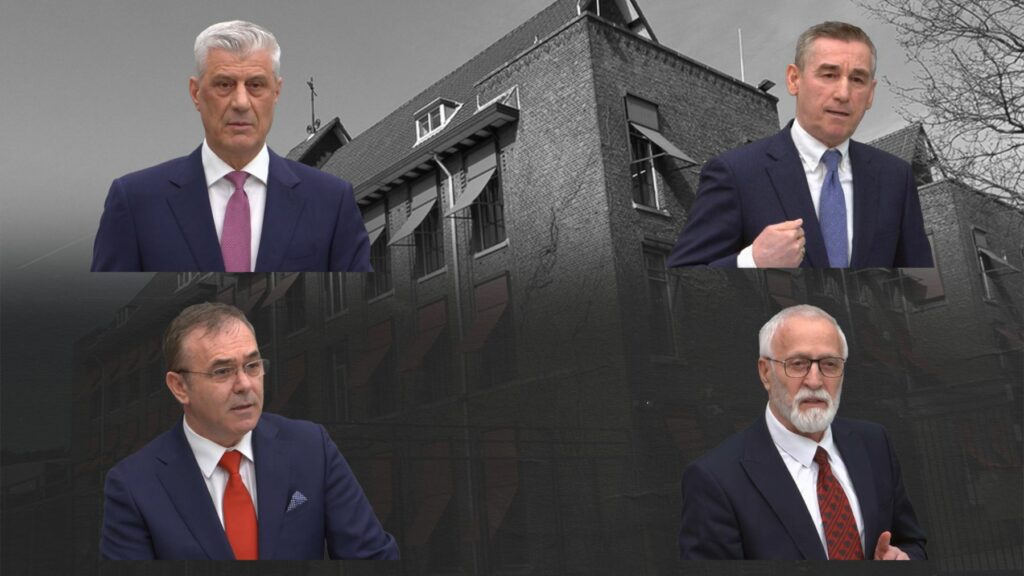
Hashim Thaci (upper left), Kadri Veseli (upper right), Rexhep Selimi (lower left), and Jakup Krasniqi (lower right) in court, February 18, 2026. Photos: Kosovo Specialist Chambers livestream. Montage: BIRN
Thaci, Veseli, Krasniqi and Selimi, are accused of individual and command responsibility as part of a joint criminal enterprise, with a common purpose of controlling Kosovo, for crimes committed against prisoners held at KLA detention facilities in Kosovo and in neighbouring Albania, including 102 murders.
The alleged crimes are said to have been committed between at least March 1998 and September 1999, during and immediately after the Kosovo war.
The defence sought to establish that the KLA did not have a conventional military command structure and that, as a result, the defendants could not be held responsible for crimes allegedly committed by lower-ranking fighters.
During closing arguments in February, prosecutors requested sentences of 45 years in prison for each of the four defendants, citing the seriousness of the alleged war crimes.
According to the prosecution’s final submissions, the applicable sentencing law is the Law on Specialist Chambers, which defines war crimes and crimes against humanity under international law and establishes the applicable sentencing framework. The Trial Panel may impose a maximum sentence of life imprisonment.
Some observers, however, have described the requested sentences as excessively harsh.
Thaçi is also accused, in a separate case involving four other defendants, of obstructing justice and interfering with witnesses. He has pleaded not guilty.
In a new indictment against him, prosecutors alleged that Thaçi disclosed confidential information concerning prosecution witnesses and coordinated with four visitors to his detention cell in The Hague “to unlawfully influence the testimony of those witnesses and/or contact them.”
The trial in the Hague
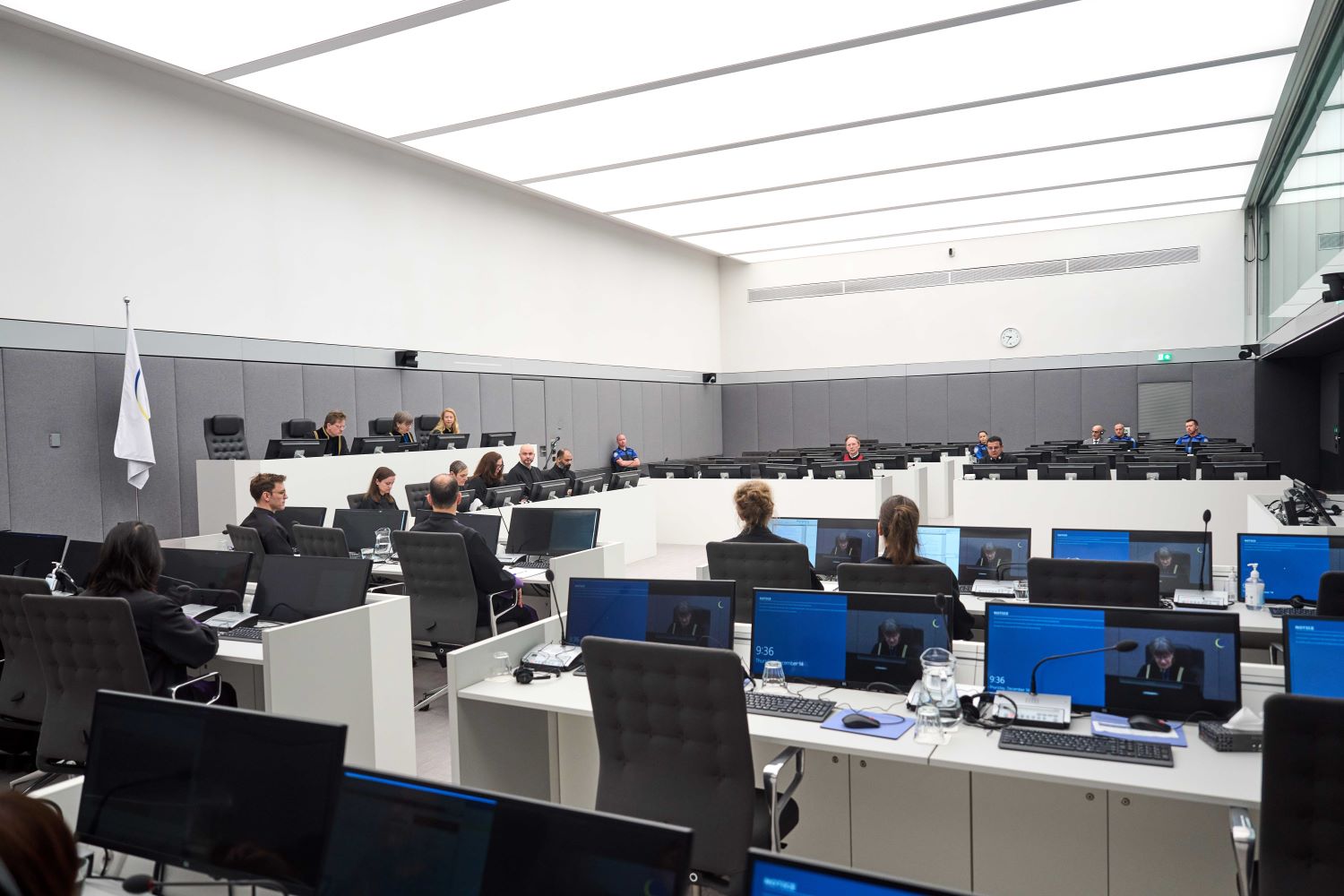
A general view of the Kosovo Specialist Chambers court in The Hague, Netherlands, 14 December 2023. Photo: EPA/PHIL NIJHUIS
The trial of Thaçi and the other defendants lasted 234 days, amounting to more than seven months of courtroom proceedings. The pre-trial phase, from their arrests until the filing of the indictment, lasted approximately 29 months.
Throughout the trial, the defence teams repeatedly requested changes to the detention measures imposed on their clients.
According to the Kosovo Specialist Chambers’ public records, there were 28 decisions concerning Thaçi’s detention. For Krasniqi and Veseli, the records contain 27 detention decisions each, while Selimi was the subject of 26 such decisions.
The September 16, 2026 judgment will not necessarily be the final decision in the case. Any party dissatisfied with the first-instance judgment of the Kosovo Specialist Chambers may appeal to the Court of Appeals.
During closing arguments, prosecutor Matt Halling Matt Halling told the court the accused were founders of the KLA, and “the strong collective role they had as main members of the General Staff” gave them substantial power.
He explained that the defendants used their positions to advance the goals of the
joint criminal enterprise and had command responsibility for the crimes of lower-ranking fighters but also individual responsibility for participating in crimes themselves
However, during the trial, defence witnesses, and some prosecution witnesses, argued the guerrilla force did not have a proper command structure as the prosecution alleges, and the defendants did not have full control over fighters on the ground.
This argument was articulated by well-known witnesses, such as former U.S. Deputy Secretary of State James Rubin and Wesley Clark, Supreme Allied Commander Europe of NATO from 1997 to 2000.
A total of 134 witnesses were heard in court, of which 125 were prosecution witnesses, 2 were victim council’s witnesses, and seven testified for the defence. An additional 138 witness statements were admitted in written form only.
A considerable number of hearings were held behind closed doors.
Angela Griep, a spokesperson for the court, told BIRN that “the Judges can order such protective measures only when, in the particular circumstances of the witness, it is assessed that closed session is necessary to manage the security risks facing the witness
should they testify in public, and after carefully balancing the safety of victims and witnesses and the accused’ right to public proceedings,” Griep explained.
Amer Alija, a lawyer at the Kosovo Humanitarian Law Fund, HLC, which monitors war crimes trials, agreed that the frequency of closed hearings made monitoring difficult.
“For us, as external monitors, it is difficult to assess whether the trial panel had sufficient evidence to support the charges, given that our access to the case files and protected testimony was limited,” Alija said
Griep said that 12 witnesses had testified “fully in private session”, while noting that for those who testified publicly “there could be occasional and temporary private session ordered for the witness’ protection”.
The Specialist Chambers are part of Kosovo’s judicial system, but are based in The Hague and staffed internationally. They were established under pressure from the country’s Western allies, who believed that Kosovo’s justice system was not sufficiently robust to try cases involving the KLA and to protect witnesses from intimidation.
Many Kosovo Albanians believe that the court is biased and denigrates the just war fought by the KLA against Serbian repression.