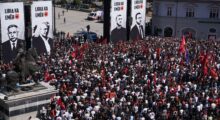
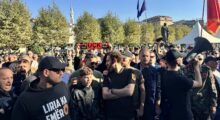
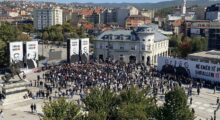
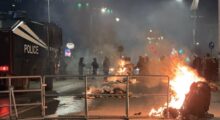
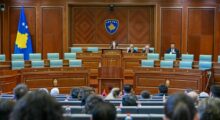
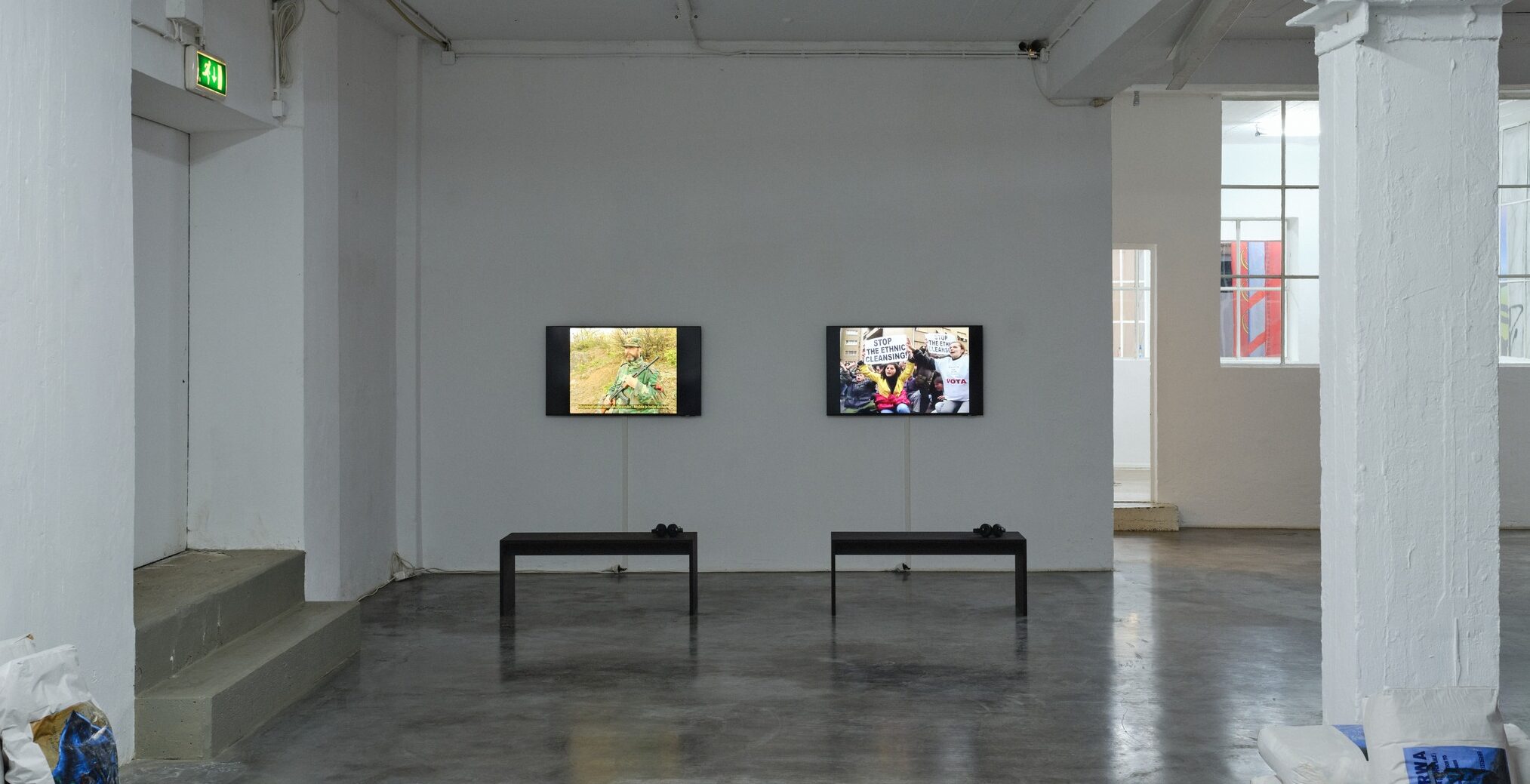
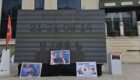
 Work of BIRN's Reporting House showcased at Lothringer 13 Halle, in Munich, Germany, as part of the Antifascism initiative. Photo: BIRN
Journalistic documentation of Kosovo’s civil resistance in the 1980s, which led into the 1998-99 war, from BIRN’s Reporting House museum, is being presented at Lothringer 13 Halle, in Munich, Germany, as part of the Antifascism initiative.
An exhibition showcasing the work of BIRN’s Reporting House museum in Prishtina, Kosovo, dedicated to the memory of Kosovo’s 1980s resistance and the 1998-99 war, opened last weekend at Lothringer 13 Halle in Munich, Germany, as part of Antifascism: Now (2026–2028)—a large-scale transnational art and research initiative spanning 14 countries.
On display until July 31, 2026, the exhibition presents journalistic work from the 1990s by Jeta Xharra, producer of the Reporting House and director of BIRN Kosovo, including an interview with the late Kosovo Liberation Army, KLA, fighter Fehmi Lladrovci. Also on display is documentation by various journalists from the women-led “Bread for Drenica” and “Peaceful Divorce” protests of 1998, which were part of Kosovo’s civil resistance.
“The exhibition in Munich is using art to initiate debate and push for social change on a very urgent topic that concerns us all: the rise of populism, disinformation, nationalism, and the far right,” Xharra noted, adding that the Reporting House documents the rise of nationalism in the 1980s and 1990s in former Yugoslavia so “this topic fits like a glove.”
She also emphasised that, “this initiative is happening in the birthplace of fascism, as Hitler’s fascist movement started operating from Munich in the aftermath of WWI.”
“We are very happy that Kosovo has such a prominent role here and I was particularly amazed to see over 600 people show up to the opening where the curator [Gazmend Ejupi] and myself were invited,” she concluded.
The Goethe-Institute played a central role in connecting the Reporting House with Kalas Liebfried, the artistic director of Lothringer 13 Halle.
Marc-André Schmanchtel, Head of the Cultural Department at the Goethe-Institute Athens, highlighted the regional scope of the project, which involves partners from across all the Western Balkan countries.
“When we see the historical context of what happened in Kosovo, its political and societal dynamic gives relevance to the topic of the exhibition,” Schmanchtel said. “The presence of the Kosovan work in this exhibition right now is very good and it is an important contribution chosen by the curator Liebfried.”
The exhibition also includes the testimony of Donika Shahini, who preserved a child’s school notebook from the battle in the village of Prekaz, where more than 50 members of the Jashari family were killed in March 1998. The notebook has since become a key artefact of the Reporting House.
A dedicated section of the exhibition, supported by the City of Munich, also features the installation Fragments of Survival, which features the work of Gazan artist Hussein al-Jerjawi who painted on flour bags handed out by the United Nations Relief and Works Agency to Palestine Refugees in the Near East. The canvases, born out of necessity during a crisis, were used to express the suffering of the people in Gaza. The installation, curated by Ejupi, first opened in Prishtina at the Reporting House Gallery in June 2025, to bear witness to art, but also to the persistence of life and expression under siege.
On June 26, 2025, al-Jerjawi connected with the Reporting House via Zoom from Gaza. “We were displaced without any belongings. We didn’t have tools or paints. All I had were the flour bags in front of me. I took one and started working on it. I searched for materials and went from person to person to get paints, then I would use their paint and start working on the project,” al-Jerjawi told the audience.
A Walk through Resistance: A Visitor’s Take from Kosovo’s Reporting House
In a declaration for Prishtina Insight, the curator Ejupi considered that the installation of the work of Gazan artist al-Jerjawi brought an urgent, deeply human dimension to the exhibition.
Ejupi highlighted that being part of this innovative programme revealed the strength of the Reporting House’s curatorial vision, bringing together artists, curators, museum directors, and researchers through exhibitions, lectures, and public discussions.
“Reporting House is gaining significant international attention, demonstrating a strong impact through its distinctive approach to curated journalism and the powerful artistic contributions it presents,” he declared. “Through its consistently rigorous programming and engagement with critical global narratives, Reporting House is establishing itself as an influential platform on the international cultural scene,” he added.
The German Embassy in Kosovo supported the museum during its inception.
Reporting House is produced by BIRN Kosovo in collaboration with Prishtina Biennale. Opened in June 2024, the museum combines media archives, investigative journalism, and contemporary art to examine the causes, consequences, and human impact of the Kosovo war.
Through historical documentation and artistic interpretation, Reporting House offers an in-depth reflection on one of the last major conflicts in 20th-century Europe—from the emergence of the KLA and the violence of 1998–99, to NATO’s intervention and Kosovo’s declaration of independence in 2008.


06 February 2026 - 16:30
The daily protests by Kosovo citizens and other supporters of the Koso...
Vaughan Smith, a Kosovo war reporter from the UK, recalls his encounte...
High-profile former Serbian security figures including Jovica Stanisic...
Activists in Kosovo are installing countdown timers counting off the d...