 Photo: BIRN
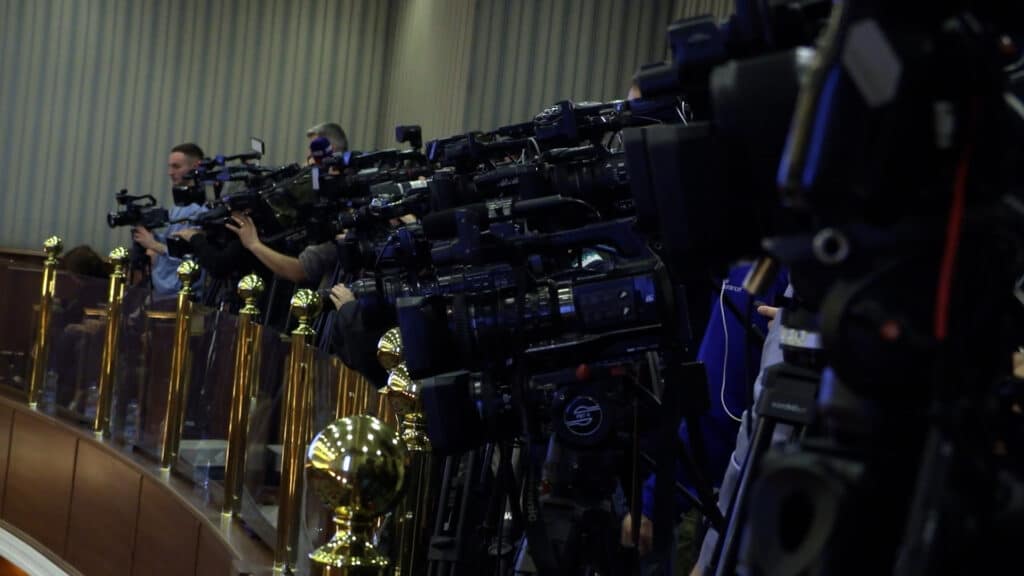
Kosovo has recorded significant progress in media freedom compared to last year, according to the latest World Press Freedom Index by Reporters Without Borders, RSF.
On Thursday the Reporters Without Borders annual index showed that Kosovo has moved up 15 places in the global press freedom ranking this year, following last year’s sharp decline.
The RSF report—which is published annually on May 3rd, World Press Freedom day—shows Kosovo ranks 84th out of 180 countries, up from 99th place in 2025.
“With the exception of Kosovo, which saw an improvement despite remaining one of the lowest-ranked countries in Europe, press freedom in the Western Balkans is generally getting worse,” the report states.
The country scored 55.89 points, an increase of three points from the previous year.
RSF noted that Kosovo’s media regulator, the Independent Media Commission, IMC, “was subjected to a legislative reform judged unconstitutional by the Constitutional Court.”
In April 2025, the constitutional court annulled the law on the IMC, citing several provisions that conflicted with the Constitution. These included issues related to the appointment and dismissal of commission members, the regulator’s competencies, media ownership rules, and certain provisions on sanctions and fines.
The report highlights that journalists in Kosovo continue to perform their duties despite facing political pressure.
“Even though the media succeeds in holding politicians accountable, journalists continue to be the targets of political attacks,” RSF stated.
It also notes that while journalists generally enjoy public trust, independent media and investigative reporters are often subjected to insults and disinformation campaigns on social media.
“They are unfairly accused of “collaborating with the enemy,” rhetoric used by political and religious groups, while adding that, “more and more journalists have been subjected to SLAPPs initiated by business groups and politicians.”
The report includes the BIRN brand among the leading news portals in Kosovo.
“Online news portals include strong brands such as KOHA, BIRN, Kossev or Kosovo 2.0, the latter being one of the few media outlets to publish both in Albanian and Serbian,” the report says.
Regarding media financing, the report states that most outlets in Kosovo rely on advertising revenue from the private sector, while some receive support from local authorities or political parties.
RSF also pointed to a government boycott of certain private media outlets in 2025, ahead of the general elections.
“Several private media outlets were targeted by a boycott from the government, which also threatened the independence of the public broadcaster RTK.”
The Association of Journalists of Kosovo in its reaction noted that, “Kosovo improved its ranking in the Reporters Without Borders Index following the Constitutional Court’s decision on the law on the Independent Media Commission.”
Flutura Kusari, a legal advisor at the European Centre for Press and Media Freedom, also attributed the improvement to the judiciary. She said the progress was “100 percent due to the judicial system.”’
In the region, Montenegro ranked 41st, North Macedonia 45th, Albania 83rd, Bosnia and Herzegovina 90th, while Serbia ranked lowest at 104th place.


30 April 2026 - 13:26

Two Kosovo Serbs pleaded guilty to violating the constitutional order ...

The Basic Court of Prizren has ordered 30 days of pre-trial detention ...
The deputy leader of the governing Vetevendosje said that his party ca...
As the EU awaits final approval for plans to set up ‘return hubs’ ...