


Unresolved trauma and contested histories resurface in media coverage of the Kosovo Specialist Chambers’ verdict against Kosovo Liberation Army, KLA, leaders.
Dorentina Thaçi was just nine months old when the war in Kosovo ended in 1999, having lost her father and several other relatives. Growing up in the village of Krusha e Madhe, where most of the men and young boys were killed and their bodies disappeared, she experienced a childhood marked by deep pain and anger over the failure to bring those responsible to justice.
When she became a journalist, Thaçi had to make “a conscious decision” to keep her personal emotions out of her reporting as much as possible. “It was not easy. But yes, you can maintain emotional distance, even though it is often difficult,” she said.
According to her, choosing journalism means being prepared for all the circumstances the profession may bring. “I have managed to draw a line, so that my personal history does not overlap with my professional life,” she added. But there were many moments that challenged her: “When I realized that the two things might clash, I declined to address certain topics.”
Like many journalists in Kosovo, Thaçi may have struggled to remain emotionally detached when reporting on her own people’s suffering, particularly reporting on the Kosovo 1998-99 war.
Arsim Lani, a journalist and editor at local broadcaster T7 who experienced the war, pointed out that there are moments when, for a journalist, setting aside certain professional principles is permissible and even justified. “This applies when the national interest is at stake,” he argued.
For him, the verdict delivered on September 16 by the Kosovo Specialist Chambers, KSC, against four former leaders of the Kosovo Liberation Army, KLA, was one such moment.
The court sentenced former Kosovo president Hashim Thaçi and three other former KLA leaders — Jakup Krasniqi, Kadri Veseli and Rexhep Selimi — to 25, 25, 18 and 13 years in prison, respectively, for war crimes committed during the Kosovo war.
The verdict was an emotional moment for many journalists reporting from The Hague, where the court is based, and from Kosovo.
“One cannot remain emotionally detached when, as a journalist who has personally experienced the war and Serbian atrocities, you stand in front of a microphone to report on an event related to that war,” Lani said.
In some cases, the line between personal emotions and professional reporting became blurred. Journalists took to wearing wartime symbols and uniforms, posting pictures of themselves wearing them, and joining citizens in the protest slogan “Not in My Name,” objecting to the KSC’s decision to issue its verdict in the name of the people of Kosovo. Some did so in the course of their professional work, others in a personal capacity.
Not just a journalist
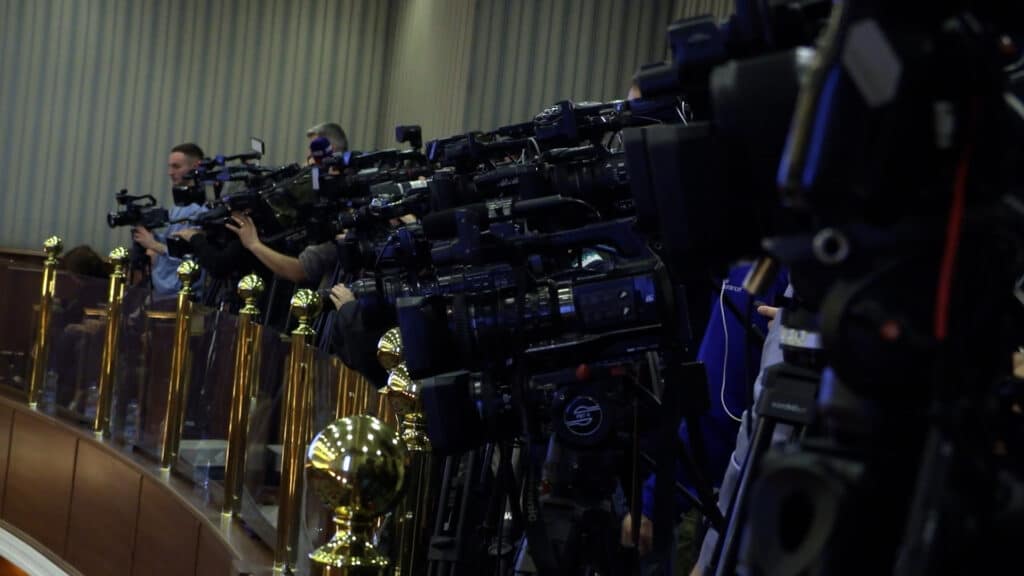
News media camera operators. Photo: BIRN
Lani was one of the journalists who joined the protest against the verdict, taking the stage to speak in support of the KLA. Lani lost family members during the war.
The emotional distance essential to a journalist’s work is often shaken by the fact that the atrocities have gone unpunished and that Serbia has not apologized for the crimes committed in Kosovo, he said.
“I have walked over corpses during the war. On September 16 [the day of the verdict], I couldn’t bring myself to just be a journalist,” he explained. Lani was not reporting that night.
Remzije Shahini-Hoxhaj, a journalism professor at the University of Prishtina, noted that maintaining emotional distance can be difficult when society and the media perceive their own people’s rights and the truth as having been violated.
“As Wilhelm Kempf argues in his theory of peace journalism, it is very challenging for journalists to remain balanced. I believe this challenge has arisen in various historical contexts around the world,” she said. “Before being a journalist, one is a human being with other identities related to their ethnicity, gender, race, or religion, especially when one belongs to a people that has historically been victimized,” she added.
In Kosovo, most media outlets offered largely homogeneous coverage, reflecting the country’s mass mobilization against the court’s verdict.
Festim Rizanaj, a journalism professor at the University of Prishtina, noted that emotionally charged language in some headlines and content covering the KSC verdict may have blurred the line between informing the public and mobilizing their emotions.
“A journalist is also a citizen with natural feelings about their nation,” he noted. “However, ethics require that emotions do not dictate reporting.”
Reporting with emotion
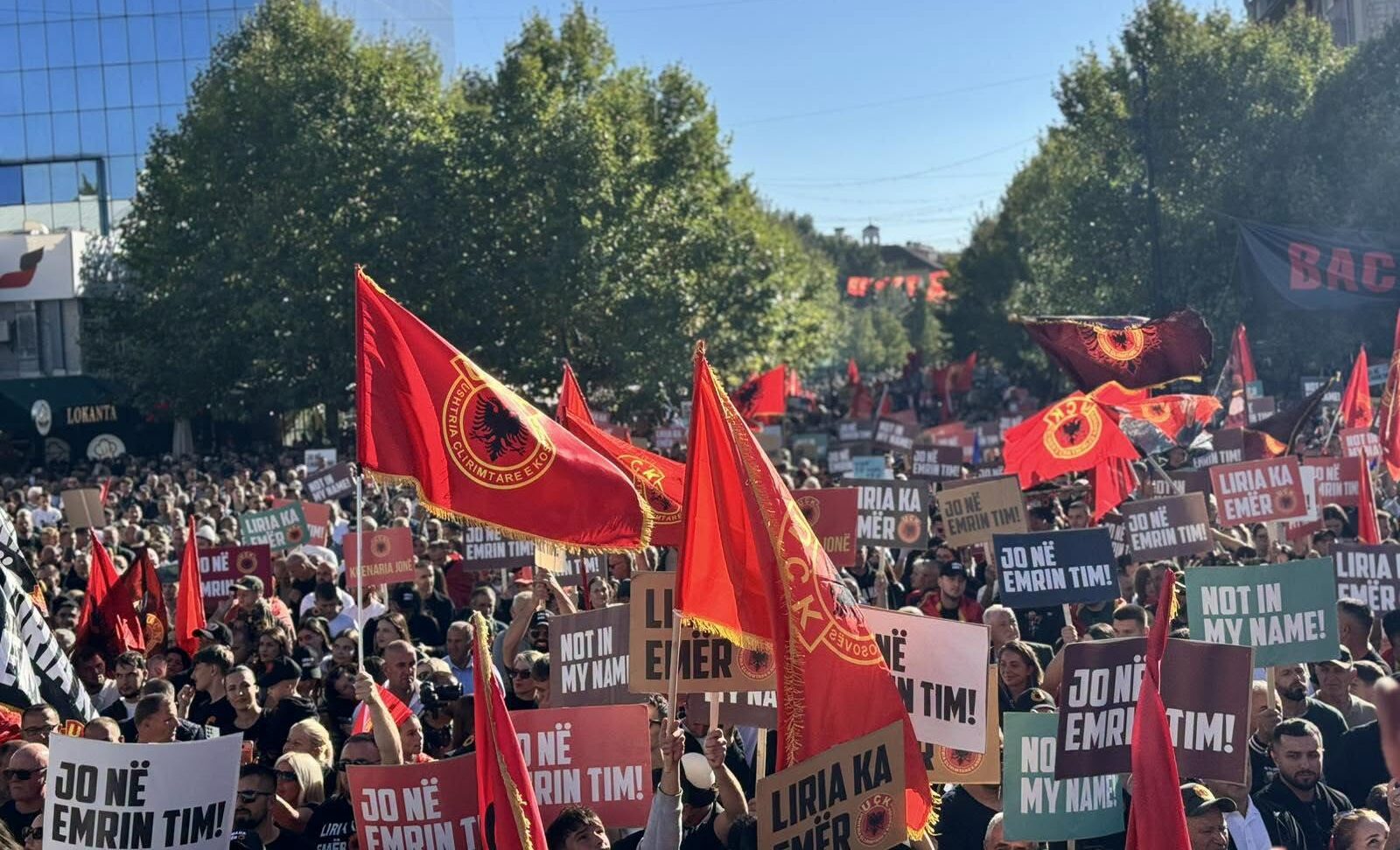
Thousands gather in Prishtina in protest against Hague court verdict, October 1, 2026. Photo: BIRN
In countries that have yet to fully confront their past, emotional reporting often emerges when journalists perceive their national identity as being under attack. This was evident in the coverage of the KSC verdict, which many journalists viewed as criminalizing the struggle for freedom.
Dafina Halili, a journalist and editor at Kosovo 2.0, cited several examples of emotionally charged, dramatized reporting. “Some moments call for reporting free from excessive pathos and emotion, and a judicial ruling is one of them,” Halili argued.
She said that some journalists’ displays of personal emotion made their reporting nearly indistinguishable from influencers’ social media content. “The public needs to understand what was decided, on the basis of what evidence, and for what reasons.”
According to Rizanaj, “a journalist must understand that their primary professional allegiance is not to a national narrative but to the truth and the public. Reporting unpleasant truths is not unpatriotic. Responsible journalism must confront even the painful aspects of one’s own history.”
Against a backdrop of tense relations with Serbia and deep divisions on the region’s past and future, many saw the court’s verdict as rubbing salt in the wounds left by the atrocities committed during the 1998–99 war.
Anna Di Lellio, a New York University lecturer and former international media commissioner under the UN mission in Kosovo, UNMIK, between 2002 and 2004, when the country was under UN administration, believes it is common for journalists to respond to suffering with empathy.
“In this case the question is: to what extent emotion and empathy might cloud judgment and make journalists frame news in a sensationalist, biased, or untruthful way?” Di Lellio asked. “I am not sure we need to demand emotional distance when journalists cover people’s suffering.”
Looking back on her time as head of the Temporary Media Commissioner, TMC, in Kosovo’s postwar media environment, Di Lellio sees the same emotional intensity persisting in today’s media. “Newspapers liberally used the insults ‘traitors’ or ‘spies’ to attack opponents or settle accounts from the pre-war and war periods,” she recalled.
The language used by some journalists reflected the emotional dimension of reporting on an event that is widely perceived as an attack on the truth about Kosovo’s history, amid collective anger.
“That is why I see ‘distance’ as a professional approach journalists should maintain, even when emotions run high. It begins with the simple discipline of verifying information before publishing or speaking about it,” Halili said.
Journalists without flags
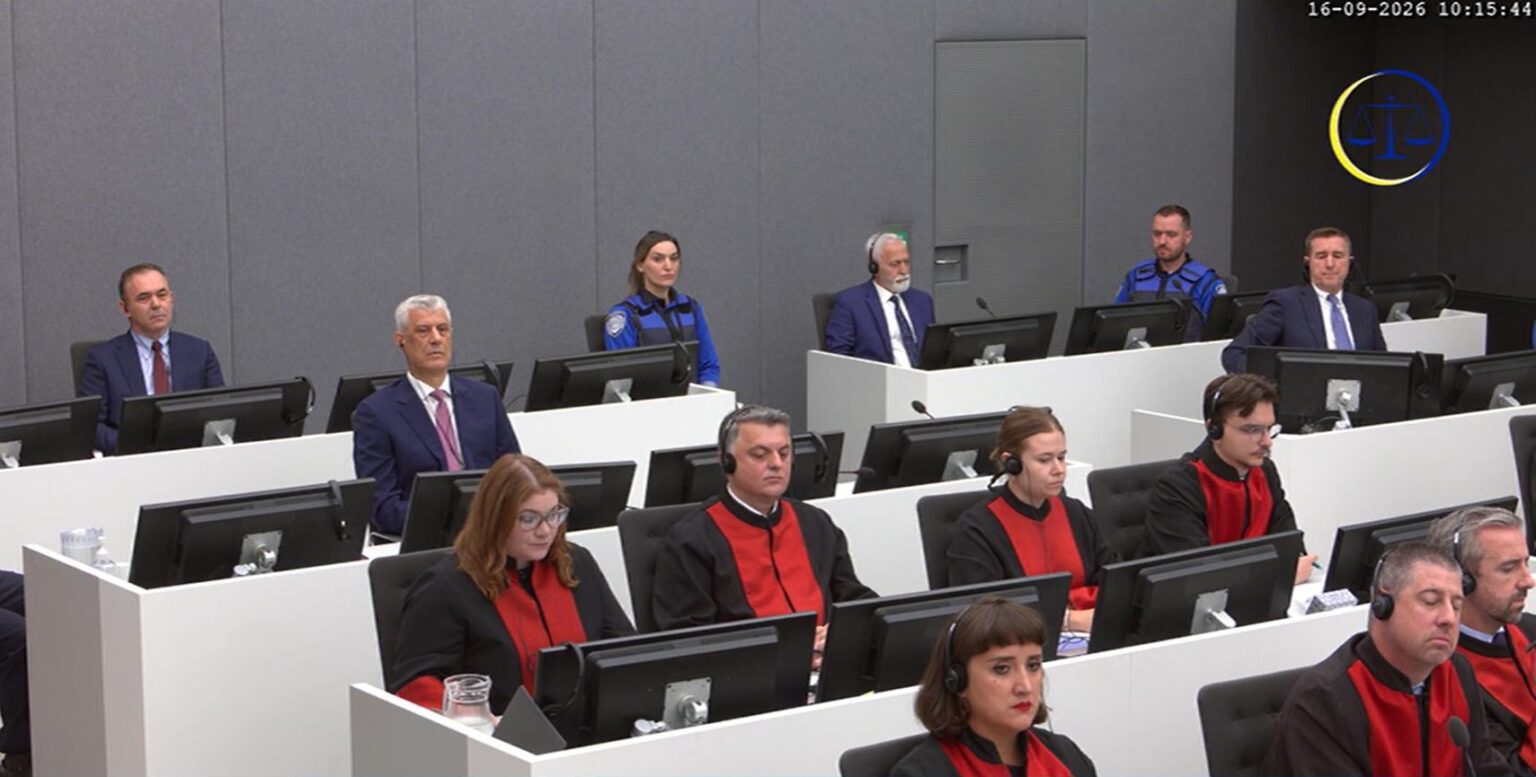
Rexhep Selimi, Hashim Thaci, Jakup Krasniqi, and Kadri Veseli in court on September 16, 2026. Photo: Screenshot/Kosovo Specialist Chambers.
Still, Halili acknowledged that emotional distance has its constraints: those who lived through the war cannot remain unmoved when it is discussed. At the same time, she warned that, “the risk is that emotional attachment to one’s nation leads people to view their own suffering as more significant than that of others, creating a hierarchy of pain.”
Except for emotive language, coverage of the KSC verdict featured national symbols, including flag pins and KLA insignia, displayed on-screen and worn by journalists. These elements point to longstanding tensions between journalistic rules, patriotism, professional objectivity, and civic identity.
Professor Rizanaj said that wearing a national symbol does not, in itself, make a journalist unethical. “However, when reporting from the field, it can undermine perceptions of impartiality and professional credibility,” he clarified. “Journalists should therefore avoid signs that could be interpreted as support for a particular cause or political side.”
Halili echoed Rizanaj’s view, arguing that the symbols journalists wear signal to the public and their sources which side they support. “This undermines the credibility of their reporting and makes it harder to engage with people who hold different views,” she said. “Journalistic ethics emphasize independence and avoiding conflicts of interest for precisely this reason.”
For Dorentina Thaçi, reporters face a difficult balancing act, in which emotional reporting should have its limits. “Emotional reporting might be acceptable to a point, provided it neither distorts information nor undermines the journalist’s credibility.”
This article is published in collaboration with Pro Peace.