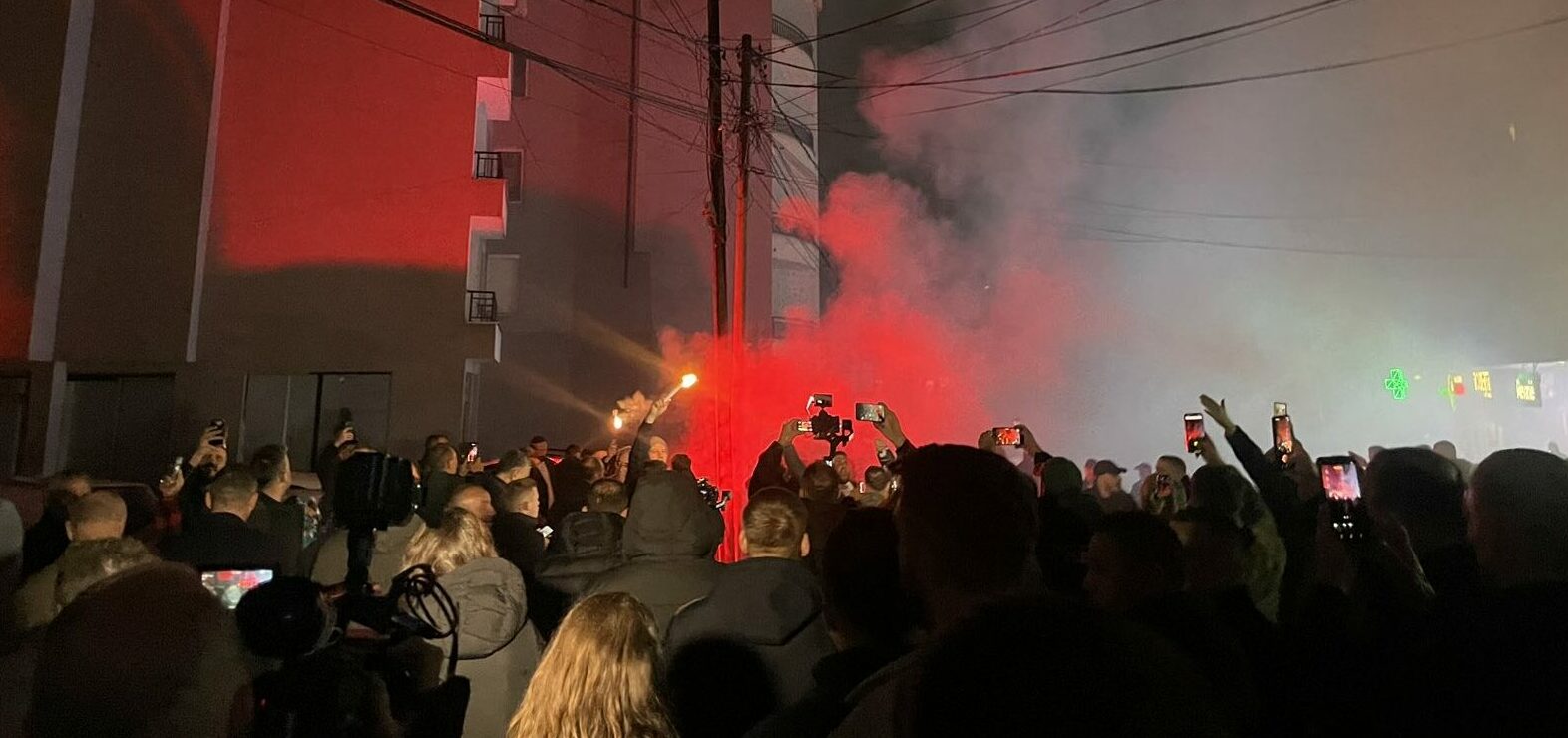
 Celebrations in the streets of South Mitrovica following the runoff local election results on November 9, 2025. Photo: BIRN
Voters in 18 Kosovo municipalities went to the polls on Sunday for the second round of local elections, with close contests in several key municipalities, according to CEC’s preliminary results.
Streets in several cities across Kosovo were filled with celebrations on Sunday evening as polling stations were closed in the country’s local election runoffs. Supporters of political parties beat the rain to gather outside political headquarters and in public squares, waving flags and honking car horns, after exit polls hinted at early leads in key municipalities.
The runoffs were held in 18 of Kosovo’s 38 municipalities, including in the capital Prishtina, as part of the second round of Kosovo’s local elections following the first vote on October 12, when no candidate secured a majority.
Preliminary results from the Central Election Commission, CEC, show that in the capital, incumbent mayor Përparim Rama of the Democratic League of Kosovo, LDK, won with 51.54 percent against Hajrulla Çeku of the Vetëvendosje Movement, LVV, who secured 48.46 percent of the vote, with all ballots counted.
In South Mitrovica, Faton Peci of LVV defeated Arian Tahiri of the Democratic Party of Kosovo, PDK, with 53.53 percent of the vote to Tahiri’s 46.47 percent, after 98 percent of votes were counted. Tahiri had intended to retain control of the municipality.
LVV also won in Fushë Kosova. LVV candidate Valon Prebreza got 54.99 percent of the vote while his LDK opponent Besnik Osmani received 45.01 percent. LVV secured a second term in Gjilan, where incumbent Alban Hyseni won with 61.06 percent of the vote, with all ballots counted.
LVV also won in Obilic municipality, where Halil Thaci secured 51.09 percent of the vote against Xhafer Gashi of LDK, who received 48,91 percent.
Acting Prime Minister Albin Kurti told the citizens of Fushë Kosova that his party, LVV, won a total of seven municipalities in these local elections, up from four in the previous elections.
“This is a success for LVV. Naturally, we aimed for more,” he declared.
Kurti added that other parties had united against LVV in the runoff, which makes this result “a success for LVV.”
In Gjakove, Ardian Gjini of the Alliance for the Future of Kosovo, AAK, won with 56.03 percent of the vote, whereas his opponent Ardian Gola of VV secured 43.97 percent, with all ballots counted.
In Peje, Gazmend Muhaxhiri of LDK will continue in his third term as mayor with 61.15 percent of the vote. His opponent, Taulant Kelmendi of LVV, received 38.85 percent, with 100 percent of ballots counted.
Meanwhile, in Prizren, Shaqir Totaj of PDK won with 53.86 percent of the vote, defeating Artan Abrashi of LVV, who received 46.14 percent of the vote.
In the Serb-majority municipality of Kllokot, Bozidar Dejanovic of the Srpska Lista secured a victory with nearly 90 percent of the vote. His opponent, Srecko Spasic, who had withdrawn from the race earlier and endorsed Dejanovic, was kept on the ballot by the CEC and still received 9.97 percent of the vote.
Kosovo Local Elections Head to Runoffs in Most Municipalities: Early Results
According to the CEC, the voting process proceeded without major incidents across all municipalities. “No irregularities were recorded that could affect the integrity or outcome of the elections,” stated CEC Chair Kreshnik Radoniqi in a media conference.
The State Prosecutor’s Office reported that three people were detained for election-related offenses. Two criminal cases were opened—one in Fushë Kosova for alleged bribery related to voting, and another in Klina for breaching the secrecy of the ballot.
Voter turnout stood at 32.64 percent, down from 38.91 percent in the first round.
The preliminary results do not include the conditional ballots, votes of people with special needs, and postal ballots.
The head of the OSCE Mission in Kosovo, Gerard McGurk, praised the management of the elections, saying the professionalism of the CEC had “strengthened democratic processes in Kosovo.”
“I commend Chair Kreshnik Radoniqi, the Central Election Commission, and everyone involved in managing and delivering the October and November local elections. Congratulations to all new and re-elected mayors—your work with and for your communities begins tomorrow. Looking forward to meeting you soon,” he wrote.
Meanwhile, acting Interior Minister Xhelal Svecla faced backlash after posting photos of an LDK activist near a polling station on Facebook, accusing him of violating election rules.
Election observers, however, said the action did not constitute a violation because the LDK activist was not in a restricted area. According to the electoral rules of the CEC, the area of polling centres where the display of campaign materials is prohibited includes only the interior of the centre and its enclosed perimeter.
Albert Krasniqi, from the NGO Demokraci Plus, described Svecla’s post as, “political pressure and intimidation,” calling it inconsistent with institutional neutrality during elections.
After casting her ballot in Prishtina, President Vjosa Osmani urged citizens to exercise their right to vote, calling Kosovo “the strongest electoral democracy in the region” due to transparent and peaceful elections.
Acting Prime Minister Albin Kurti described the runoff as, “a good day for democracy and free will,” encouraging voters to, “take part in shaping the next four years of local governance.”
During a press conference in the capital, LDK leader Lumir Abdixhiku stated that Prishtina was won with honesty, dedication, and with the best people this country has. “We won because the citizens clearly understood the difference between work and words,” Abdixhiku said.
During a presentation in front of citizens in Prizren, PDK leader Memli Krasniqi stated that this is a victory for the citizens and for Prizren. “This shows that cooperation beyond calculations and divisions is what citizens support.”, while expressing gratitude to coalition partners.
The runoffs were held in Prishtina, Prizren, Peja, Junik, Dragash, Gjakova, Kaçanik, Fushë Kosova, South Mitrovica, Rahovec, Suhareka, Gjilan, Viti, Vushtrri, Obilic, Klina, Mamusha, and Kllokot.
Voting took place in 525 polling centres with 1,648 stations.


09 November 2025 - 22:26
Announcements about the planned integration of Serbian-run ‘parallel...
Remote village schools in Kosovo are emptying, as teachers and experts...

A Kosovo court has sentenced a man to 24 years in prison for the murde...

Despite the social stigma and numerous obstacles he faced throughout h...