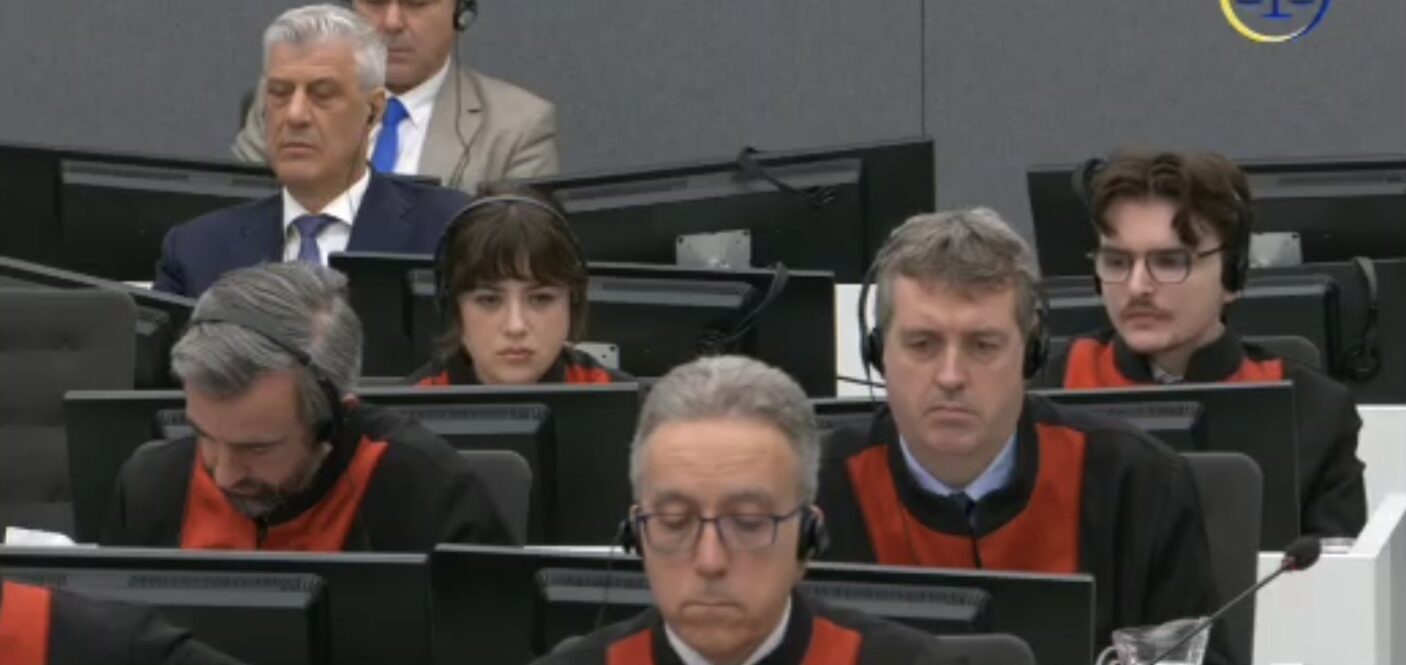
 Hashim Thaci and his defence team in court, February 10, 2026. Photo: Kosovo Specialist Chambers/Livestream.
The defence for the four former Kosovo Liberation Army leaders said in closing statements that the prosecution selectively used evidence, ignored historical facts – and failed to find witnesses linking them to the crimes.
The closing statements of the defence teams of wartime Kosovo Liberation Army, KLA leaders Hashim Thaci, Jakup Krasniqi, Kadri Veseli and Rexhep Selimi argued that the prosecution has failed to establish their guilt and has not taken into account that ethnic Albanians were fighting Serbian oppression.
The lawyers argued over several days of hearings up until Monday that the prosecution provided inconclusive evidence, failed to bring witnesses that connected the defendants to the crimes charged, and ignored historical facts.
Thaci and the three other defendants are accused of having individual and command responsibility for crimes committed against prisoners held at KLA detention facilities in Kosovo and neighbouring Albania, waging a systemic campaign against “opponents”, including 102 murders.
The prosecution says these “opponents” were people that the KLA deemed to be “collaborating or associating” with Yugoslav forces, officials or state institutions, including Serbian police, and people who did not support the aims and methods of the guerrillas or the Provisional Government of Kosovo, which Thaci headed from March 1999, while also KLA commander-in-chief.
The crimes were allegedly committed between roughly March 1998 and September 1999, during and just after the war in Kosovo. All four accused have pleaded not guilty.
Veseli’s lawyer Rodney Dixon told the court last Wednesday that “there is no direct first-hand evidence that shows Veseli’s involvement in the criminal acts he is alleged to have committed. The direct allegations are based on secondary evidence, based on word of mouth, and are often dismissed”
He claimed the prosecution “has not found a single witness even after all this time to come to court and claim that Veseli committed crimes”.
He said that ethnic Albanians were being oppressed by the Serbian regime and that the “KLA fought bravely against extremely unequal opportunities to defend Kosovo”.
Defence lawyers for Krasniqi and Selimi, in separate closing statements, said the prosecution based its case against Krasniqi and Selimi on documents seized from their homes during raids. Both defence teams claimed that the presence of documents in their clients’ residences does not necessarily mean they are the authors, or show they were responsible for the crimes they are charged with.
Krasniqi’s lawyer, Venkateswari Alagendra, told the court on Friday that “a strange element in the prosecution’s case is that it consistently turns a blind eye to any evidence that does not fit its narrative”.
She said that Krasniqi collected material on the KLA as a historian. “These documents seized from Krasniqi do not mean that he is the author, knowing that he has also stated to the ICTY [International Criminal Tribunal for the Former Yugoslavia] that he collected documents to write a book,” she added.
Alagendra urged the court to “allow this 75-year-old gentleman to return to his family and spend the years that God has destined for him with his family”. She added that witnesses have testified that Krasniqi, who was the KLA spokesperson, was a moderate person who called for respect for civilians’ rights and was not involved in any criminal activity.
Selimi’s lawyer, Geoffrey Roberts, told the court on Friday that “there was no joint criminal enterprise in which Selimi or his co-defendants were involved”.
Roberts also highlighted that “Selimi was not a commander. He did not exercise any superior responsibility in any way or form.”
The defence has repeatedly insisted that the KLA did not have a proper army command structure but was a ground-up guerrilla force, and that the defendants could not have had control over the actions of lower-ranking fighters.
The prosecution has sought sentences of 45 years in jail for each defendant – causing outrage in Kosovo.
One of Selimi’s lawyers, Fortuna Sheremeti, told the court that “a 45-year sentence is a life sentence. This is not proportionate.”
Mentor Beqiri, one of Krasniqi’s lawyers, noted that the 45-year sentence is double the sentence given to convicted wartime Serbian leaders, such as the Yugoslav Deputy Prime Minister Nikola Sajnovic, Yugoslav Army General Nebojsa Pavkovic and Serbian Police General Sreten Lukic, who were each sentenced to 22 years in prison.
Closing statements will continue until February 18. The judges should decide on a verdict within 90 days.


16 February 2026 - 19:09

In the first week of Hashim Thaci's trial for obstruction of justice, ...

Kosovo began three day commemorations marking the 28th anniversary of ...

At the close of their trial in The Hague, the four former Kosovo Liber...

On the 18th anniversary of the independence of Kosovo, thousands of ci...