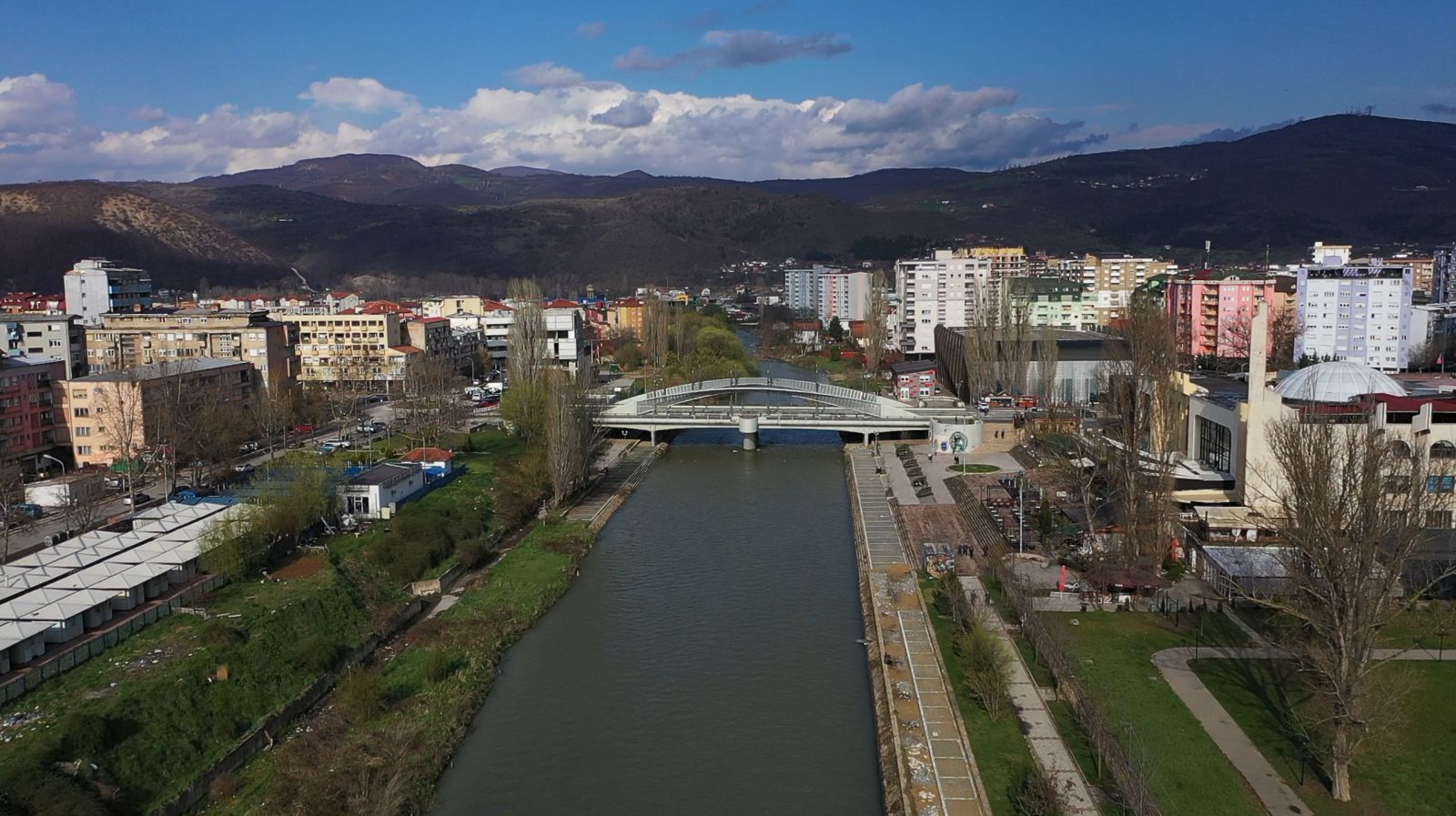
 Mitrovica main bridge. Photo: BIRN/Denis Sllovinja
The Kosovo Government has agreed to grant temporary residence permits and accept applications from members of the Serb community who do not hold Kosovo-issued documents, as the law on foreigners comes into force.
Kosovo’s Interior Ministry announced that, from Monday onwards, foreign citizens can apply for residence permits as laws governing the status of foreigners and vehicles enter into force—legislation that had sparked fears among Kosovo Serbs about their residence and working rights.
On Saturday, Prime Minister Albin Kurti said the government had agreed to grant temporary residence permits to Serbs living and working in Kosovo. His announcement came after he met EU officials in Prishtina with the EU special envoy for the Kosovo-Serbia dialogue, Peter Sorensen, and the head of the EU office in Prishtina, Aivo Orav.
The decision will affect Kosovo Serbs who hold IDs issued by the so-called Serbian-run ‘parallel institutions,’ following concerns voiced by civil society groups that failure to issue Kosovo IDs to de facto residents of Kosovo could violate their human rights.
“The government will obtain lists from local leaders of academic and healthcare staff engaged in providing these services, which will then be used to issue temporary residence permits to foreign nationals applying to the Ministry of Internal Affairs,” Kurti said at a joint press conference with Sorensen and Orav, on Saturday.
He noted that the same will apply for students studying in Kosovo under Serbia’s education system.
“At the same time, the Ministry of Education, in coordination with Sorensen and the providers of these public services, will begin the necessary procedures and set deadlines for full integration, including the licensing of institutions and their staff,” Kurti added.
Meanwhile no solution was announced for ethnic Albanians in southern Serbia, who may not have Kosovo or Serbian identity documents either due to the “passivisation” of their addresses in Serbia or administrative issues in Kosovo.
The step was welcomed by the international officials and diplomatic missions as well.
“We considered it a key priority for the government of Kosovo to ensure residence permits for workers and students involved for an initial period of 12 months, in order to prevent any disruption to health and education services,” Sorensen said.
The decision was also welcomed by EU foreign policy chief Kaja Kallas, who said it created “new momentum” for advancing relations in the Kosovo-Serbia dialogue.
“I am ready to host a high-level meeting soon,” she wrote on X.
Kosovo’s opposition Democratic Party of Kosovo, PDK, criticised the decision, accusing the government of legitimising what it described as “illegal Serbian parallel institutions and documentation operating in Kosovo.”
The 2013 Law on Foreigners and the 2017 Law on Vehicles were implemented on January 15, 2026, with an initial information campaign explaining procedures and requirements that ended on March 15.
Under the Law on Foreigners, short-term stays are permitted for up to 90 days within a 180-day period without a visa. Foreign nationals wishing to stay longer must apply for residence permits through Kosovo’s institutions.
The regulations also introduce limits on the use of vehicles with foreign registration plates. Vehicles registered outside Kosovo may circulate in the country for up to three months from the date of entry, after which additional authorization is required.
The legislation has been opposed by representatives of the Serb community and by civil society organisations, who emphasise that the measures could affect health and education services operating under Serbia’s institutional framework in Serb-majority municipalities.
On Friday, Dusan Radakovic from the North Mitrovica based NGO, ACDC, told reporters from the Kallxo Përnime TV Programme that the Serb community is among those most affected by the new laws. He added that the government had not carried out a sufficiently broad information campaign.
Radakovic said that thousands of Serbs in Kosovo still do not have Kosovo IDs, and the legislation will make their lives precarious.
“These people still have ID cards from the [old Serb-run police stations] SUP Kosovska Mitrovica, SUP Pristina, SUP Gnjilane and so on, or as they say in Pristina, a ‘parallel ID card,’ which will not be recognised,” he explained, adding that the situation is similar with cars because, according to him, thousands of cars used in Kosovo have “Serbian licence plates from Raska, Belgrade, Kraljevo, Novi Pazar and so on.”
These Serbian-registered cars are not only driven by Serbs, but also by ethnic Albanians from Serbia’s Presevo Valley, “so everyone will be affected, all communities will be affected by this law,” Radakovic warned.
Labinot Leposhtica, head of BIRN Kosovo’s legal office told Kallxo Përnime on Friday that individuals denied residence permits should seek legal remedies through Kosovo’s administrative courts.
Acknowledging that, “these are old laws and the implementation is outdated, and it can be said that there have been shortcomings in informing the public,” Leposhtica explained that, “in administrative procedures, any citizen who believes they have evidence proving they have lived here-such as municipal records, schooling or similar documentation can present these facts in administrative court proceedings.”


16 March 2026 - 15:13

Announcements about the planned integration of Serbian-run ‘parallel...

Remote village schools in Kosovo are emptying, as teachers and experts...

A Kosovo court has sentenced a man to 24 years in prison for the murde...

Despite the social stigma and numerous obstacles he faced throughout h...