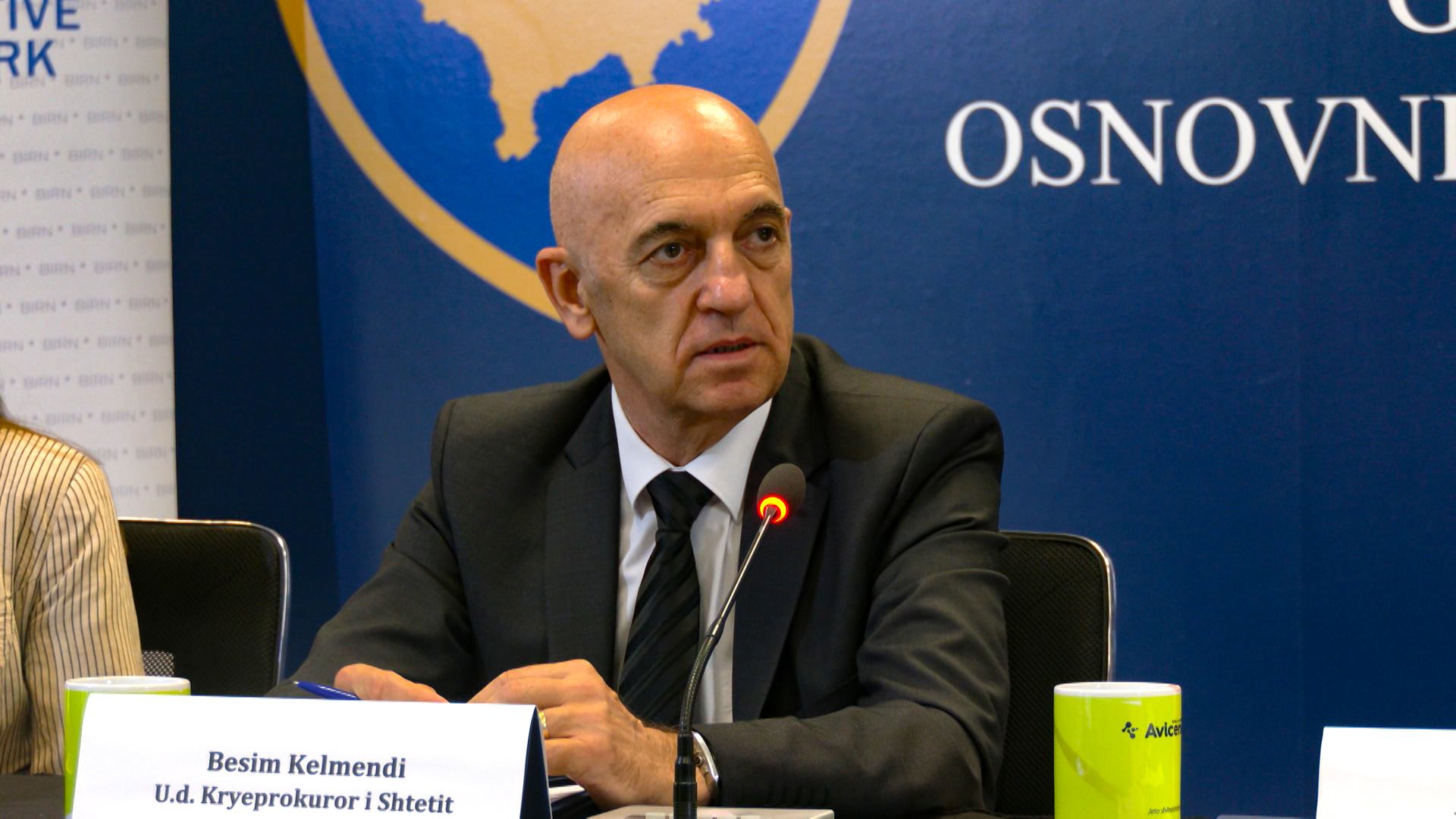
 Kosovo' acting chief prosecutor, Besim Kelmendi. Photo: BIRN
Kosovo’s acting chief state prosecutor was dismissed after media allegations about his supposed role in a probe that dismissed the 1999 Recak/Racak massacre as faked – claims he has rejected as defamatory.
The Kosovo Prosecutorial Council, KPC, on Thursday dismissed Besim Kelmendi as acting Chief State Prosecutor, after media reports of his alleged involvement in a legal probe into the 1999 Recak/Racak massacre of 45 Kosovo Albanians that dismissed the atrocity as fabricated.
Kelmendi strongly denies the claims.
The Council approved the proposal for his removal and appointed Agron Qalaj as the new acting Chief State Prosecutor. But the vote was challenged a few hours after by Visar Krasniqi, another member of Prosecutorial Council, who said it was “legally void” for procedural reasons.
“Five [KPC] members attempted today to take a decision without a quorum. The vote with five members has no legal effect,” Krasniqi said at a press conference.
The acting Justice Minister, Blerim Sallahu, also condemned the dismissal as unlawful. “It is a flagrant violation of the law by those who should be its most diligent enforcers,” Sallahu stated.
Kelmendi’s dismissal comes a day after he refuted reports claiming he was professionally connected to a Serbian judge at the District Court in Prishtina in 1999, Danica Marinkovic, who dismissed the Recak/Racak massacre as a “fabricated event”.
Kelmendi insisted on Wednesday that in 1999, he had been “a professional collaborator, as a note-taker” of Marinkovic’s and not her assistant.
“I was not a judge, prosecutor, or investigator before 2000, when I was appointed a judge at the District Court in Prishtina,” Kelmendi said. “I later served on a panel with two international judges and an international prosecutor in a Recak-related case. Thanks to my contribution, one of the perpetrators was convicted, and that final judgment was used as evidence in the trial of [Yugoslav President] Slobodan Milosevic.”
On Wednesday, the Paparaci media outlet published a report which claimed that Kelmendi was to be interviewed as a witness in connection with the Recak/Racak case – and suggested he had been involved in the case in 1999.
Kelmendi called the article “defamatory and tendentious”
“It is unfortunate that a well-known portal like Paparaci continues to publish fabrications and untruths about my work and my career,” he said.
Kelmendi accused Paparaci’s owner, Vehbi Kajtazi, of attempting to influence him to offer “legal protection” to certain businesses. He added that he had formally notified the prosecution of an “orchestrated campaign” against him. “It has been three years since I filed a lawsuit against this portal, but I have not yet received a summons,” Kelmendi said.
Kajtazi has denied any wrongdoing and said he was “ready to confront Kelmendi in a public debate”.
In January 1999, William Walker, head of the OSCE Mission in Kosovo, documented the killings by Serbian forces in Recak/Racak, which became a defining moment in international responses to the violence in Kosovo.
Following the massacre, NATO launched airstrikes against Yugoslav military and police targets in March 1999. The 78-day bombing campaign ended on June 10, 1999, with the adoption of UN Security Council Resolution 1244, which paved the way for international administration and the entrance of NATO troops into Kosovo.


20 November 2025 - 17:04
Youth in Kosovo nowadays are far more likely to be exposed to extremis...
Announcements about the planned integration of Serbian-run ‘parallel...
Remote village schools in Kosovo are emptying, as teachers and experts...
A Kosovo court has sentenced a man to 24 years in prison for the murde...