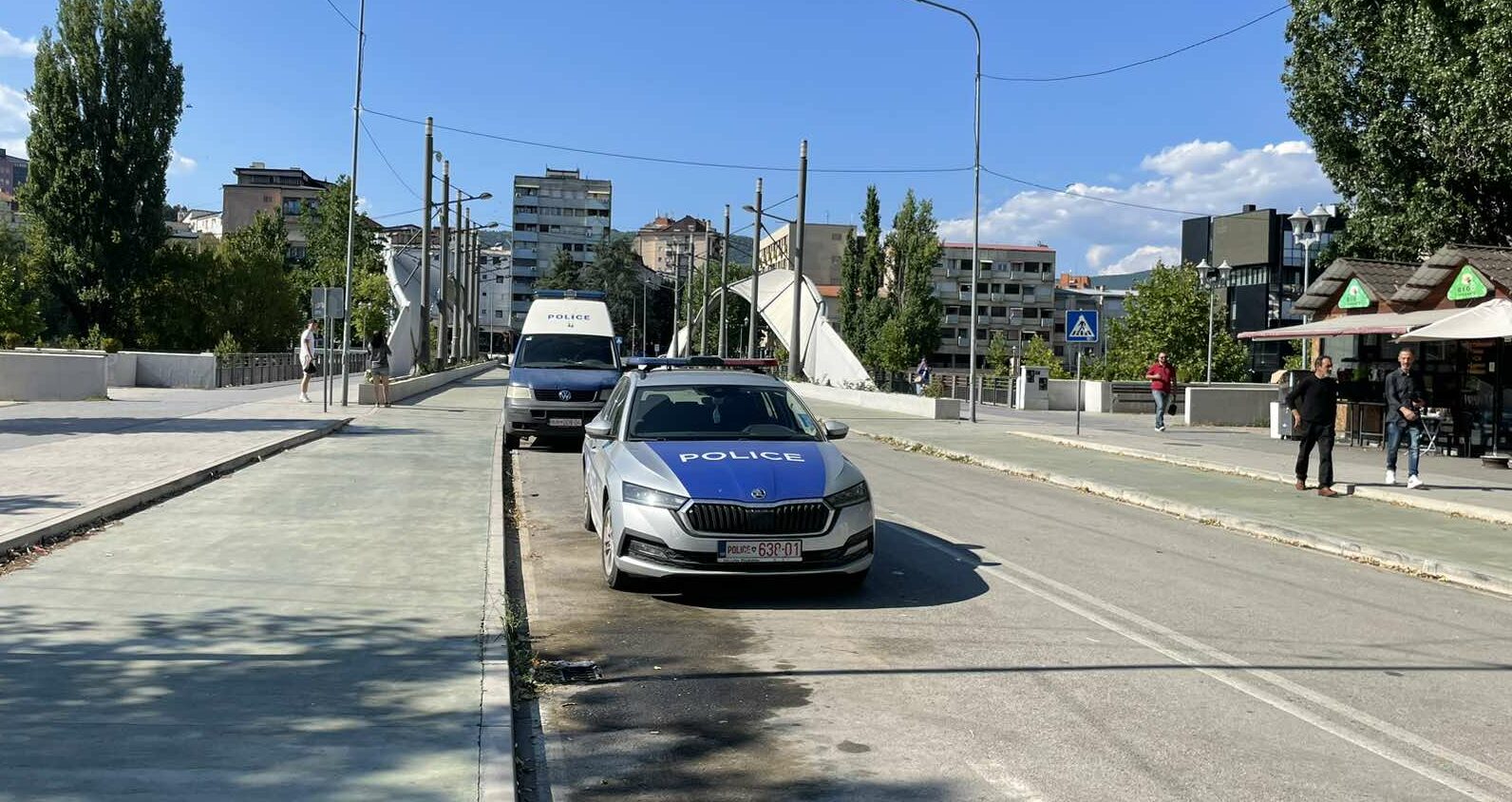
 A Kosovo Police patrol car on the Iber bridge in Mitrovica, August 10, 2026. Photo: BIRN/Florinda Kelmendi.
As NATO-led KFOR mission starts winding down presence on bridge in divided Mitrovica, Kosovo's main Serb party warns of potential problems at 'site of serious conflicts'.
The NATO-led peacekeeping mission in Kosovo, KFOR, said on Monday that it had begun a gradual transition away from its permanent presence on the main bridge in the ethnically divided town of Mitrovica, citing “an improved security situation in Kosovo”.
The town has been split into a northern, Serb-run half and a southern, Kosovo Albanian-run half, since the end of the Kosovo war in 1999, sparking numerous incidents since then.
“In line with the improved security situation in Kosovo, this is part of the process for optimising KFOR’s posture,” KFOR told BIRN on Monday.
“This process will be gradual, conditions based, and is being closely coordinated with all relevant stakeholders, including representatives of the Institutions in Kosovo and of international organisations, as well as with representatives of the Kosovo Police and the EU Rule-of-Law Mission in Kosovo (EULEX),” it added.
However, after a Kosovo Police vehicle appeared on Monday on the bridge, Srpska Lista, the Belgrade-backed Kosovo Serb party, said it strongly opposed the withdrawal of KFOR members from the bridge and called for an urgent meeting with KFOR commander Ozkan Ulutas.
“Given the extremely complex political and security situation, as well as the fact that the area around the main bridge has for decades been a site of serious tensions and conflicts, we believe that any decision that could affect security at this sensitive location must be made with the utmost care and with full consideration for the concerns of citizens,” Srpska Lista said.
According to Srpska Lista, Kosovo Police “have failed to build the trust of the Serbian people through their actions.
“Their conduct in numerous situations, including their support for actions that we consider unlawful and directed against the Serbian people and their institutions, has further deepened mistrust and the sense of insecurity among Serbs,” the statement said.
Apart from the main bridge over the Iber/Ibar in Mitrovica, Kosovo’s government has opened two additional bridges connecting the southern and northern, Serb-run, parts of the city.
Earlier on Monday, meanwhile, KFOR announced that it has begun a “gradual integration of Kosovo Police personnel into KFOR’s security architecture” at the Decani Monastery in western Kosovo, an important site for Serbian Orthodox believers. The mission said the move was part of a “broader process to optimise its security posture and will be implemented gradually and based on conditions on the ground”.
KFOR noted that it “remains the first responder responsible for the Monastery site’s protection and will maintain a visible presence in south and north Mitrovica and in northern Kosovo”.
The monastery, a UNESCO World Heritage site, has been under KFOR protection since the end of the war in Kosovo in 1999. The mission said it would maintain close cooperation with the Serbian Orthodox Church, Kosovo institutions, international organisations and the Serbian Armed Forces, in order “to safeguard mutual transparency, cooperation and trust, and to avoid misunderstandings”.
“KFOR’s commitment to the security of the Visoki Decani Monastery and to the safety of all local communities is steadfast,” the mission said.


10 August 2026 - 17:15

The Peja Basic Prosecution has charged nine people suspected of operat...

Two Kosovo Serbs pleaded guilty to violating the constitutional order ...

The independent inspectorate has launched an investigation into allega...

A court in Prishtina has ordered 30 days of pre-trial detention for Ig...