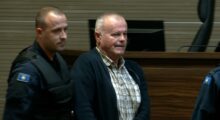
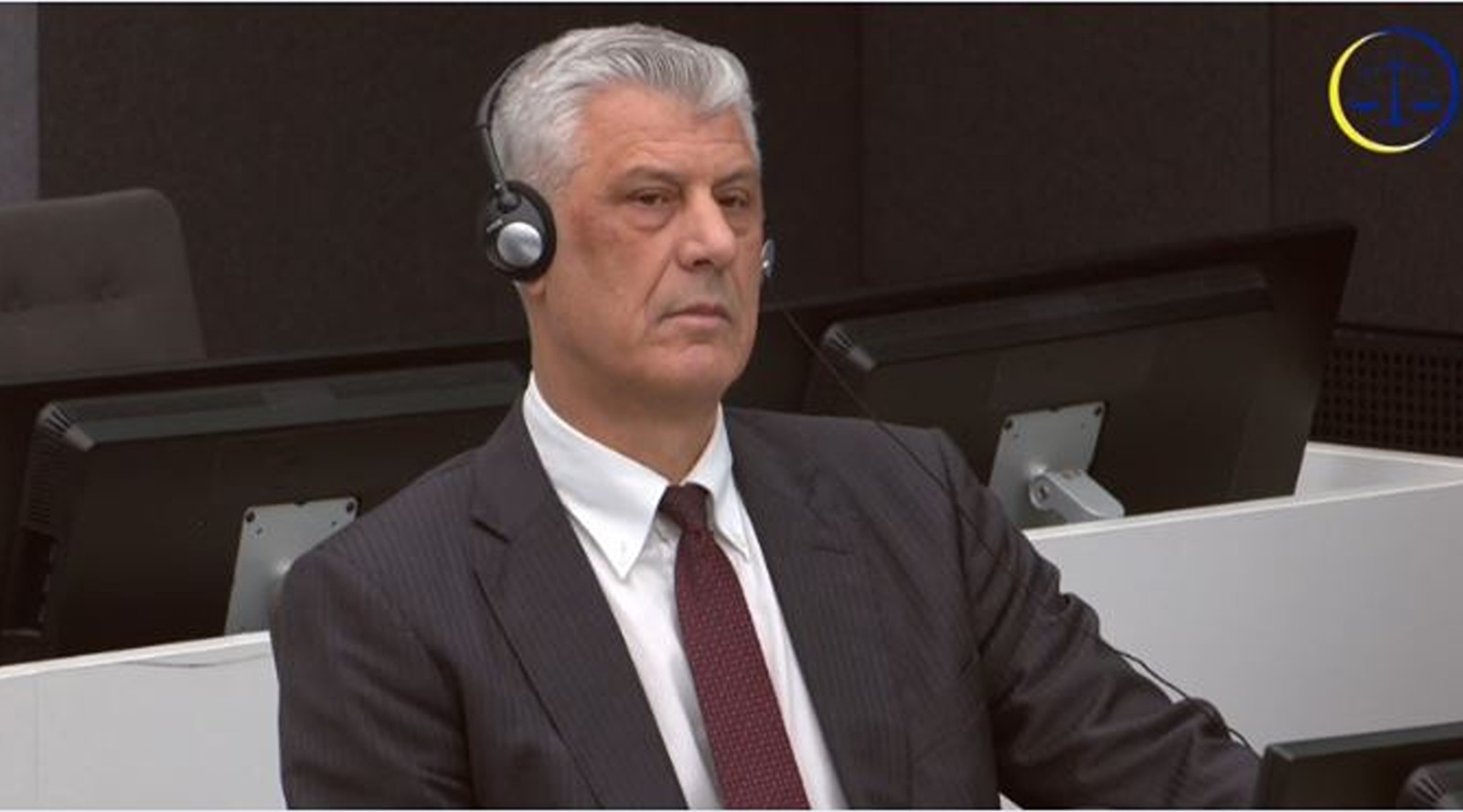
 Hashim Thaci at his initial appearance on obstruction of justice charges at the Kosovo Specialist Chambers in the Hague, December 8, 2024. Photo: Kosovo Specialist Chambers/Live Updates.
Former Kosovo President Hashim Thaci says he expects to be acquitted of all charges in the war crimes case against him and three other former Kosovo Liberation Army leaders when the verdict is announced on September 16.
Former Kosovo President Hashim Thaci said in an interview broadcast on Thursday evening that he anticipated being acquitted of all charges in the war crimes and crimes against humanity case against him and three other former Kosovo Liberation Army, KLA leaders at the Kosovo Specialist Chambers in The Hague.
The verdict in the case against Thaci, Kadri Veseli, Rexhep Selimi and Jakup Krasniqi is expected on September 16.
“I expect to be acquitted of every charge. I have nothing to add to the arguments of the defence team or to my final statement in the courtroom,” Thaci said in the written interview with the Prishtina-based broadcaster RTV Dukagjini.
The four men are accused of individual and command responsibility for crimes committed against prisoners held at KLA detention facilities in Kosovo and in neighbouring Albania, including 102 murders. The crimes were allegedly committed during and just after the Kosovo War in 1998 and 1999.
All four defendants have pleaded not guilty.
Thaci said he did not regret supporting the creation of the Kosovo Specialist Chambers when he was in office, but said he had not expected the decision by Kosovo’s elected representatives to be “misused so brutally”.
The Kosovo Specialist Chambers was created specifically to try former members of the KLA. It is located in The Hague and staffed by international judges and prosecutors due to doubts about the Kosovo justice system’s ability to try former KLA fighters, many of whom are considered heroes in Kosovo.
In the interview, Thaci spoke about a 2010 report by former Swiss Council of Europe rapporteur Dick Marty, which alleged serious crimes including organ-trafficking by KLA-linked figures. The report ultimately led to the establishment of the Kosovo Specialist Chambers. Thaci claimed that its allegations were developed with the involvement of officials at the Council of Europe from Serbia and Russia – both of which oppose Kosovo’s independence.
“The freedom and the construction of Kosovo’s independence were unswallowable for Serbia and Russia. After failing to delegitimise it at the International Court of Justice [which ruled that Kosovo’s independence declaration did not violate international law], they turned to the Council of Europe. The aim was clear: to discredit the state of Kosovo,” he said.
Thaci also criticised the prosecution’s treatment of defence witnesses and evidence in his trial.
He accused prosecutors of giving greater weight to what he described as “fabricated testimony” originating from the time when Slobodan Milosevic was in power in Belgrade, and dismissing testimony from senior Western and international officials who were “the eyes and ears” in Kosovo.
“The prosecution is elevating evidence fabricated during the era of the Milosevic regime, and ignoring the testimony of senior officials from the US, NATO, Britain, the UN, the OSCE and other international institutions,” he said.
Thaci noted that the appearance of such international figures as defence witnesses demonstrated their concern about the proceedings.
“It is not easy for these personalities to sit in such a courtroom. I understood that they were seeing that something wrong was happening in this process. They felt a moral obligation to tell the truth,” he said.
Thaci declined to comment on the current Kosovo government’s approach to the Specialist Chambers.
Asked whether his rights had been violated during the proceedings, he replied that he considered the “process as a whole” to have involved violations.
He also criticised the decision not to release him on bail, saying that the arguments used against his release were based on “prejudices and hypotheses”. Thaci said several NATO member states had offered guarantees on his behalf and that he remained grateful to them.
During the trial, the prosecution attempted to prove that, as members of the KLA General Staff, they were responsible for lower-ranking fighters who committed crimes. The defence argued that the KLA did not have a proper army command structure, so the defendants did not have real authority over lower-ranking KLA fighters.
Thaci resigned as Kosovo’s president in November 2020 to face the charges and together with the other three men was sent to detention in The Hague, where they have been ever since. The trial started in April 2023.
During the trial, KLA veterans and their supporters have staged protests in Pristina, Tirana, Skopje, Strasbourg and The Hague, accusing the Specialist Chambers of bias.
In 2024, Thaci was also charged with obstruction of justice, alongside four others, including former Kosovo Justice Minister Hajredin Kuci. The trial for this case started in February, days after proceedings in the war crimes and crimes against humanity trial ended. Thaci and the four others accused of obstruction of justice – Kuci, Isni Kilaj, Bashkim Smakaj and Fadil Fazliu – have denied wrongdoing.


21 August 2026 - 11:33
Letters exchanged between Fehmi and Xheve Lladrovci in the 1980s, whil...
Kosovo's attempt to curb the Hague-based Court might not yield results...
In a last minute save, Kosovo MPs avoided another snap parliamentary e...
After violent clashes on Monday night, protesters started to reassembl...