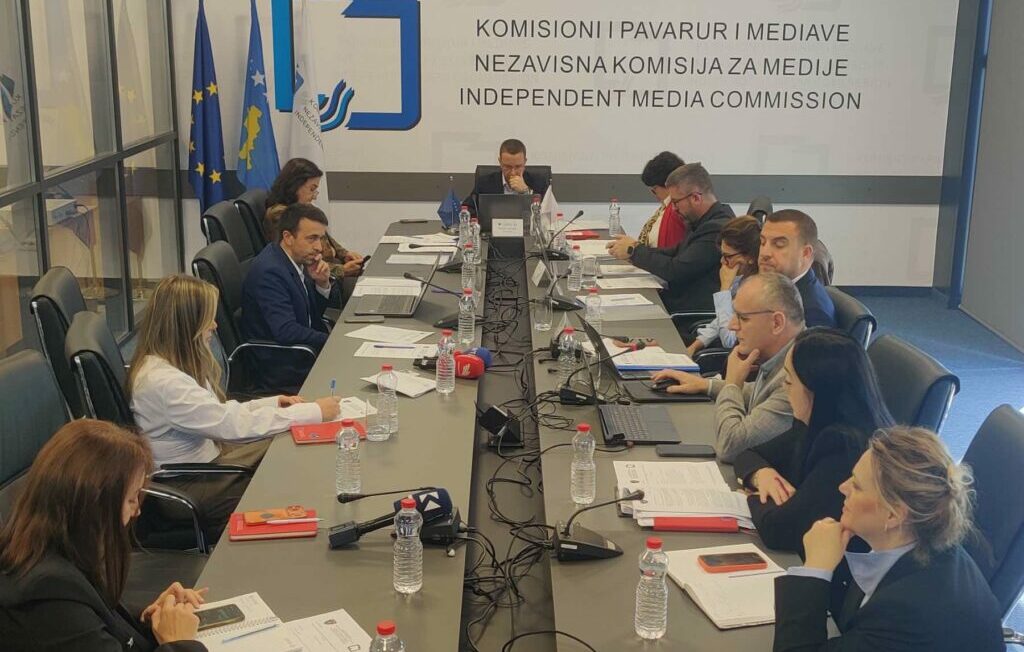
 Independet Media Commission, IMC, meeting on October 12, 2026. Photo: BIRN/Mediana Halili
Kosovo’s media regulator has approved an experimental broadcasting licence for a radio station run by the Kosovo Police, but media experts have cast doubts over the move.
In a meeting on Monday, Kosovo’s Independent Media Commission, IMC, approved an experimental broadcasting licence for ‘Radio Policia’, following a request from the Kosovo Police, for a radio service focused on traffic updates and public safety.
“The request was made to provide information and announcements about traffic and citizens’ safety,” Niman Racaj of the IMC’s Legal Department said in the meeting, adding that the application had a legal basis and had been processed accordingly.
Racaj said experimental broadcasting licences are subject to restrictions to prevent licensees from competing in the commercial media market.
“All commercial activities are prohibited, as specified in the regulation,” he said, adding that such services “do not qualify as traditional media in the commercial sense.”
Under the regulation, experimental broadcasting licences are valid for one year, with the possibility of extension for an additional year.
IMC chair Besnik Berisha said that, “the principle remains that the IMC sets the operational conditions while safeguarding proportionality and editorial independence.”
He added that different models of experimental broadcasting existed and that the IMC could prepare a document outlining lessons learned, “including how responsibilities should be divided and whether the service should operate on a voluntary basis.”
The Kosovo Police told KALLXO.com it had “consulted domestic and international partners, including by examining the model of Radio KFOR, which has operated in Kosovo since the post-war period. It had also held meetings with several radio stations in Kosovo to learn about their broadcasting procedures and the provision of news and information.”
According to the police, the proposed station “is intended to promote police work in the community and bring officers closer to citizens by addressing local concerns and security issues.”
The initiative has drawn criticism from media lawyer Flutura Kusari, who on Sunday described it as “one of the biggest political propaganda initiatives,” warning of potentially far-reaching consequences for public opinion through state propaganda.
Kusari emphasised that the “state is opening a media outlet which goes against the principles of international organisations that oppose the creation of state media.”
She also raised concerns about the process that led to the new licensing framework.
According to Kusari, the IMC put its Regulation on Experimental Broadcasting out for public consultation on July 10 and adopted it on August 7.
In a post on Facebook, Kusari criticised the regulator for adopting the regulation without a public hearing, or broader debate to inform and prepare the media industry for what she described as a “major change that could fundamentally alter Kosovo’s information landscape.”
Kusari also warned that the regulation was unclear and vulnerable to abuse.
“The Regulation on Experimental Broadcasting does not have a clear purpose and can easily be misused by anyone who obtains an experimental broadcasting licence,” she added.


12 October 2026 - 15:43

Kosovo’s media regulator has approved an experimental broadcasting l...

The Peja Basic Prosecution has charged nine people suspected of operat...

The independent inspectorate has launched an investigation into allega...

A court in Prishtina has ordered 30 days of pre-trial detention for Ig...