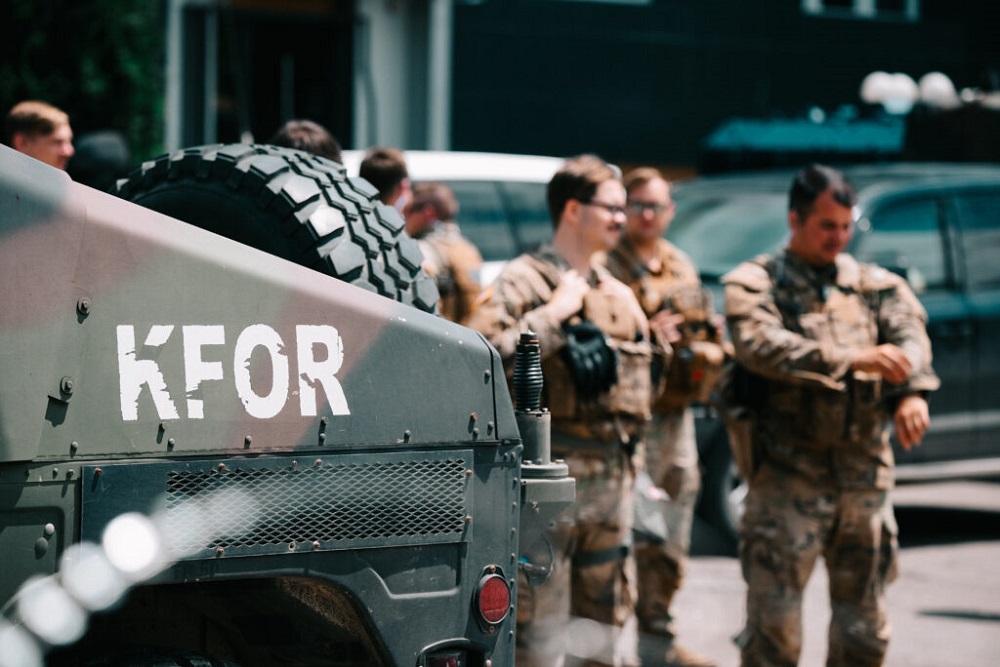
 NATO Peacekeeping Forces in Kosovo, KFOR. Photo: BIRN/Denis Sllovinja
The NATO peacekeeping mission will reduce troop numbers as a result of improved security conditions in Kosovo’s north. NATO increased troop numbers in 2023 in response to increased violence, including an armed attack by Serb gunmen that left one Kosovar police officer dead.
NATO Secretary General Mark Rutte announced on Wednesday in a press conference in Brussels that NATO will considerably reduce peacekeeping troops in Kosovo as a result of the improved security situation.
“NATO ceased in January the deployment of reserve forces to the Kosovo Force and this is after two years of continuous rotation,” Rutte told the media, explaining that the security situation has been continuously improving over the last two years in Kosovo.
“At this moment KFOR [Kosovo Force] has an overall size of 4,700 troops and what we will do is go back to 2023 levels. Depending on the circumstances you will see a KFOR going forward between 3,000 and 3,500 troops,” Rutte said.
In a press release on June 12, NATO explained that “following increased tensions and violence in 2023, including unjustified attacks against KFOR peacekeepers in Zvecan, KFOR saw its largest reinforcement in over a decade with the deployment of nearly 1,000 additional troops.”
At the end of April 2026, KFOR commander Ozkan Ulutas, during a meeting with ambassadors of NATO countries and NATO contributing partners in Brussels, said that “we have not seen a recurrence of violence, as we saw in 2023. However, the situation remains fragile, with the potential for new tensions, particularly in northern Kosovo.”
In 2023, NATO deployed additional troops in Kosovo after several security incidents in the Serb-majority north of the country including an armed attack in September by Serb gunmen in the village of Banjska that left one Kosovo police officer and three Serb gunmen dead. In late April 2026, three Serbs were found guilty of terrorism and involvement in a violent attempt to seize northern parts of Kosovo in September 2023, as part of an armed group that was backed by Serbia.
In total, 44 individuals and one legal entity were named in the indictment. Of these individuals,, 43 were charged with terrorism and serious acts against the constitutional order and security of Kosovo, including the three who were found guilty in April. The legal entity RAD d.o.o. and its owner Radule Stevic were charged with money-laundering, as was the alleged ringleader, Kosovo Serb powerbroker, businessman and politician Milan Radoicic.
Radoicic, the former deputy leader of Srpska Lista, the Serbian government-backed Serb political party of Kosovo, is in Serbia. He has accepted responsibility for the armed attack, but Serbia, which does not recognise Kosovo’s independence, is unlikely to hand him over for trial.
Earlier that year, in May 2023, violent protests in four Serb-majority municipalities in northern Kosovo left 93 KFOR soldiers injured. Protesting Serbs argued that the ethnic Albanian mayors of Leposavic, North Mitrovica, Zvecan and Zubin Potok who had won the elections after Serbs boycotted the election were illegitimate and should not be allowed to take office. Several protesters have since been sentenced in relation to the violence.
In mid-June 2023, the EU announced a package of “reversible” measures against Kosovo, citing its failure to restore calm in the Serb-majority north.
In early December 2025, mayors from Srpska Lista were sworn into office in four Serb-majority municipalities, after winning in October 2025 local elections.
Later that month, on December 17, following the EU-Western Balkans Summit, European Commission President Ursula von der Leyen, announced that “following the smooth and orderly transition of local governance in the north after the recent local elections, we are moving forward to lift the measures on Kosovo. We are programming 216 million euro of financial assistance. And we intend to release 205 million euro early next year.”
The measures were fully lifted in March 2026.
The article was updated on June 18, 2026, to specify the reasoning of the upcoming reduction.


17 June 2026 - 16:32
Kosovo marked the 27th anniversary of the end of the 1998-99 war, on J...

Kosovo has begun initial procedures to establish a national gendarmeri...

Slobodan Radenkovic was jailed for two years for taking part in attack...

Slavko Simic of the Belgrade-backed Srpska Lista party pleaded not gui...

Prishtina court sentences Milos Antovic to nearly five years' jail and...