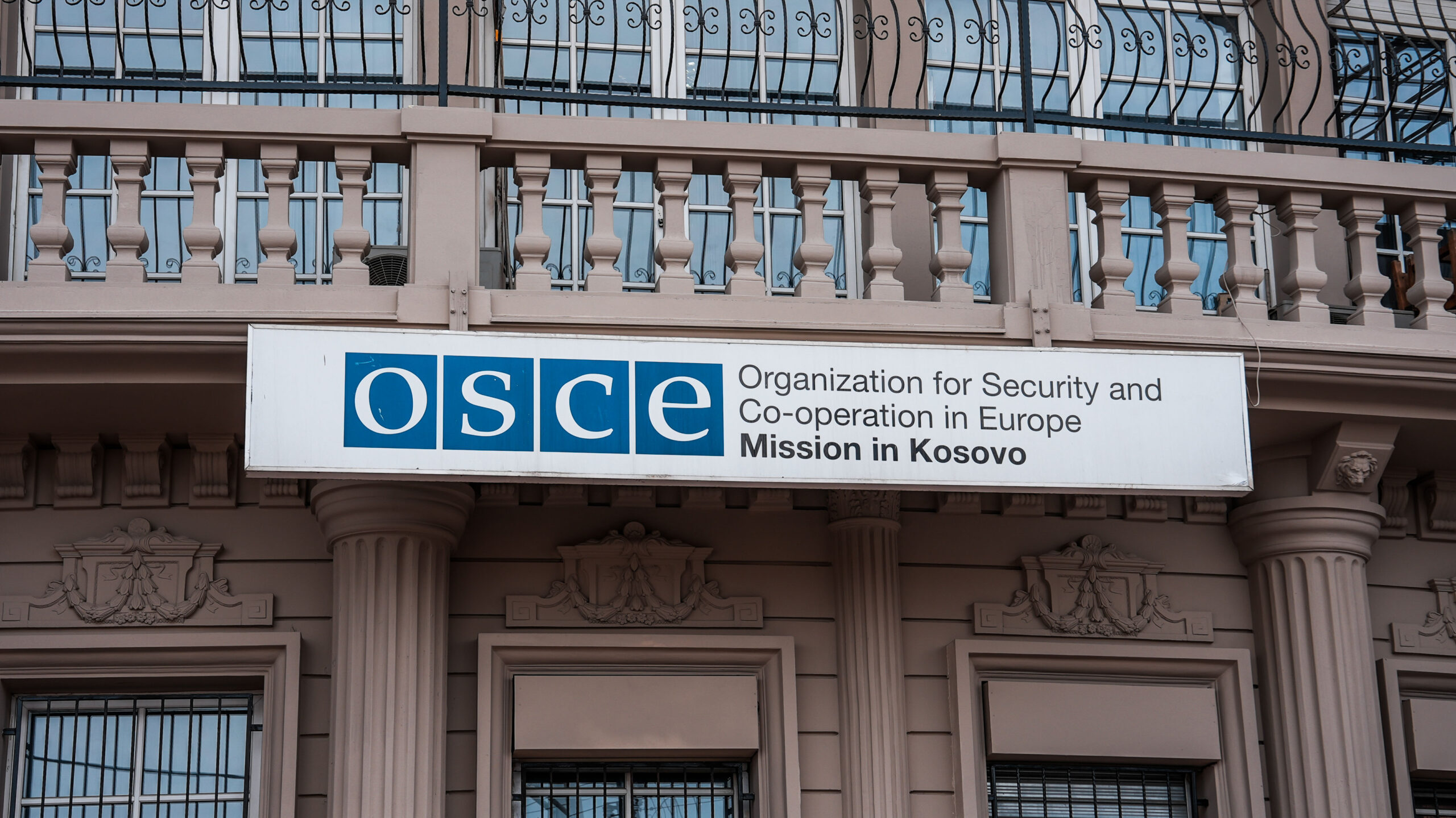
 The Organization for Security and Co-operation in Europe (OSCE) Mission in Kosovo. Photo: BIRN/Denis Sllovinja.
Kosovo’s judicial institutions have taken steps to strengthen the handling of serious organised crime and corruption cases, but lengthy proceedings and inconsistent courtroom practices continue to pose challenges, according to a new report by the Organisation for Security and Co-operation in Europe.
Judicial institutions in Kosovo have taken important steps to strengthen the handling of serious organised crime and corruption cases, but reforms have yet to translate into consistent courtroom practice, an OSCE report published on Wednesday claims.
The “Regional Trial Monitoring Project” report examines developments across six Western Balkan jurisdictions since 2024, assessing progress in implementing reforms and identifying practical priorities for making criminal justice systems fairer, more efficient, and more effective..
On courtroom monitoring, analysis of judicial decisions, and consultations with judicial institutions in Kosovo, the report finds stronger institutional ownership of reforms, including strategic planning, expanded digital tools, specialised training, and measures to promote more consistent judicial practice.
“Improved publication of judicial decisions is one example of progress,” the report notes.
During the reporting period, 36 of 41 monitored judgments were published online, including all 20 monitored Court of Appeals judgments.
“Institutions have also taken steps to strengthen interpretation and translation services and improve communication with the public,” the OSCE further noted.
However, the reports added that implementation remains uneven.
The report mentions challenges related to lengthy proceedings, particularly at the appellate level; consistency in indictment drafting and judicial reasoning; access to interpretation and translated case materials; and the use of financial investigations, confiscation, and accessory punishments.
“The report recognises the progress made by justice institutions and their follow up to our recommendations. The next step is to build on this progress so that reforms consistently improve how complex cases are prepared, managed and decided,” said Kahramon Sanginov, who manages the OSCE’s Regional Trial Monitoring Project in Kosovo.
The OSCE’s recommendations include clearer institutional responsibilities, stronger follow-up, and sustained investment in specialised expertise and operational resources.
“The emphasis is on ensuring that strategies, guidance and digital tools produce measurable improvements in everyday case handling, while safeguarding fair trial rights and judicial independence,” the report recommends.
In comparison, Albania’s monitoring report notes that the Specialised Prosecution Office, SPAK, and the Specialised Court for Corruption and Organised Crime, SCCOC, have established themselves as central pillars of Albania’s justice system.
“Some progress was observed towards the prioritisation of high-level Organised Crime and Corruption, OCC, related cases.”
The report notes that a critical gap remains: “No formal, system-wide criteria currently exist to distinguish high-level corruption and OCC-related cases from other matters falling within the jurisdiction of SPAK and the SCCOC courts. This limits the ability of institutions to prioritise cases for statistical, policy and operational purposes.”
Meanwhile, trial monitoring in Serbia notes that transparency in OCC proceedings remains uneven and fragmented across institutions, procedural stages, and types of information made publicly available.
“Positive practices are seen in certain areas, regarding the publication of appellate court decisions and their plain-language summaries. However, approaches to transparency continue to vary, resulting in differing levels of public access to information,” the report notes.
The findings and recommendations will be discussed at the Regional Judicial Forum in Budva, Montenegro, on 26–27 October 2026.


21 October 2026 - 16:53

Kosovo’s judicial institutions have taken steps to strengthen the ha...

More than 13,000 people were killed, forcibly disappeared, or died as ...

EU and OSCE regret bulldozing of allegedly illegally-built Serb villas...

From limited cooperation from other countries to prolonged delays in p...