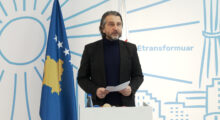
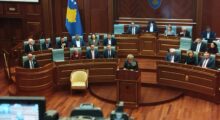
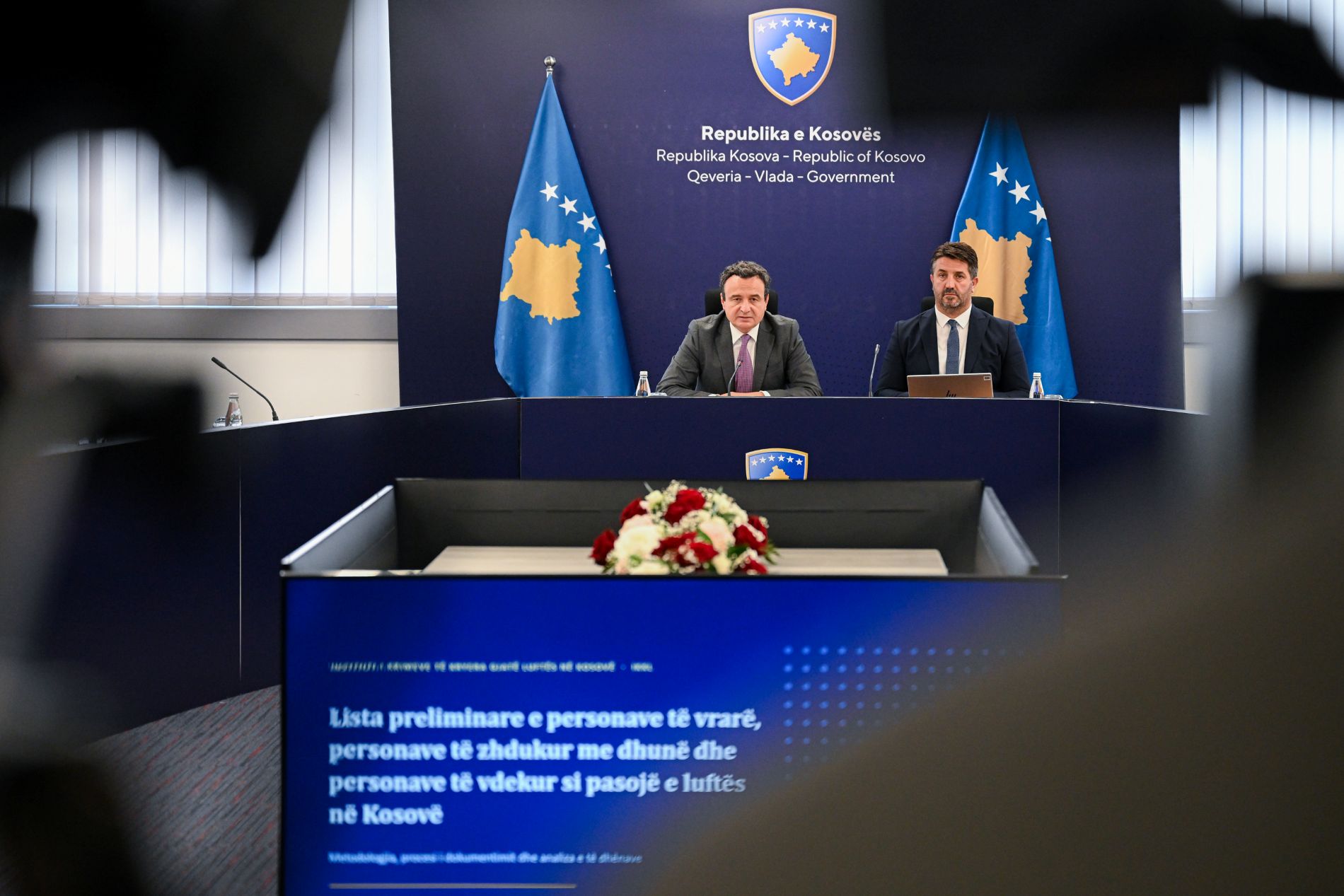
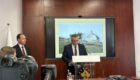
 Acting Prime Minister of Kosovo Albin Kurti (L) and IKKL Director Atdhe Hetemi (R) at the launch of the Institute for Crimes Committed During the War in Kosovo, IKKL, report on wartime victims, July 29, 2026. Photo: Prime Minister's Office.
More than 13,000 people were killed, forcibly disappeared, or died as a result of the Kosovo war, according to a preliminary list published by Kosovo's Institute for Crimes Committed During the War, the country's first institutional record of wartime victims.
On Wednesday Kosovo’s Institute for Crimes Committed During the War in Kosovo, IKKL, published a preliminary list documenting 13,227 people who were killed, forcibly disappeared or died as a consequence of the 1998-99 Kosovo war, as the first institutional effort in standardising decades of fragmented data.
According to the report, the list includes 12,230 people who were killed, disappeared or died as a result of the war by June 1999, while another 997 cases were recorded in the post-war period, up to the end of 2000.
Speaking at the report’s launch, acting Prime Minister Albin Kurti said the publication represents “institutional evidence of the high price of the freedom we enjoy together.”
Kurti noted that the database remains preliminary and will be continuously updated. He called on citizens, victims’ families, and civil society organisations to submit additional evidence to the institute.
“Without documentation there is no memory, without memory there is no justice, and without justice there can be no lasting peace,” he stated.
He also called on internationals to pressure Serbia to open the war and military archives as that is a “crucial step towards knowing the fate of forcibly disappeared persons.”
The report categorises 11,408 people or 86.2 per cent of all documented victims, as having lost their lives as a direct result of war-related violence, including killings, executions, massacres, bombings and other forms of violence.
It also documents 1,578 people who remain forcibly disappeared, individuals whose fate remains unknown and for whom there is evidence linking their disappearance to wartime circumstances.
241 people are listed as having died as a consequence of war-related injuries.
According to the report, of the total 13,227 individuals, 11,415 (86.3%) were male and 1,811 (13.7%) were female, while in one case (0.01%) sex could not be determined at this stage of the documentation process.
According to the report, the 31–50 age group represents the largest category of killed persons, with 4,080 (30.8%), followed by the 18–30 age group, with 3,531 individuals (26.7%), and 1,949 (14.7%) aged over 65 years.
The report also emphasises that 1,047 children aged between 0 and 17 were killed, while 94 died as a consequence of wartime conditions. Another 100 children remain missing.
Kurti said the report would be published one day after Kosovo authorities began excavation works in the village of Kalludër, in the municipality of Zubin Potok, following suspicions that the site may contain a mass grave.
He said the investigation demonstrates that the legacy of the war remains unresolved and that, for many families still searching for missing relatives, “the war has not ended.”
The report covers two periods: the war, from January 1, 1998, to June 20, 1999, and the immediate post-war period, from June 21, 1999, to December 31, 2000.
IKKL Director Atdhe Hetemi said that for more than two decades information on war victims had been collected by various organisations: “As a result, the Institute has begun a standardised process of verifying the data,” Hetemi said.
He added that the current publication is limited to three categories: the killed, the forcibly disappeared, and those who died as a consequence of the war, while “other categories of victims will be addressed in future”.
According to the report, 81.3 per cent of all documented victims were recorded between March and June 1999, when 9,948 people were killed.
The institute said the preliminary list includes people who were born, lived or had permanent residence in Kosovo at the time of the war, those who were killed, wounded or disappeared in Kosovo in circumstances related to the war, people who later died from injuries sustained during the war and cases for which verified documentation establishes a connection to wartime in Kosovo.


29 July 2026 - 15:11
The daily protests by Kosovo citizens and other supporters of the Koso...
Kosovo authorities arrested nine individuals in northern Zubin Potok i...

Vaughan Smith, a Kosovo war reporter from the UK, recalls his encounte...
High-profile former Serbian security figures including Jovica Stanisic...