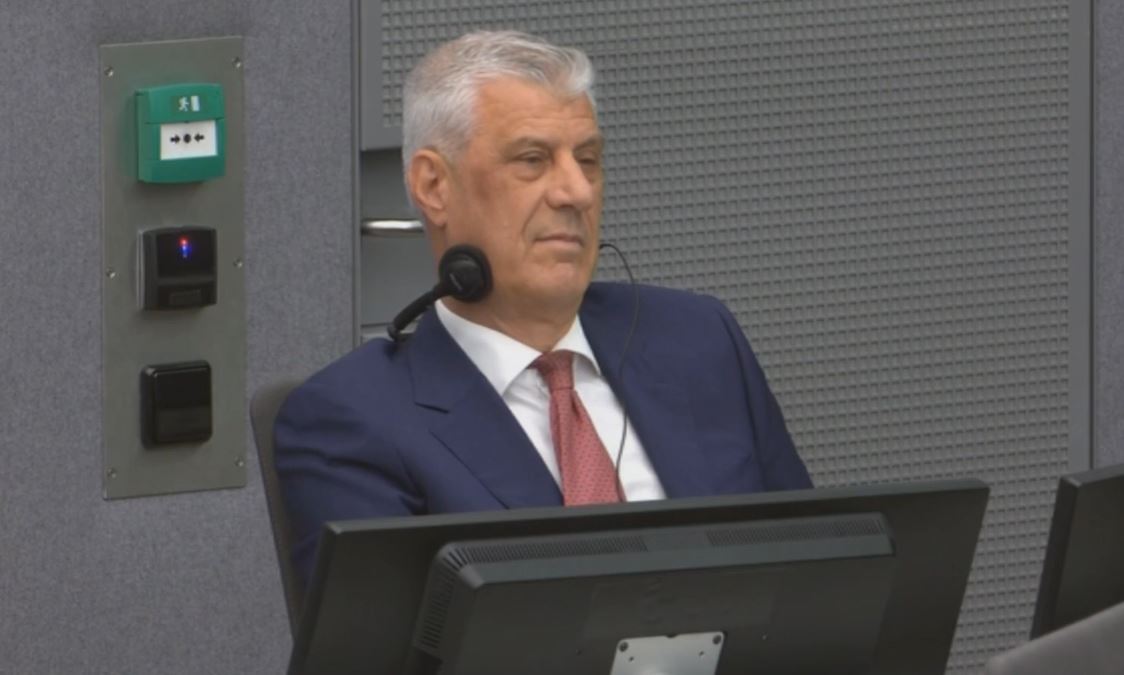
 Hashim Thaci in court on Thursday, September 10, 2026. Photo: Screenshot/Kosovo Specialist Chambers.
Prosecution in closing statements demands six years' prison for Thaci, claiming he told his co-defendants to instruct witnesses what to say while testifying in his war crimes case.
The Kosovo Specialist Prosecutor’s Office in The Hague on Thursday demanded six years’ imprisonment for former President Hashim Thaci on obstruction of justice charges, days before the announcement of the verdict in his other trial for war crimes.
Thaci is being tried alongside four co-defendants in the obstruction of justice case for interfering with witnesses in his war crimes trial.
“The prosecution asks that you impose … nine months of imprisonment for [Hajredin] Kuci; three years for [Fadil] Fazliu; three years for [Isni] Kilaj; three years for [Bashkim] Smakaj; and six years for Thaci,” prosecutor Joshua Hafetz said during closing statements.
The prosecution claims Thaci told the other four defendants to give instructions to certain witnesses in the war-crimes case about to what to say in court. Thaci and his four-co-accused have denied wrongdoing.
Prosecutor Hafetz highlighted that the prosecution wants the six years in prison for Thaci “to be served consecutively to any sentence that might be imposed” at his war crimes and crimes against humanity trial alongside three other former Kosovo Liberation Army, KLA, leaders: Kadri Veseli, Jakup Krasniqi and Rexhep Selimi.
The verdict in the war crimes case will be announced on September 16. All four have plead not guilty.
Hafetz told the court on Thursday that the evidence of obstruction of justice consists of around 28 hours of recordings of Thaci during nine separate visits over four months at the Detention Centre in The Hague.
“What was important to Thaci and his co-defendants was that the witnesses Thaci had chosen for intervention should say and do what Thaci wanted,” Hafetz told the court.
He added that whenever Thaci instructed Kuci, Fazliu, Kilaj and Smakaj, he “lowered his voice and whispered to give specific instructions on what the visitors should say to the witnesses. He did this for months and his instructions had a similar practice; to dilute the charges in [the war crimes case]”.
Prosecutor Kimberly West told the court during the closing statements that Thaci, “together with his collaborators in this process, attempted to obstruct this process by interfering with the testimonies of these witnesses and was caught. He was caught with many hours of recordings and documents confirming the recordings in question.”
West said the instructions went from asking witnesses to change their testimony to denying Thaci’s presence in a place where crimes were allegedly committed, so that the testimonies fit “his narrative”.
The prosecution claimed that the evidence, parts of which were found at Kilaj’s home in November 2023 less than a month after Kryeziu and Kilaj met Thaci, was printed via the only printer at the detention centre that Thaci could use, and discussed during visits to the same centre.
Hafetz also claimed that Thaci tried to influence two former KLA fighters, Bislim Zyrapi and Rrustem Mustafa, who were testifying in his war crimes case. The testimony of both men favoured Thaci’s defence.
In his testimony in 2023, former KLA area commander Mustafa claimed that the KLA zone commanders made operational decisions, not the guerrilla force’s General Staff. He said the KLA’s leaders, who included Thaci, did not have control over lower-ranking fighters – testimony that bolstered the defence’s case.
Zyrapi, former chief of the KLA’s General Staff, gave his testimony in 2024.
During defence questioning, he said the General Staff often was not informed of the actions of fighters in the KLA’s operational zones and that, despite attempts, it had not been possible for the KLA to fully exercise control over its lower-level units, partly because of Serbian offensives.
The Kosovo Specialist Chambers was created specifically to try former members of the KLA; it is located in The Hague and staffed by international judges and prosecutors due to doubts about the Kosovo justice system’s own ability to try former KLA fighters, many of whom are considered heroes in Kosovo. Witness-tampering has been one of its key concerns from the outset.


10 September 2026 - 16:13