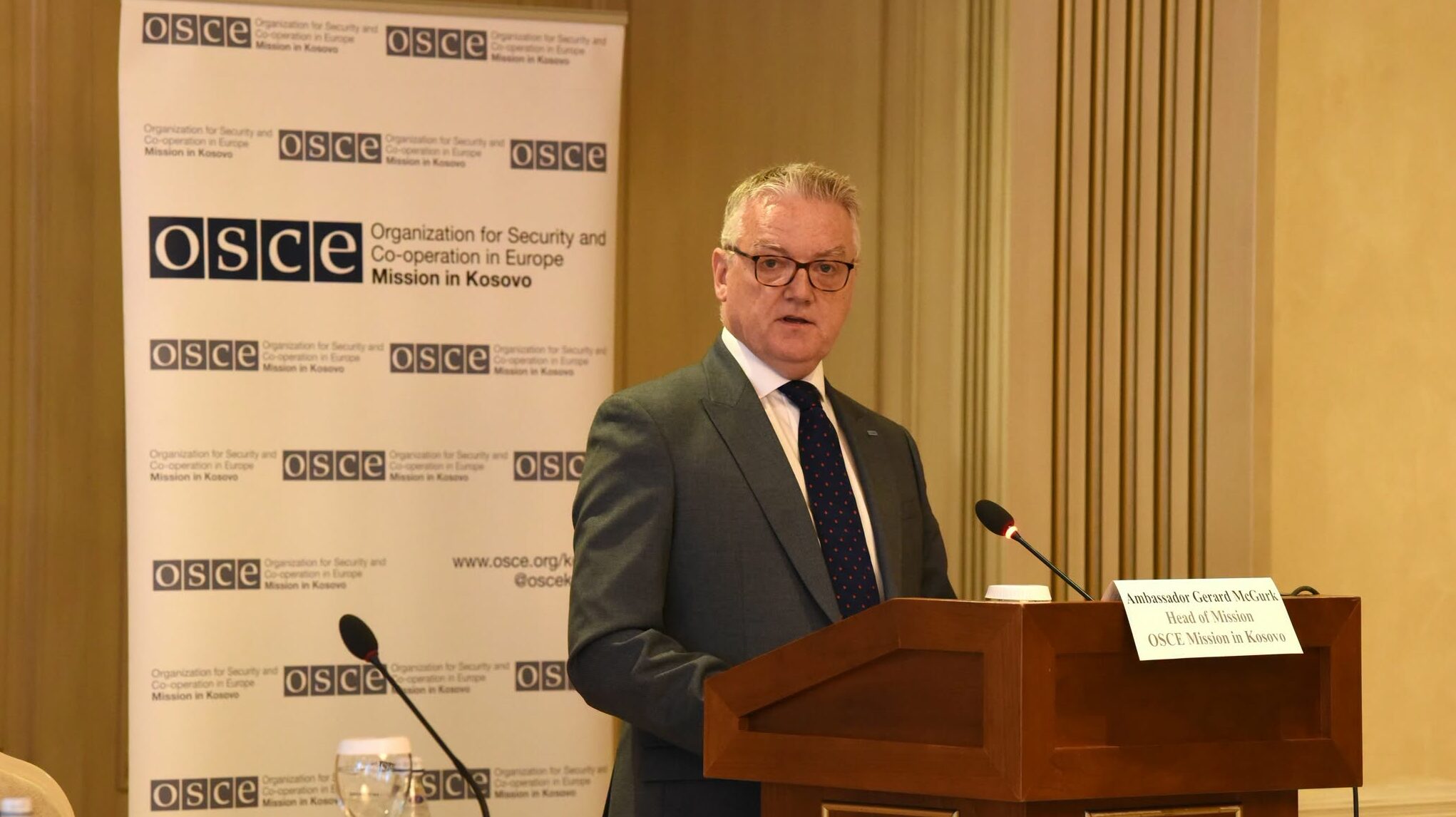
 Gerard McGurk, Head of the OSCE Mission in Kosovo at the presentation of the report in Prishtina, July 8, 2026. Photo: OSCE
From limited cooperation from other countries to prolonged delays in proceedings, an OSCE report outlines the issues that Kosovo's justice system continues to face in the adjudication of war crime cases.
The OSCE Mission in Kosovo said on Wednesday that “structural and operational shortcomings” continue to undermine the efficiency, consistency, and perceived fairness of war crime proceedings in Kosovo courts and that delays and procedural uncertainty risk affecting the rights of the accused, the meaningful participation of victims, and public trust in the justice system.
The newly- published report “Adjudication of War Crimes Cases in Kosovo” urges Kosovo’s courts to prioritise live witness testimony wherever feasible, and increase the use of alternative examination methods, such as video-link testimony, to ensure effective examination of witnesses. It also says initial hearings in in absentia proceedings – introduced in 2023 – should be held within the time limits prescribed by the Kosovo Criminal Procedure Code.
The OSCE said it has noted recurring delays linked to the non-appearance of witnesses, changes in trial panel composition, delayed disclosure and translation of evidence, and logistical constraints affecting the transport of the detained accused.
It said it has has also observed shortcomings in the individualisation of charges, particularly in cases involving multiple accused and collective modes of liability, as well as in the identification of mitigating circumstances known at the time of filing.
“The credibility of proceedings in complex and sensitive cases depends not only on outcomes, but on the fairness, consistency, transparency and timeliness of the process,” Ambassador Gerard McGurk, Head of the OSCE Mission in Kosovo, said.
“Through our trial monitoring, we help turn courtroom observations into practical recommendations, identify systemic challenges and support institutions in strengthening safeguards, public confidence and access to justice for victims and witnesses, while fully respecting judicial independence,” he added.
The report examines the monitoring of 48 war crimes cases involving 138 accused before the Basic Court of Prishtina over a seven-year period. It says that by the end of 2025, 17 cases had been finalised, with 88 per cent of the cases that proceeded to trial resulting in a guilty verdict.
Representatives of Kosovo’s justice system admitted that as time goes by, 27 years after the war, it is becoming more difficult to investigate and try war crimes.
“Many of witnesses have died, so we could not do what was supposed to be done … Every passing day means putting justice in place becomes impossible,” Fejzullah Rexhepi, Head of Kosovo’s Supreme Court, said.
Genc Nimoni, Kosovo’s Acting Deputy Minister of Justice, said that Kosovo’s institutions will take the report’s findings seriously.
“Our commitment as the Ministry of Justice remains unchanged: fully addressing the rights of victims and further advancing processes in the field of war crimes and transitional justice,” Nimoni said.
The OSCE also urged country’s authorities to explore “legal and practical” ways to strengthen regional cooperation on war crimes cases, as courts face obstacles in securing witnesses from abroad
“Limited regional co-operation, combined with witness security concerns and the limited practical use of alternatives such as video-link testimony, continues to affect both the prosecution and the defence and raises equality of arms concerns.
Brokered by the European Union, Kosovo and Serbia in 2013 signed an agreement on “mutual legal assistance” – but in 2022 BIRN reported that cooperation on criminal cases was far from smooth.
Court monitoring has highlighted constant delays in criminal proceedings in Kosovo due to a lack of cooperation from Serbia, particularly on war crimes cases, or cases involving high-profile individuals.


08 July 2026 - 17:44
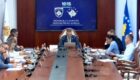
On Monday, Kosovo Prosecutorial Council members voted to terminate mem...

The former head of the Pristina-based Institute for Advancing Intereth...

The death of a 32-year-old worker at Kosovo’s state-owned energy cor...
High-profile former Serbian security figures including Jovica Stanisic...